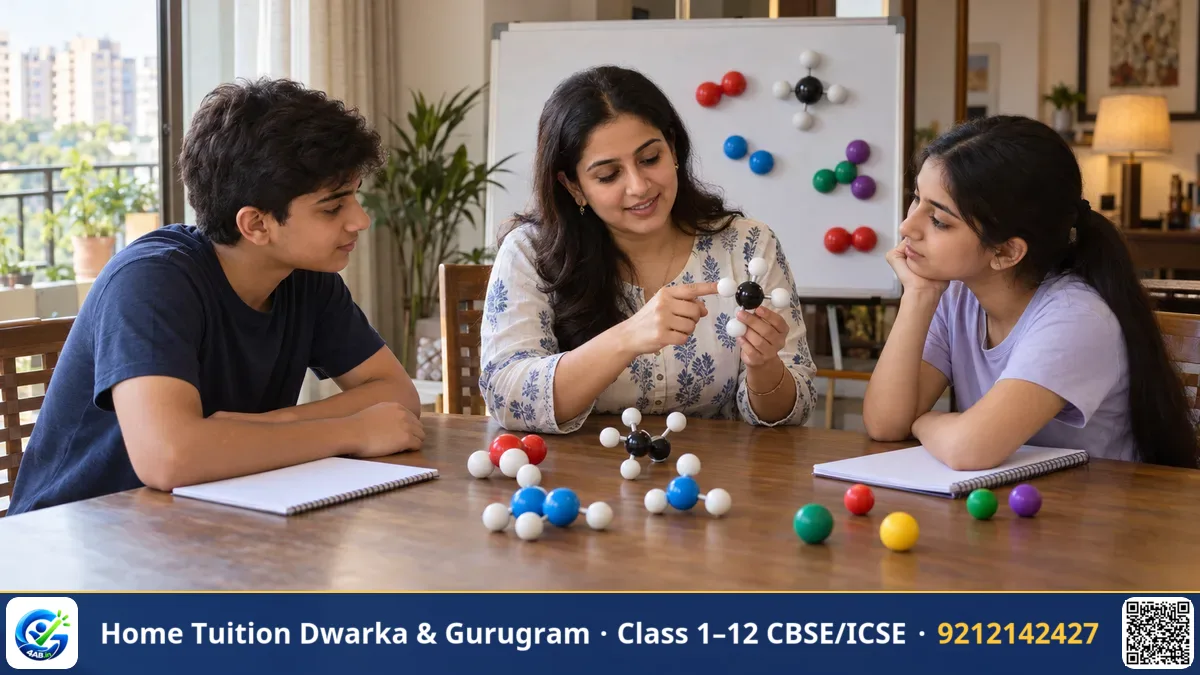
The chapter where chemistry first becomes arithmetic, and where Class 11 begins.
Why Class 9 is where the trouble begins
Atoms and Molecules is the first quantitative chapter a student meets. Until now chemistry has been about naming and observing. Now there are formulae, masses and a new unit, the mole. Because there is no board exam in Class 9, students often pass the school test by memorising and carry the gaps into Class 10 and eventually the mole concept of Class 11, where the gaps become expensive. Getting it right now is cheap.
The laws of chemical combination
Two laws are in the chapter. Learn each with a one-line statement and one numerical example.
- Law of conservation of mass: mass is neither created nor destroyed in a chemical reaction. Example: 5.3 g of sodium carbonate reacts with 6 g of ethanoic acid and the products add up to the same total. Questions ask the student to check whether given masses obey the law.
- Law of constant proportions: a pure compound always contains the same elements in the same proportion by mass. Example: water has hydrogen and oxygen in a mass ratio of 1 : 8, whatever its source.
Numericals are short: given masses before and after, or the mass of one element, find the other. Show each step in a line. Dalton’s atomic theory, which explains the laws, can be learnt as a short numbered list of its postulates.
Atomic mass, molecular mass and formula writing
Atomic mass is expressed in atomic mass units (u), taken relative to carbon-12. Molecular mass is the sum of the atomic masses of all atoms in the molecule, found by adding with the right multiples. Students add wrongly when a bracket is present, as in calcium hydroxide, Ca(OH)2, where the bracket multiplies both O and H. Practise ten such formulae.
For formulae, use the criss-cross method. Write the symbols, put the valency below each, and swap them, then reduce if they share a factor. Magnesium (valency 2) and chlorine (valency 1) gives MgCl2. Aluminium (3) and oxygen (2) gives Al2O3. A short list of common ions and their charges, including polyatomic ones such as sulphate, nitrate, carbonate, hydroxide and ammonium, should be known as thoroughly as multiplication tables.
The mole as a counting unit
A mole is a fixed number of particles, 6.022 × 10²³, the Avogadro number. The easiest way to teach it is with an analogy to a dozen: a dozen eggs is twelve eggs, a mole of atoms is 6.022 × 10²³ atoms. The important relation is that the mass of one mole of a substance, in grams, equals its atomic or molecular mass in u. That is the molar mass.
Three formulas then cover almost every question:
- Number of moles = given mass / molar mass
- Number of particles = number of moles × Avogadro number
- Given the number of particles, work backwards to the moles and then the mass.
Encourage the child to write the units at every step. A student who writes “18 g / 18 g per mol = 1 mol” rarely multiplies where division was needed.
Typical mistakes
- Confusing a molecule of oxygen (O2) with an atom (O) when counting atoms.
- Using the atomic mass of a compound’s symbol rather than adding it up.
- Rounding too early in a multi-step numerical.
- Mixing the molar mass of hydrogen atoms (1 g) and hydrogen molecules (2 g).
A two-week approach
Week one: laws with examples, symbols, valency, formulae. Week two: molecular mass, mole relations, ten numericals. Revisit the formula list every few days for a month. The investment is small, but it is the same material that Class 10 equations and Class 11 stoichiometry quietly assume.
Home tuition for this stage
For a Class 9 student in Dwarka or Gurugram, one session a week with a chemistry-focused tutor is usually enough at this stage, checking the written formulae and the numerical working. Consistency matters more than volume here.
A short worked example
How many moles are there in 36 g of water? The molecular mass of water is 2 × 1 + 16 = 18 u, so the molar mass is 18 g per mole. Moles = 36 / 18 = 2 mol. How many molecules? 2 × 6.022 × 1023 = 1.2044 × 1024 molecules. How many atoms? Each molecule has three atoms, so the number of atoms is three times that. The last step, counting atoms per molecule, is the one most children miss, and it is exactly the sort of extra step that a competency-style question likes to add. Ask the child to explain each line aloud while writing, since the explanation is where misunderstanding shows up.
Questions parents ask
There are no board exams in Class 9. Is this really worth the effort?
Yes, because this is the base for Class 10 equations and Class 11 mole concept. Gaps now are cheap to fix and costly later.
Does my child need to memorise atomic masses?
The common ones used in school questions, such as hydrogen, carbon, nitrogen, oxygen, sodium, magnesium, chlorine and calcium, are worth knowing. Others are given in the question.
Is the mole concept in the Class 9 syllabus for ICSE too?
ICSE introduces the mole more fully in Class 10 with gas laws. Class 9 ICSE chemistry still covers atoms, molecules and formula writing, so the first half of this article applies. Follow your school’s textbook for the sequence.
Looking for home tuition in Dwarka or Gurugram?
Great Home Tutor offers Home, Online, Group and One-to-One tuition for Class 9 to 12 Science and Maths across Dwarka and Gurugram.
Call / Contact us: Support@4ab.in