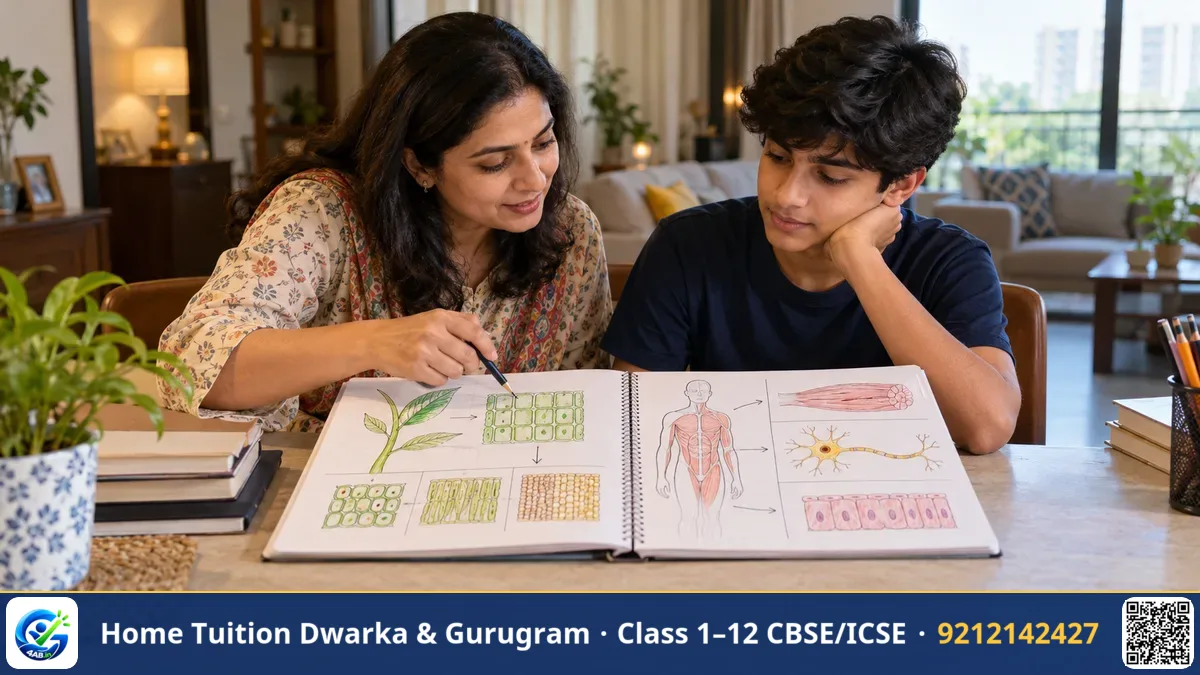
Everything in this chapter answers the same question: what does this tissue do, and why does its shape suit that job?
The chapter that looks like a list
Tissues is the chapter where Class 9 biology turns into vocabulary: meristematic, parenchyma, collenchyma, sclerenchyma, xylem, phloem, squamous, columnar, cardiac. Students read it twice, find they can recite it, and still lose marks on the test because the questions ask them to compare and explain. The way out is to learn tissues as a family tree with one reason attached to every branch.
Plant tissues: the tree
Start with the split. Meristematic tissue divides actively and is found at growing regions: the tips of roots and shoots (apical), the sides of stems (lateral, which adds girth) and at the base of leaves or internodes (intercalary). Permanent tissue has stopped dividing and has a fixed role.
- Simple permanent: parenchyma (living, thin walls, stores food and fills space), collenchyma (extra thickening at the corners, gives flexibility to leaf stalks and stems), sclerenchyma (dead cells with lignin, gives strength and hardness, as in husks and seed coats).
- Complex permanent: xylem carries water and minerals upward; phloem carries food, and works through sieve tubes with companion cells.
For each, ask three things: does it have living cells, what is the wall like, and what does it do? A comparison table of the three simple tissues and a second one of xylem versus phloem answers most of the typical questions, including the common one on why sclerenchyma is dead.
Animal tissues: four groups
Animal tissue is grouped as epithelial, connective, muscular and nervous.
- Epithelial: covers and lines. Squamous (flat, in the lining of the mouth and blood vessels), cuboidal (in kidney tubules), columnar (in the intestine, helps absorption and secretion), and ciliated types in the respiratory tract. Tightly packed with little intercellular space.
- Connective: binds and supports. Blood, bone, cartilage, ligaments, tendons and areolar tissue. The useful contrast: a tendon joins muscle to bone, a ligament joins bone to bone.
- Muscular: striated (voluntary, skeletal), unstriated (involuntary, smooth) and cardiac (involuntary, striated, branched). Know where each is found and whether it is voluntary.
- Nervous: neurons carry impulses. Know the labelled neuron: cell body, dendrites, axon and nerve ending.
Why function should come first
If the child understands that columnar cells line the intestine because absorption needs a large surface, the name follows. The reverse, memorising a name and then hunting for its function, is how forgetting starts. Each time a tissue is learnt, ask the question “why this shape?” and write the answer in four words.
The diagrams that carry marks
Diagrams are a quick route to marks in Class 9 biology if they are neat and correctly labelled. The ones worth drilling are: the three simple plant tissues, xylem and phloem, the types of epithelium, the three muscle types, the neuron, and the structure of a bone or cartilage if your school includes it. Draw each with a sharp pencil, ruled label lines and labels on one side. Practise until each can be drawn in under three minutes.
A study plan for one week
- Day 1: plant tissue tree and the first table.
- Day 2: xylem and phloem, and the diagrams.
- Day 3: animal tissue groups, the epithelial types and connective tissue.
- Day 4: muscle and nervous tissue, and every diagram once more.
- Day 5: a self-test: draw the tree for both plant and animal tissues from memory.
- Day 6: NCERT in-text and exercise questions, answered in writing.
Home tuition and Class 9
For families in Dwarka and Gurugram, this chapter is a good example of why a short, regular home session works at the Class 9 stage: the tutor can quiz the child orally, check diagrams, and correct the stray labels that school teachers have no time to look at. It builds the habit of learning with reasons, which carries into the Class 10 biology of life processes.
Typical questions and how to answer them
Expect the same few question shapes. “Differentiate between xylem and phloem” wants a table with at least three points, such as the direction of transport, the type of cells and whether the cells are living. “Why is sclerenchyma dead at maturity?” wants the link between the thick lignified wall and its job of providing strength. “Name the tissue that joins bone to bone” is a one-word recall, but one wrong word loses the whole mark, which is why ligament and tendon are worth drilling together.
For long questions, a labelled diagram plus three lines of function usually earns the full marks. Teach the child to start with the diagram, because a good diagram settles the nerves and gives the examiner something to credit while the writing is read.
Working with a school textbook and NCERT together
Read the NCERT text once for understanding, then close it and write the plant and animal charts from memory. Compare with the book and correct in a different colour. Repeating that cycle twice in a week works better than reading the chapter four times.
Questions parents ask
My child remembers everything the night before and nothing a week later. Why?
The learning is shallow. Spread the same material over several short sessions and use the quiz method: cover the answers and write them out.
How many diagrams should be practised?
Six to eight, drawn several times each. Quality and speed matter more than the number.
Is this chapter in the ICSE Class 9 syllabus?
ICSE Class 9 Biology treats cells and tissues under its own units, with plant and animal tissue coverage. The method above applies; follow your school’s textbook for the exact list of tissues and diagrams.
Looking for home tuition in Dwarka or Gurugram?
Great Home Tutor offers Home, Online, Group and One-to-One tuition for Class 9 to 12 Science and Maths across Dwarka and Gurugram.
Call / Contact us: Support@4ab.in