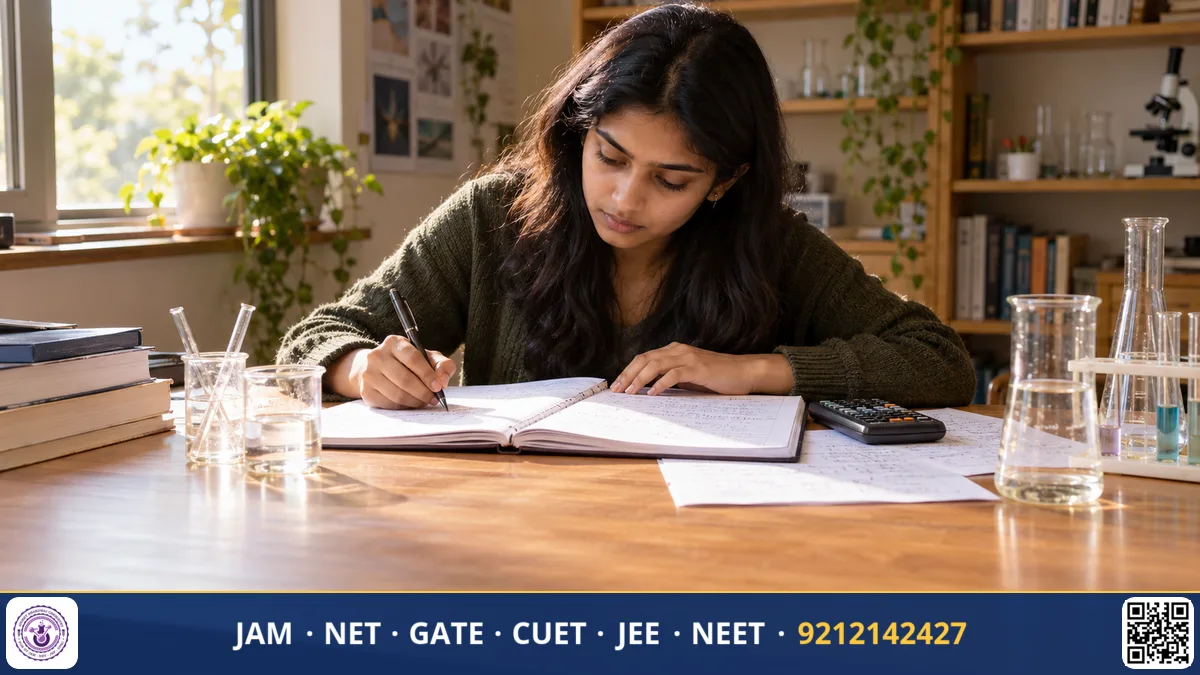
Concept clarity vs rote learning in maths: a Dwarka parent view
This guide explains how to identify whether your child understands mathematics concepts or is simply memorising steps to pass school tests. You will learn practical methods to test understanding at home, address secondary syllabus difficulties, and establish a steady study routine in Dwarka.
How rote learning hides behind school test scores
Many parents in Dwarka and neighbouring Gurgaon notice an unexpected drop in mathematics marks when their children enter Class 9 or Class 10. In earlier classes, questions follow predictable patterns from class notebooks. A student can memorise arithmetic sequences, write required steps, and secure passing marks without understanding the underlying concepts.
Board examinations under CBSE and ICSE test application over direct recall. When a question alters a diagram's orientation or frames an algebraic problem in unfamiliar words, memorised steps fail. The student recognises the topic but gets stuck because they cannot map the question to a memorised formula.
This pattern frequently causes anxiety at home. Parents assume the child is careless, while the student feels frustrated after practicing textbook exercises repeatedly. The child has simply relied on mechanical repetition rather than building foundational understanding.
In school classrooms with high student-teacher ratios, teachers must keep moving forward to finish the syllabus on schedule. When a child nods along, completes standard homework questions, and reproduces memorised proofs, teachers reasonably assume comprehension. In reality, the child has developed pattern-recognition habits that mimic genuine competence. The student memorises which steps to write down whenever they see particular keywords in a question.
When tests contain only slight variations of standard textbook questions, memorisation produces acceptable grades. However, as the syllabus progresses into higher classes, mathematics stops being a collection of isolated procedures. Topics begin to interlock. Coordinate geometry relies on algebraic manipulation, while probability draws upon set logic and arithmetic reasoning. When earlier chapters rest on rote learning, subsequent topics quickly become incomprehensible to the student.
Spotting the difference between memory and understanding at home
You do not need an advanced mathematics background to evaluate your child's grasp. A parent can check understanding through a short conversation during daily study time at home.
Instead of checking whether the final answer matches the NCERT textbook, ask your child to explain the starting step. Ask why they chose a specific formula or how they would solve the problem without that rule. A student relying on rote learning recites steps from memory without explaining why each operation is valid. A student with concept clarity explains the relationship between quantities and justifies each step logically.
| Observation area | Rote learning response | Concept clarity response |
|---|---|---|
| Altered phrasing | Stops immediately and claims the question is out of syllabus. | Extracts given values and restates the core question clearly. |
| Formula use | Recites equations from memory without explaining variables. | Explains each term and the conditions required to use it. |
| Calculation errors | Erases the page and restarts identical steps mechanically. | Estimates a sensible range and locates the specific faulty step. |
| Geometric diagrams | Solves problems only if the figure matches textbook orientation. | Identifies parallel lines and angle properties in any orientation. |
| Alternative methods | Insists that only one specific method is acceptable. | Demonstrates an alternative path or explains why another method applies. |
Another reliable diagnostic test is to ask your child to teach a concept back to you. When a student explains an idea in simple language without reading directly from notebook pages, their true level of comprehension becomes visible. If they hesitate, stumble over fundamental definitions, or resort to repeating memorised phrases verbatim, they require structured guidance to rebuild that concept from first principles.
Syllabus pain points where memorisation breaks down
In secondary school mathematics, specific topics expose rote learning quickly. Algebra and geometry are the primary areas where memorisation creates bottlenecks for Class 9 and Class 10 students.
In coordinate geometry—the study of points and shapes using ordered grid pairs—students frequently memorise the distance formula mechanically. They view the formula as a complicated string of squares and square roots without realising that it comes directly from measuring horizontal and vertical distances on a right-angled triangle. When an examination question asks them to find a point equidistant from two vertices or to verify whether three points form a specific shape, memorised formulas alone do not tell them how to proceed.
In quadratic equations—equations where the highest power of the unknown variable is two—memorising formulas allows students to solve standard drills. However, word problems involving speed, distance, or geometric area require translating real constraints into algebraic expressions. A student without deep concept clarity cannot form the initial equation, even if they can solve it once it is written down.
Worked example: understanding quadratic roots
Problem: Find the roots of x2 - 5x + 6 = 0 and explain what they signify.
Rote learning method: The student recalls the quadratic formula mechanically: x = (-b ± √(b2 - 4ac)) / (2a). They substitute values to get x = 2 and x = 3, but cannot explain why the discriminant—the expression b2 - 4ac under the radical that reveals whether solutions are real or distinct—determines the nature of the roots.
Conceptual method: The student factors the expression into (x - 2)(x - 3) = 0. They apply the zero-product rule, which states that if the product of two factors is zero, at least one factor must equal zero. Hence, x - 2 = 0 or x - 3 = 0, giving x = 2 and x = 3. They also understand these roots represent points where the graph crosses the horizontal axis.
When students understand zero-product logic, they do not struggle with higher-degree polynomials or equations with missing constants. They see mathematics as a connected system of rules rather than a random set of textbook procedures.
Similar breakdowns happen in trigonometry. Students often memorise values in standard ratio tables through mnemonic tricks without understanding the geometric proportions of right-angled triangles. When questions introduce complementary angle relationships or require proving trigonometric identities, students who rely on memorisation find themselves unable to choose the correct transformation step.
How a one-to-one home tutor builds mathematical reasoning
Large classrooms and crowded tuition batches rarely dismantle rote habits. In a group setting, teachers maintain a fast pace to complete the syllabus. A student who feels unsure often copies steps from the board without asking questions. The fear of appearing slow in front of peers prevents children from voicing genuine doubts.
One-to-one tuition at your home addresses this issue directly. Without peer pressure, a checked home tutor observes the student's scratch work in real time. Instead of merely checking the final answer, a tutor monitors how the student begins, which theorems they select, and where hesitation occurs.
When a tutor notices that a student is reciting a method without understanding, they can pause the session and unpack the core idea. The tutor asks probing questions that lead the child to discover the next step independently. This guided questioning transforms mathematics from passive listening into active problem solving.
Through Great Home Tutors, parents in Dwarka, Janakpuri, and nearby localities can request a home tutor matched specifically to their child's board, class, and syllabus requirements. Tutors verified through identity checks, qualification reviews, and teaching conversations focus on underlying principles. A first class allows parents and students to evaluate the teaching fit before confirming regular sessions.
Furthermore, an experienced home tutor adapts pacing to the student's learning rhythm. While a school teacher must move on to coordinate geometry regardless of whether every child has mastered quadratic factorization, a private tutor can devote appropriate time to strengthening foundational arithmetic and algebraic manipulation before advancing to complex multi-step problems.
A practical weekly study routine for Dwarka students
Fixing rote learning requires consistency. A student cannot undo memorisation habits right before an examination. A steady weekly routine creates space for deep practice and independent thinking.
- Daily concept review: Have the student review definitions and derive standard formulas from the NCERT textbook without looking at solutions before starting calculations. The student should state what each variable represents in plain words.
- Independent problem solving: Assign a selection of varied problems covering different difficulty levels. The student must solve them independently without checking answer keys, guides, or worked solutions until every question has been attempted.
- Error analysis notebook: The student maintains an error log, recording every mistake and noting whether it stemmed from an arithmetic slip, misreading the question, or a conceptual misunderstanding. Reviewing this log prevents repeating the same conceptual errors.
- Weekend oral summary: At the end of the week, the child explains core concepts to a parent or tutor in plain language to confirm understanding before moving on to new chapters.
When students adhere to this structured flow, mathematics shifts from an intimidating memorisation task into a predictable discipline. The regular habit of self-explanation clarifies thinking, while systematic error analysis ensures that weak areas receive focused attention during weekly home tuition sessions.
Key takeaways
- Rote learning works for routine textbook drills but fails when examination questions alter wording or combine multiple concepts.
- Parents can spot rote learning at home by asking children to explain formula choices rather than just checking final marks.
- Algebraic topics like quadratic equations require understanding logical principles such as the zero-product rule.
- One-to-one home tuition provides the focused environment needed to observe working steps and rebuild foundational reasoning.
- A steady daily routine combining concept review, unassisted practice, and error analysis builds lasting clarity.
Frequently asked questions
How can I tell if my child is memorising maths questions?
Change the numbers or context of a textbook question slightly while keeping the core concept identical. If your child cannot solve the modified problem or claims it is unfamiliar, they are memorising steps rather than understanding concepts.
Does completing NCERT exercises build concept clarity?
Completing NCERT exercises is necessary for CBSE preparation, but copying solutions or memorising steps does not build understanding. True clarity comes from explaining why methods work and solving unfamiliar questions independently.
Why is one-to-one home tuition better for clearing maths doubts than coaching centres?
In group coaching batches, instruction moves at a preset pace, making it easy to hide confusion. One-to-one tuition at your home lets a tutor examine step-by-step working, identify specific conceptual gaps, and tailor explanations to the child.
How does Great Home Tutors check tutors before sending them to a home?
Great Home Tutors checks every tutor through identity verification, qualification checks, and a teaching conversation. Verified tutors carry a Verified mark, and a first class allows families to assess the fit before committing to tuition.
What to do next. Try it yourself on the page below.
Great Home Tutors — home tuition at your home · 4AB →