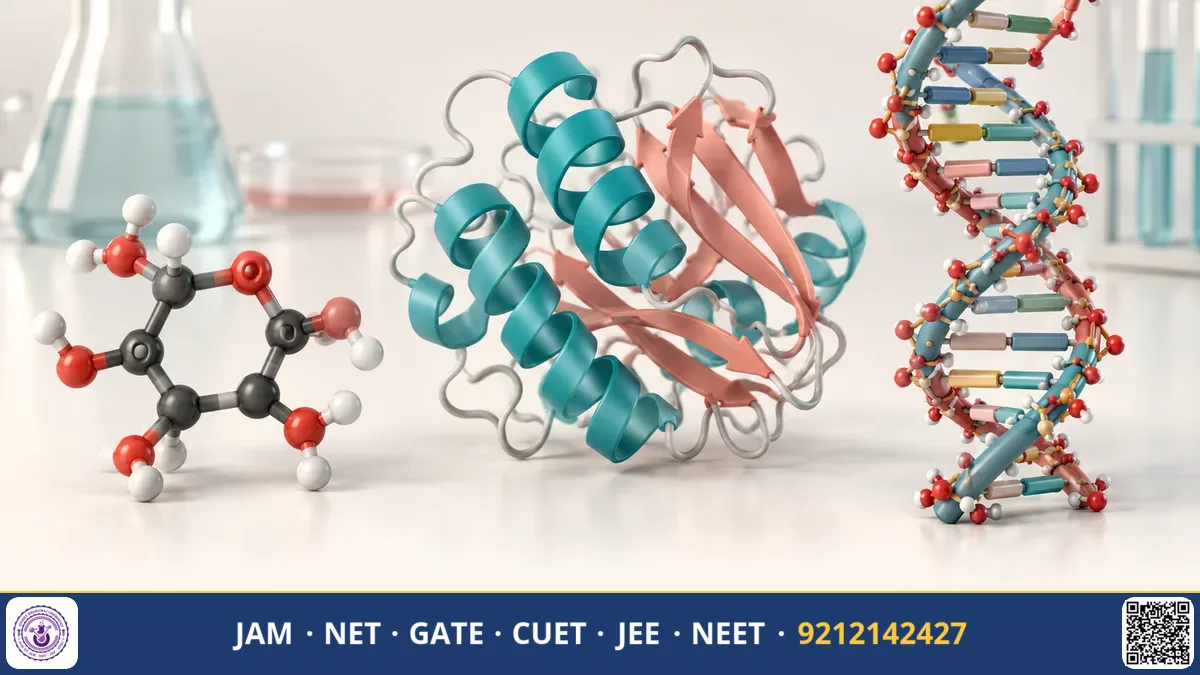
JEE Biomolecules and Polymers: Fast Revision, Gurugram
This revision guide outlines how Class 12 students in Gurugram can master JEE biomolecules and polymers through focused NCERT preparation. Parents will learn syllabus pain points, an efficient home study timetable, and how a personal home tutor builds retention.
Syllabus pain points in biomolecules and polymers
In Class 12 chemistry for entrance exams like JEE, biomolecules and polymers form a distinct category. Biomolecules are organic molecules found in living systems, including carbohydrates, proteins, nucleic acids, and vitamins. Polymers are macromolecules formed by joining repeating structural units called monomers. Unlike physical chemistry, these chapters demand accurate factual recall and spatial structural awareness.
Many students prioritise physical chemistry and organic mechanisms, leaving descriptive chapters for the final weeks. When revision begins, factual volume creates stress. Without regular review, students confuse basic definitions, such as essential versus non-essential amino acids, or addition versus condensation polymerisation.
The first major bottleneck is structural representation. In carbohydrates, students must distinguish open-chain structural formulas from cyclic ring structures. Flat open-chain projections show straight carbon chains, whereas cyclic drawings show closed rings. Confusing alpha-D-glucose and beta-D-glucose at the anomeric carbon (the carbonyl carbon that becomes asymmetric during ring closure) leads to mistakes in drawing disaccharides like maltose, lactose, and sucrose.
The second challenge is polymer classification. In condensation polymerisation, bi-functional monomers combine with the loss of small molecules like water or alcohol. Students frequently mix up starting units of synthetic fibres and cross-linked resins. Without active written recall, students lose easy marks on straightforward questions.
Core NCERT concepts every student must master
To score full marks, students must ground preparation directly in the NCERT textbook. Every table, reaction scheme, and structure carries exam weight. Revision should be grouped into distinct chemical areas:
- Carbohydrates: Master glucose reactions with hydrogen iodide, hydroxylamine, and bromine water. Understand reducing sugars, which have free aldehyde or ketone groups capable of reducing mild alkaline metal solutions, compared to non-reducing sugars like sucrose. Learn how a glycosidic linkage, an oxygen bridge joining two sugar rings, forms between monosaccharides.
- Proteins: Focus on alpha-amino acids and their zwitterion structure. A zwitterion is an internal salt containing positive ammonium and negative carboxylate ions while remaining neutral overall. Distinguish fibrous proteins like keratin from globular proteins like insulin. Understand protein structure levels, peptide bonds (-CO-NH-), and denaturation, which disrupts secondary and tertiary structures while leaving the primary chain intact.
- Nucleic acids: Differentiate between a nucleoside (a base attached to a pentose sugar) and a nucleotide (a nucleoside linked to a phosphate group). Review complementary base pairing in DNA, where adenine pairs with thymine and guanine pairs with cytosine.
- Polymers: Distinguish elastomers (weak intermolecular forces), fibres (strong intermolecular forces like hydrogen bonds), thermoplastics (soften reversibly on heating), and thermosetting plastics (cross-link permanently on heating).
Key polymers and biomolecule linkages compared
A reference table helps students review core structures and bond types specified in NCERT.
| Substance | Constituent Monomers | Characteristic Linkage | Key Chemical Property |
|---|---|---|---|
| Maltose | Two units of alpha-D-glucose | Alpha-(1,4)-glycosidic linkage | Reducing disaccharide with a free hemiacetal group |
| Sucrose | Alpha-D-glucose and beta-D-fructose | Alpha-(1,2)-glycosidic linkage | Non-reducing sugar with no free carbonyl group |
| Cellulose | Beta-D-glucose units | Beta-(1,4)-glycosidic linkage | Linear structural polysaccharide in plant walls |
| Polypeptides | Alpha-amino acids | Peptide bond (-CO-NH-) | Biological polymers forming enzymes and tissue |
| Synthetic polyamide fibre | Hexamethylenediamine and adipic acid | Amide linkage (-CO-NH-) | Synthetic fibre with high tensile strength |
| Synthetic polyester fibre | Ethylene glycol and terephthalic acid | Ester linkage | Polyester fibre resistant to creasing |
| Phenol-formaldehyde resin | Phenol and formaldehyde | Methylene bridges (-CH2-) | Thermosetting polymer with cross-linking |
| Synthetic elastomer rubber | Styrene and conjugated diene units | Carbon-carbon bonds | Synthetic elastomer formed by copolymerisation |
A structured home study routine for Gurugram students
Families living in Gurugram, such as in Sector 108, Sector 109, Sector 110, Sector 111, Sector 112, or Sector 113, often face long daily commutes across Delhi NCR. Travelling to distant coaching centres drains student energy and leaves little time for self-study. For descriptive chapters, passive listening in a crowded classroom is inefficient. A quiet home routine allows students to learn systematically without commuting fatigue.
Parents should encourage a three-stage weekly study routine:
- Stage 1: Line-by-line reading (Two hours): Read one NCERT section at a time. The student must write out every chemical reaction, cyclic ring, and polymer structure by hand rather than reading passively.
- Stage 2: Active recall testing (One hour): Use blank paper to write out monomer names, linkage numbers, and vitamin deficiency symptoms from memory. Compare written notes with the textbook immediately to identify mistakes.
- Stage 3: Question practice (Two hours): Solve textbook in-text problems, end-of-chapter exercises, and previous-year questions. Focus on writing clear structural formulas and precise definitions.
How one-to-one home tuition supports fast revision
While self-study is necessary, one-to-one home tuition provides personal feedback and accountability. In a coaching batch of fifty students, a teacher cannot verify whether each student has correctly drawn the structure of beta-D-fructose. An individual home tutor sitting beside the student identifies memory gaps immediately.
A qualified tutor guides the student with rapid oral quizzes, checks written homework, and explains the reasoning behind physical properties. For example, a tutor can explain why high-density polyethene has a higher melting point than low-density polyethene by demonstrating polymer chain packing. This interactive dialogue converts memorisation into genuine understanding.
Great Home Tutors helps parents find checked chemistry tutors across Delhi NCR and Gurgaon. Parents submit their needs online by selecting class, subject, board, and locality, whether in Dwarka or Gurgaon. Great Home Tutors then calls back to understand the student and matches a suitable home tutor. Tutors who complete identity verification, qualification checks, and a teaching interview carry a Verified mark. A first class is held at home to ensure a good fit before confirming a regular schedule.
Key takeaways
- Biomolecules and polymers are high-yield chapters that reward direct, line-by-line NCERT revision.
- Common mistakes happen when students confuse monomer pairs, invert glycosidic linkage numbers, or skip polymer reaction conditions.
- Active written practice, such as drawing cyclic ring structures and writing condensation reactions by hand, builds lasting exam recall.
- A structured home routine avoids tiring travel for students in Gurugram localities like Sector 108 through Sector 113.
- One-to-one home tuition through Great Home Tutors provides personal doubt solving, regular oral testing, and verified tutor support right at home.
Frequently asked questions
Why are biomolecules and polymers considered scoring chapters in JEE Chemistry?
These chapters are directly based on the NCERT textbook. The exam questions assess factual recall, monomer identification, and structural linkages rather than lengthy numerical calculations. A student who masters textbook content can answer these questions quickly, saving time for complex problems.
How can parents in Gurgaon verify a home tutor's background?
Great Home Tutors reviews every tutor through an identity check, qualification verification, and a short teaching conversation. Tutors who pass these checks receive a Verified mark. Parents can also request a first class at home to evaluate the tutor before making a decision.
Should students memorise specific polymer preparation conditions?
Yes. Students must know the catalysts, temperatures, and pressures mentioned in NCERT. For example, understanding how free-radical initiation works for low-density polyethene helps students answer mechanistic and assertion-reason questions accurately.
How does Great Home Tutors match a tutor for a student?
Parents enter their details, including class, subject, board, and locality, such as Sector 108 or Dwarka. A representative calls back to understand the student's requirements and matches a checked tutor for an introductory first class at home.
What to do next. Try it yourself on the page below.
Great Home Tutors — home tuition at your home · 4AB →