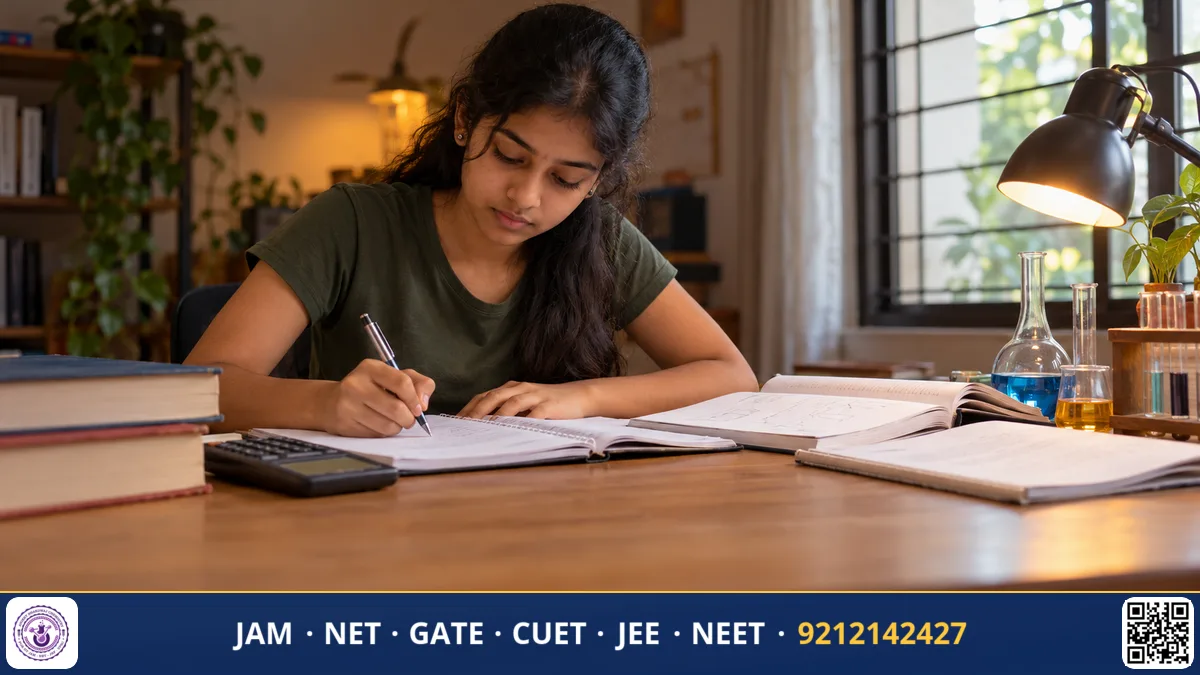
JEE Chemistry Equations Sheet: Daily Recall Habit in Dwarka
Preparing for JEE Chemistry requires accurate formula recall and disciplined practice under exam conditions. This guide outlines how Class 11 and Class 12 students can build a concise equation sheet and follow a daily recall routine at home in Dwarka.
Syllabus pain points in JEE Chemistry preparation
JEE Chemistry covers three broad areas: numerical calculations, reaction equations, and reaction mechanisms. Each area demands a distinct way of thinking, creating continuous challenges for students in Class 11 and Class 12.
Numerical topics like chemical kinetics, equilibrium, and thermodynamics involve multi-step calculations. Students often understand principles during lectures but stumble during tests by confusing sign conventions, temperature scales, or units. A slip in remembering the universal gas constant R or equilibrium relations can invalidate an entire calculation.
Reaction-heavy topics require recalling periodic trends, oxidation states, coordination compounds, and balanced equations. Passive reading creates an illusion of understanding. During timed tests, distinguishing between subtle reaction conditions or predicting products on an empty sheet becomes difficult.
Reaction mechanisms present another major hurdle. Students must track reactants, reagents, catalysts, and molecular rearrangements across multi-step pathways. A student might recognise a reaction in notes, yet struggle to draw reaction steps on an empty page. In Dwarka and Gurgaon, long school hours leave learners tired. A focused equation sheet isolates the facts needing regular revision.
How to organise an effective three-part equation sheet
An equation sheet is a compact, handwritten summary of core formulas, reaction conditions, and constants. Active recall means retrieving and writing down facts from memory without looking at reference material, rather than passively re-reading notes.
Students should divide their sheets into three distinct sections:
- Numerical calculations: Record core formulas, define each variable, state standard units, and list constants. Note boundaries, such as ideal behaviour conditions in gas equations.
- Reaction equations: Group reactions by chemical families. Write balanced chemical equations, catalytic conditions, temperature requirements, and visible signs such as colour changes.
- Reaction mechanisms: Set up reaction flowcharts. Note reactants, reagents, solvent conditions, key intermediates, and products. Group related reaction types together for clear comparison.
Keep these sheets handwritten on paper. Writing by hand reinforces memory retention and ensures quick access during daily revision sessions at home.
| Sheet section | What to record | Daily recall check | Common student mistake |
|---|---|---|---|
| Numerical formulas | Core formulas, variable units, constant values, sign conventions | Write formulas from memory and solve one problem | Mixing up units for pressure, volume, or temperature |
| Reaction equations | Balanced reactions, oxidation numbers, colour changes, catalysts | Complete equations from memory when given reactants | Confusing reagent conditions such as dilute versus concentrated acids |
| Reaction pathways | Reagents, mechanisms, functional group conversions, conditions | Draw reaction pathways and write missing reagents | Forgetting specific catalyst requirements or temperature limits |
A structured daily recall routine for Dwarka students
Consistency is more effective than irregular cramming. A dedicated daily routine trains the brain to retrieve chemical facts under pressure without consuming excessive study time.
Students can follow this structured routine every evening at home:
- Numerical formula recall: Select one chapter, such as chemical kinetics or solutions. On a blank sheet of paper, write down all governing formulas, rate laws, and constant definitions entirely from memory.
- Reaction equation recall: Write down balanced chemical reactions from a selected topic, such as coordinate compounds or p-block elements. Include oxidation states and catalyst details without looking at a textbook.
- Reaction pathway recall: Choose several reaction mechanisms or functional group conversions. Write down starting materials, reagents, and end products on the sheet from memory.
- Immediate self-correction: Take a red pen and check the written sheet against your master equation sheet. Mark every missing reagent, incorrect subscript, or forgotten sign. Review the relevant NCERT paragraph immediately to understand why the mistake happened.
Writing on blank paper and checking errors immediately converts passive recognition into reliable exam recall.
Worked example: daily recall for reaction rate laws
Here is an example of practicing active recall for a chemical kinetics topic using an equation sheet.
Topic: First-order reaction integrated rate law and half-life relation.
Step 1: Write the integrated rate equation from memory
k = (1 / t) · ln([A]0 / [A]t)
Step 2: Define each variable and standard units
- k: Rate constant for a first-order reaction, expressed in units of time inverse such as s-1 or min-1.
- t: Time elapsed.
- [A]0: Initial molar concentration of reactant A, in mol·L-1.
- [A]t: Concentration of reactant A remaining at time t, in mol·L-1.
Step 3: State the half-life relation
t1/2 = ln(2) / k
Step 4: Check against the master sheet
Verify that half-life t1/2 is independent of initial concentration [A]0 for a first-order process. Catching this property prevents calculation errors during entrance tests.
How a verified home tutor reinforces daily revision
Self-study provides the foundation, but independent revision often lacks external checks. Students may believe they recall a concept until they encounter a tricky examination question.
A dedicated home tutor brings structure right at home. Great Home Tutors provides one-to-one home tuition for school and entrance students across Dwarka. Parents can specify the class, subject, and locality—such as Sector 6 Dwarka, Sector 10 Dwarka, and surrounding areas in Dwarka and Delhi NCR—to find a tutor.
Tutors undergo identity and qualification checks, along with a short teaching conversation. Those who complete these checks carry a Verified mark. During weekly home sessions, a verified chemistry tutor supports daily recall through practical checks:
- Conducting a short oral quiz at the start of each class to test formulas and reaction products.
- Reviewing red-pen corrections to spot recurring misunderstandings in numerical problems or reaction pathways.
- Providing targeted numerical problems that apply the exact formulas practiced during the week.
- Ensuring study routines align with the syllabus and competitive entrance expectations without overburdening the learner.
A first class lets the family evaluate the tutor's teaching approach before anything is fixed.
Key takeaways
- Maintain a three-part handwritten equation sheet covering numerical formulas, reaction equations, and reaction pathways.
- Practice active recall daily by writing formulas and reactions on blank paper entirely from memory.
- Check your written work with a red pen against the master sheet and review NCERT explanations for every slip.
- A verified home tutor provides regular testing, spots calculation slips, and ensures consistent study discipline at home in Dwarka.
Frequently asked questions
When should a student start preparing a JEE Chemistry equation sheet?
A student should begin making the equation sheet in Class 11 as soon as the first chapter is finished. Adding formulas and reactions after completing each NCERT chapter keeps the sheet manageable and prevents a backlog in Class 12.
Why is reading notes passively less effective than active recall?
Passive reading makes reactions and formulas look familiar, but it does not train the mind to produce them under time pressure. Writing out balanced reactions, oxidation numbers, and conditions from memory reveals gaps that simple reading overlooks.
How does Great Home Tutors help find a tutor in Dwarka?
Parents share the student's class, subject, board, and locality. Great Home Tutors matches a checked tutor based on these needs. Verified tutors carry a Verified mark, and families can have a first class to see the fit before anything is fixed.
How can daily equation recall fit alongside regular school homework?
A short recall session focuses on rapid memory retrieval rather than long worksheets. Because it requires only blank paper and immediate checking against notes, students in Dwarka and Gurgaon can easily sustain it alongside regular schoolwork.
What to do next. Try it yourself on the page below.
Great Home Tutors — home tuition at your home · 4AB →