JEE Main hyperbola: standard results recall, Gurugram
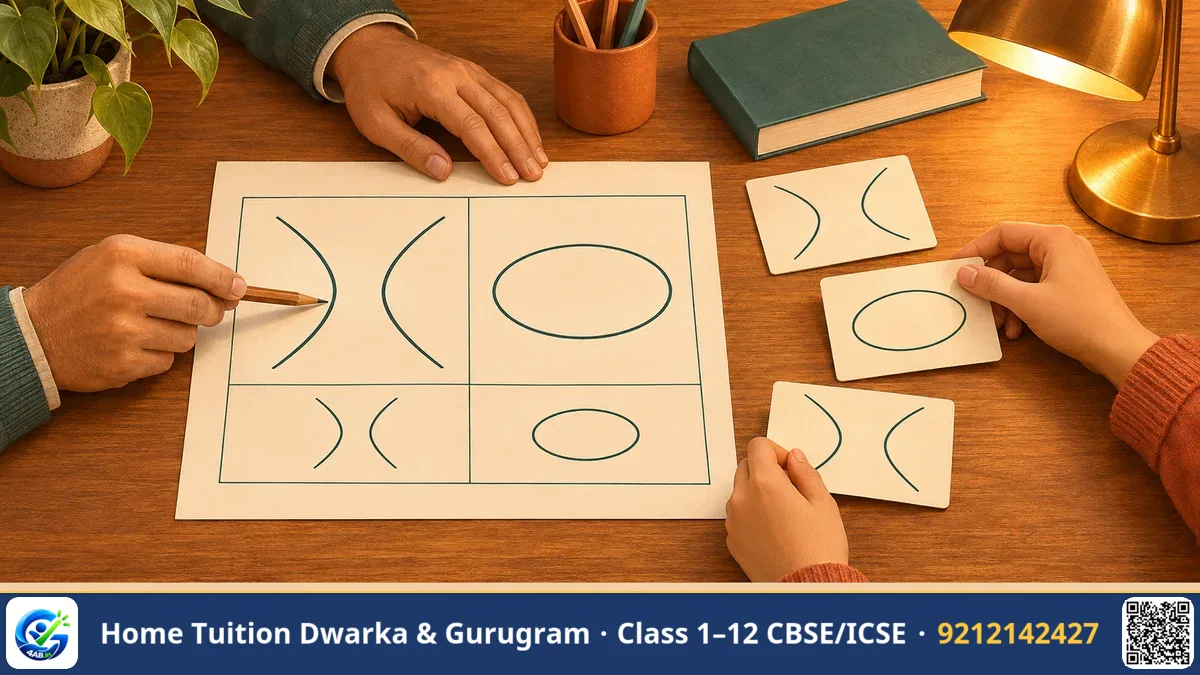
Many JEE Main students know the ellipse well and then misuse its results on the hyperbola.
This post gives contrast tables, short recall drills and a weekly routine that a tutor can run at home.
Why students mix up the two curves
A conic section is a curve you get by cutting a cone with a plane. The ellipse and the hyperbola are both conics. Both have a centre, two foci (fixed points that define the curve) and two axes. So the formulas look alike on the page.
The mistakes are usually small. A plus sign is written where a minus sign belongs. The relation b2 = a2(1 − e2) is used for a hyperbola. The tangent condition is copied from the ellipse without changing a sign.
In a JEE Main paper, a wrong sign gives a wrong option. A parent can help with one simple question: which curve is this, and what tells you so? If the answer takes more than a few seconds, the results are not yet secure.
Contrast table: equation and basic terms
Take the standard forms with the centre at the origin and the main axis along the x-axis. Learn each row for both curves at the same sitting.
| Item | Ellipse | Hyperbola |
|---|---|---|
| Equation | x2/a2 + y2/b2 = 1 | x2/a2 − y2/b2 = 1 |
| Eccentricity (how stretched the curve is) | 0 < e < 1 | e > 1 |
| Relation between a, b, e | b2 = a2(1 − e2) | b2 = a2(e2 − 1) |
| Foci | (±ae, 0) | (±ae, 0) |
| Directrices (fixed guide lines) | x = ±a/e | x = ±a/e |
| Latus rectum (chord through a focus, perpendicular to the main axis) | 2b2/a | 2b2/a |
| Meaning of 2a | Major axis, the longest chord | Transverse axis, joining the two vertices |
| Focal property | Sum of distances from the foci is 2a | Difference of distances from the foci is 2a |
Notice how much is the same: foci, directrices and latus rectum. The real differences are the sign in the equation, the range of e, the sign inside the bracket of b2, and sum versus difference. Spend your recall time on these four.
Contrast table: tangent and special lines
Here the two curves differ mainly by a sign. Also, a hyperbola has asymptotes, which are lines the branches approach but never touch. An ellipse has none.
| Item | Ellipse | Hyperbola |
|---|---|---|
| Tangent at (x1, y1) | xx1/a2 + yy1/b2 = 1 | xx1/a2 − yy1/b2 = 1 |
| Parametric point | (a cos θ, b sin θ) | (a sec θ, b tan θ) |
| Tangent with slope m | y = mx ± √(a2m2 + b2) | y = mx ± √(a2m2 − b2) |
| Condition for y = mx + c to touch | c2 = a2m2 + b2 | c2 = a2m2 − b2 |
| Asymptotes | None | y = ±(b/a)x |
One habit helps a lot. Ask whether a real tangent exists for every slope. For an ellipse, yes. For a hyperbola, the square root needs a2m2 ≥ b2, so some slopes give no tangent. That one check keeps the minus sign in memory.
Three results that belong only to the hyperbola
- Conjugate hyperbola: for x2/a2 − y2/b2 = 1, it is x2/a2 − y2/b2 = −1. Both share the same asymptotes.
- Rectangular hyperbola: this is the case a = b. Its eccentricity is √2 and its asymptotes are at right angles. Its equation can also be written xy = c2.
- Pair of asymptotes: the equation of the hyperbola and that of its asymptotes differ only in the constant term. For the standard form, the pair is x2/a2 − y2/b2 = 0.
A student who goes looking for asymptotes or a conjugate of an ellipse is carrying the wrong picture. Naming what belongs only to the hyperbola removes that confusion.
A worked example that tests the sign
Question: The hyperbola x2/9 − y2/16 = 1 is given. Find its eccentricity and the length of its latus rectum.
Step 1. Compare with the standard form. Here a2 = 9 and b2 = 16, so a = 3 and b = 4.
Step 2. Use the hyperbola relation: b2 = a2(e2 − 1). So 16 = 9(e2 − 1), which gives e2 = 25/9 and e = 5/3.
Step 3. Check: e is greater than 1, as it must be for a hyperbola. With the ellipse relation you would get a negative value of e2. That is your warning sign.
Step 4. Latus rectum = 2b2/a = 2 × 16 / 3 = 32/3.
How a tutor builds recall: the weekly routine
Recall is not rereading. It means closing the book and writing the result from memory. A tutor who sits with the student can see where the hand hesitates, and that shows which result is weak. Here is a routine for one-to-one home tuition.
- Day 1, side-by-side sheet. The student draws the two contrast tables on one page from memory. The tutor marks every wrong sign.
- Day 2, five-minute drill. The tutor reads out one item, such as the tangent condition or the relation of b2 with e. The student writes both versions, ellipse and hyperbola.
- Day 3, identify first. Give four equations. For each, the student writes only the curve, the values of a and b, and whether e should be below or above 1. No full solving.
- Day 4, mixed problems. Three or four questions that mix tangents, asymptotes and eccentricity. The student states the check, such as e > 1, before writing the answer.
- Day 5, error log. The student keeps a small notebook with one line per mistake: what was written, what was correct, and why. Re-read it before the next drill.
Keep the drill short and regular. Twenty focused minutes, a few days a week, usually does more than one long session before a test.
What parents in Dwarka and Gurgaon can do at home
You do not need to know conics to help. You can hold the sheet and read out the drill items. Check that the student answers without opening the notes, and that the error log is being kept.
Great Home Tutors offers one-to-one tuition at the student's home. You tell us the class, subject, board and your locality. A person then calls you back to understand the student. We tell you plainly whether a tutor is verified by us or not yet, and a first class lets you see the fit before anything is fixed. Dwarka and Gurgaon are both listed, and JEE is one of the class options on the request form.
The hyperbola also sits inside a wider conics topic. If the parabola and ellipse are shaky, fix those first. A tutor can look at the whole chapter and decide the order.
Key takeaways
- Learn the ellipse and the hyperbola side by side. Most of the confusion is one sign.
- For the hyperbola, e > 1 and b2 = a2(e2 − 1). Use this as a built-in check.
- The tangent condition is c2 = a2m2 − b2, and the focal property uses a difference, not a sum.
- Asymptotes, the conjugate hyperbola and the rectangular hyperbola belong only to the hyperbola.
- Closed-book drills and an error log fix recall better than rereading.
Frequently asked questions
Which results should I recall first for the hyperbola?
Start with the standard equation, the range of e, the relation of b2 with a and e, the foci, the asymptotes and the tangent condition. These appear most often in problems.
Is the latus rectum formula different for the hyperbola?
No. For the standard forms, the length is 2b2/a for both curves. Only the relation of b with e changes.
How do I remember which curve has the minus sign?
The hyperbola has a minus between the two terms, and its tangent condition has a minus too. Also picture the two separate branches opening outward. Link the picture to the sign, not just the sign to the page.
How long should a recall drill last?
Five to twenty minutes is enough if the student works closed-book and the tutor marks each result at once. Regular short drills suit this topic better than rare long ones.
Can a home tutor help if my child is in Class 11 and not yet in JEE preparation?
Yes. The request form lists Class 11 and Class 12 as well as JEE, and the same contrast tables help a school student too. Fixing the habit early saves time later.
What to do next. Try it yourself on the page below.
Great Home Tutors — home tuition at your home · 4AB →