Maths home tutor in Dwarka Sector 20 to 29 for JEE Maths
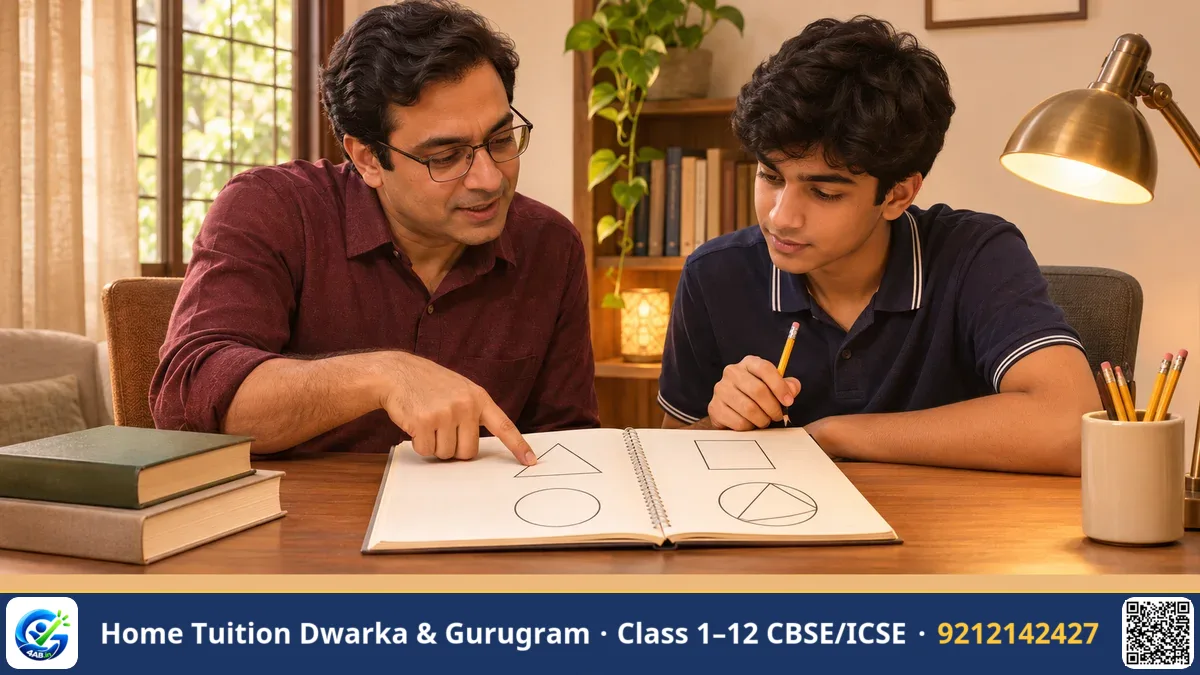
This post is for parents in Dwarka Sectors 20 to 29 whose child is preparing for JEE Maths.
You will learn where students usually lose marks, what a home tutor should do about it, and how to set up a weekly routine.
Why JEE Maths feels harder than school Maths
School Maths asks you to follow a method you were just taught. JEE Maths asks you to choose the method yourself. The same chapter can appear as a direct formula question or as a long problem that mixes two chapters.
Most students in Class 11 and Class 12 notice three changes:
- Speed matters. A student who knows the method but needs ten minutes per question will struggle in a timed paper.
- Chapters are linked. A calculus question may need trigonometry. A coordinate geometry question may need algebra.
- Weak basics show up late. A small gap in Class 9 or Class 10 algebra often becomes a big problem in Class 11.
The NCERT textbook is the base for all of this. Every JEE student should finish it fully before moving to harder problem sets. A tutor can tell you quickly whether your child has really done that or only read the solved examples.
Where students lose marks in each chapter group
The table below groups the main Class 11 and Class 12 topics and lists the mistakes a tutor sees most often. It is a teaching guide, not an exam forecast.
| Topic group | Typical pain point | What a tutor does |
|---|---|---|
| Algebra (quadratics, sequences, permutations) | Sign errors, forgetting to check the given conditions, confusion between permutation and combination | Teaches a short checklist for each question type and asks the student to explain the choice aloud |
| Trigonometry | Weak recall of identities, wrong quadrant for the angle | Builds a one-page identity sheet the student writes from memory each week |
| Coordinate geometry | Long calculations, careless algebra, no diagram | Insists on a neat diagram first, then simplifies before expanding |
| Calculus (limits, differentiation, integration) | Applying rules without understanding, missing limits of integration, wrong chain rule | Links each rule to the graph, then drills mixed problems |
| Vectors and 3D geometry | Cannot picture the situation | Uses simple sketches and real objects such as a room corner |
| Probability and statistics | Misreading the question, double counting | Trains the student to list the sample space before using a formula |
A worked example: the mistake behind many wrong answers
Question: For which values of k does x2 + kx + 4 = 0 have real roots?
Step 1. Real roots need the discriminant (the part under the square root in the quadratic formula, b2 − 4ac) to be zero or positive.
Step 2. Here a = 1, b = k, c = 4. So k2 − 16 ≥ 0.
Step 3. This means k2 ≥ 16, so k ≤ −4 or k ≥ 4.
Common error: Many students write k ≥ 4 only, because they take the square root and drop the negative value. A tutor catches this by asking the student to test k = −5 in the original equation.
This is a small question, but the habit it teaches is large: always test one value before you trust the answer. That habit saves marks in every chapter.
How a home tutor helps with JEE Maths
A school class has many students and one pace. A home tutor works at your child's pace. In practice, good one-to-one tuition does these things:
- Finds the real gap. The first few sessions should include short tests on old topics, not only the current chapter.
- Watches the working, not just the answer. Many errors are visible only when you see how the student writes the steps.
- Sets a clear order. Concept first, then NCERT problems, then harder mixed questions, then timed practice.
- Keeps a mistake notebook. Every wrong answer goes in with the reason. The student re-reads it before each test.
- Reports back to parents. You should hear which topics are improving and which still need work.
Great Home Tutors offers home tuition only. There is no coaching centre and no group batch. That means the session time belongs fully to your child. Tutors the team has checked carry a Verified mark and are listed first, and the team tells you plainly whether a tutor is verified or not yet.
A weekly routine that works at home
A tutor can only do so much in a few hours a week. The rest depends on daily habits. Here is a simple plan for a Class 11 or Class 12 student. Adjust the timings to your child's school hours.
- Tutor sessions: Fix the days and time in advance so that they do not move every week. Keep the child's table clear, with paper, a pencil and the textbook.
- Day after each session: Redo two or three questions from the session without looking at the solution. This is the step most students skip, and it matters most.
- Daily practice: A small, fixed block of problems on the current chapter is better than one long session on Sunday.
- Once a week: A timed set of mixed questions. Time pressure should be practised, not met for the first time in the exam.
- Once a week: Read the mistake notebook and write the identity or formula sheet from memory.
- Sleep and breaks: A tired student makes careless errors. Keep a fixed sleep time and one proper break each day.
Parents do not need to know the Maths. You only need to check two things: did the session happen, and did the child do the follow-up practice?
Choosing a tutor in Sectors 20 to 29
Travel time is a real issue in Dwarka. A tutor who comes to your home saves your child the commute and keeps the evening free for practice. When you request a tutor, tell us your sector so the match is made for your area.
Ask these questions in the first week:
- Does the tutor test the old basics before moving on?
- Does the tutor ask your child to explain steps, or just give the solution?
- Is there a clear plan for the chapters over the coming months?
- Does your child feel comfortable asking silly questions?
The last point is the most important. A student who is afraid to ask will hide the gaps, and the gaps will appear in the exam.
How to book the free demo
The booking is simple:
- Choose the free Maths demo on the Great Home Tutors page.
- Fill in the form: name, mobile number, class (choose JEE / NEET or Class 11 or 12), subject, board and your sector or PIN. You can also write timings and tutor preference.
- A person from the team calls you back to understand your child's needs.
- You meet the tutor, and the first class shows whether the fit is right before anything is fixed.
Your number is used only to call you about this request. It is not shown on the site.
Key takeaways
- JEE Maths tests method choice and speed, so weak Class 9 and 10 basics must be repaired early.
- Finish NCERT first, then move to harder mixed problems.
- A good tutor checks the working, keeps a mistake notebook and gives you regular feedback.
- Follow-up practice the day after each session matters as much as the session itself.
- Book the free Maths demo and judge the fit before you commit.
Frequently asked questions
Can a home tutor cover both school Maths and JEE Maths?
Yes. The Class 11 and 12 syllabus is the base for both, so the same chapters are taught with school-level and JEE-level questions. The tutor changes the difficulty as the student grows ready for it.
Is the demo class really free?
The page offers a free Maths demo. The first class is meant to show the fit before anything is fixed.
Will the tutor come to our home in Dwarka?
Great Home Tutors is one-to-one tuition at your home. Tell us your sector or PIN in the form so we can match a tutor for your area.
Does the tutor guarantee a rank or admission?
No. No tutor can promise a result. What a good tutor can promise is a clear plan, honest feedback and regular practice.
How do I know the tutor is checked?
Tutors checked by the team carry a Verified mark and are listed first. The team also tells you plainly if a tutor is not verified yet.
What to do next. Try it yourself on the page below.
Great Home Tutors — home tuition at your home · 4AB →