p-Block Class 11: Boron and Carbon Family Revision, Gurugram
This guide explains how Class 11 students can master the boron and carbon families without memorising endless reactions.
Parents in Gurugram will discover key periodic trends, syllabus trouble spots, and an effective home study routine.
Why the p-block syllabus challenges Class 11 students
The shift from Class 10 science to Class 11 Chemistry is a major academic step. In earlier grades, students work with basic reactivity rules. In Class 11, the syllabus demands structural reasoning, electronic configurations, and specific reaction mechanisms. Under CBSE and state board curricula, the p-block unit represents a substantial hurdle because it introduces descriptive inorganic chemistry.
The p-block contains elements where the outermost electrons enter p-orbitals. Class 11 focuses on the boron family and the carbon family. When students open their NCERT textbook, they often feel overwhelmed by factual details. Many attempt to memorise every equation and compound name. This rote approach fails during school examinations, where questions test the reasons behind anomalous behaviour and oxidation state stability.
Students in Gurugram also face busy schedules. Between long school hours, laboratory work, and travel across Delhi NCR, little energy remains for self-study. When students cram late at night, they confuse trends and lose marks. Systematic revision based on recurring patterns is the most reliable solution.
Grouping periodic properties to cut rote learning
The most effective way to study inorganic chemistry is comparative analysis. Instead of treating each element separately, students should study the boron family and the carbon family side by side. Both families share parallel periodic patterns governed by nuclear charge, orbital shielding, and valence electrons. Grouping these properties allows students to understand chemical trends instead of memorising disconnected facts.
- Atomic radii: Radii increase down each group as electron shells are added. However, inner d- and f-subshells shield the nuclear charge poorly, causing unexpected contractions in atomic size for heavier members.
- Ionization enthalpy: This term describes the energy required to remove an electron from an isolated gaseous atom. Irregularities down each group occur because poor shielding increases effective nuclear pull.
- Inert pair effect: This technical term refers to the reluctance of outermost s-electrons to engage in bonding. Down both families, the oxidation state two units lower than the group valence becomes increasingly stable.
- Anomalous behaviour: Boron and carbon differ from heavier members due to small size, higher electronegativity, and the absence of d-orbitals.
| Periodic property | Boron family | Carbon family |
|---|---|---|
| Valence electron configuration | ns2 np1 | ns2 np2 |
| Characteristic oxidation states | +1 and +3 | +2 and +4 |
| Stability of lower oxidation state | Increases down the family due to the inert pair effect | Increases down the family due to the inert pair effect |
| Maximum covalency of first member | 4 (limited by lack of d-orbitals) | 4 (limited by lack of d-orbitals) |
| Maximum covalency of heavier members | Can exceed 4 using vacant d-orbitals | Can exceed 4 using vacant d-orbitals |
Exam focus areas for the boron and carbon families
In the boron family, examiners focus on electron deficiency. A molecule is electron-deficient when its central atom has fewer than eight valence electrons. In simple halides, the boron atom forms three covalent bonds, leaving it with six valence electrons. Because its octet is incomplete, it behaves as an electron-pair acceptor by receiving electron pairs from donor molecules. Boron also forms hydrides such as diborane. In diborane, two bridging hydrogen atoms participate in three-centre two-electron bonds, known as banana bonds, allowing the molecule to achieve stability without expanding its valence shell.
Worked reasoning example: Why does the lower oxidation state become more stable for the heaviest members of both families?
In both families, the valence shell contains s-electrons and p-electrons. Down each group, intervening d- and f-orbitals shield the outer electrons poorly against the growing nuclear charge. The nucleus holds the outermost s-electrons firmly, making them reluctant to bond. This inert pair effect makes the lower oxidation state (+1 in the boron family, +2 in the carbon family) far more stable than the higher state (+3 and +4) for the heaviest elements.
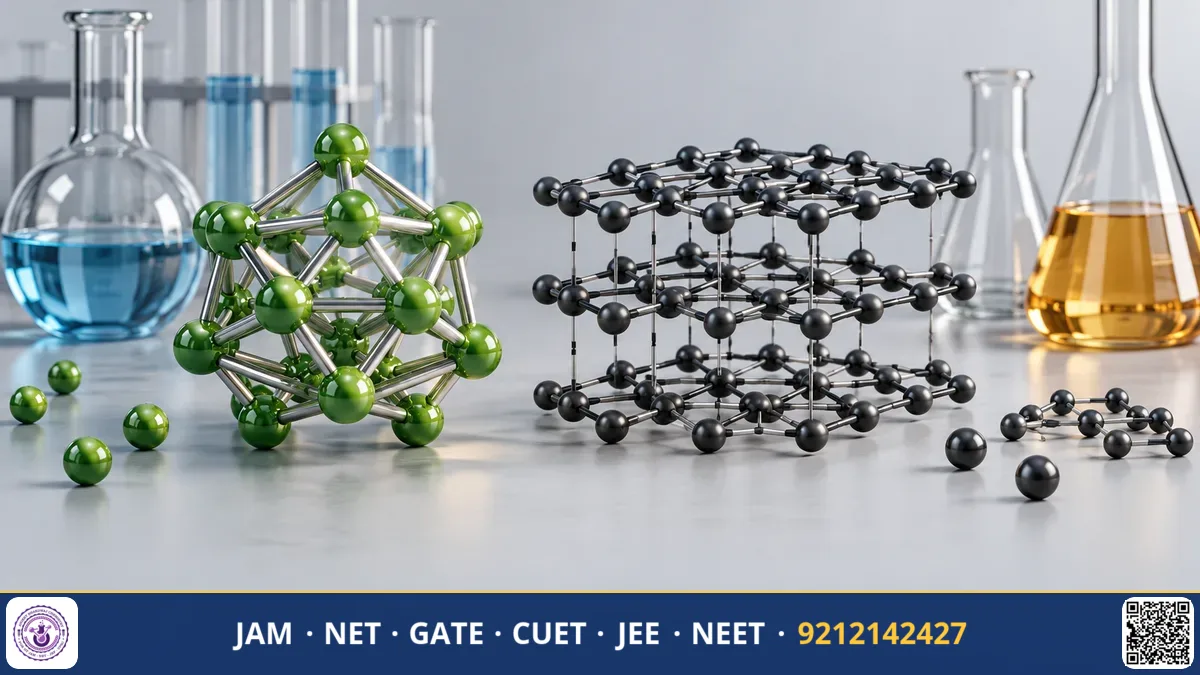
In the carbon family, key topics include catenation, allotropy, and oxides. Catenation is the ability of atoms of an element to bond into chains or rings. Carbon exhibits the highest catenation due to strong carbon-carbon bonds. Carbon forms distinct allotropes: diamond (sp3 network, hard insulator), graphite (sp2 hexagonal sheets with delocalised electrons that conduct electricity), and fullerene cages. Students must also contrast neutral carbon monoxide with acidic carbon dioxide.
How a home tutor helps students in Gurugram
Mastering descriptive chemistry requires active discussion and prompt feedback. In Gurugram, students in areas like Sector 108, Sector 109, Sector 110, Sector 111, Sector 112, and Sector 113 face tiring travel if they attend coaching institutes. Traffic congestion drains valuable evening study hours. Furthermore, large coaching batches move quickly through inorganic chapters, leaving students to memorize reactions alone.
One-to-one home tuition at your home provides focused support. A personal chemistry tutor assists the student through specific steps:
- Addressing conceptual gaps: The tutor ensures core ideas like orbital shielding and electron configurations are clear before tackling complex reactions.
- Creating comparative charts: The tutor guides the student to compare both families side by side, replacing rote memorisation with clear structure.
- Practicing oral drills: The tutor asks reasoning questions aloud, training the student to explain terms like the inert pair effect and electron-pair acceptance accurately.
- Working through NCERT exercises: The tutor prioritizes textbook reasoning questions that regularly appear in school examinations.
Parents can use Great Home Tutors to request a home tutor by selecting the class, subject, board, and locality. Tutors checked by the team carry a Verified mark following screening of their identity, qualifications, and teaching conversation. A first class at home allows parents to assess the fit before committing to regular lessons.
A structured weekly revision routine for chemistry
Regular review prevents descriptive chemistry from slipping away. Students should maintain this weekly schedule:
- Day 1 (Periodic trends): Spend 1 hour reviewing electron configurations and oxidation state stability across both groups.
- Day 2 (Boron compounds): Spend 1 hour studying electron deficiency, electron-pair acceptance, and bridge bonding in diborane.
- Day 3 (Carbon allotropes): Spend 1 hour comparing diamond, graphite, and fullerenes, along with reactions of carbon oxides.
- Day 4 (NCERT questions): Solve 10 conceptual reasoning problems from the NCERT textbook under quiet exam conditions.
- Day 5 (Tutor session): Work with your home tutor to correct errors and practice writing balanced chemical equations.
- Day 6 (Active recall): Take a timed 1-hour written test on group trends and anomalous properties.
- Day 7 (Consolidation): Spend 1 hour reviewing summary notes and organising questions for the next week.
Key takeaways
- Grouping elements by shared periodic patterns replaces rote memorisation with conceptual clarity across both families.
- The inert pair effect causes the lower oxidation state (+1 and +2) to become preferred in heavier elements.
- Boron achieves stability through electron-pair acceptance and three-centre bridge bonds in diborane.
- Carbon displays strong catenation and forms diverse allotropes including diamond, graphite, and fullerenes.
- One-to-one home tuition in Gurugram eliminates travel fatigue and provides personal guidance aligned with the NCERT syllabus.
Frequently asked questions
What is the inert pair effect in the boron and carbon families?
The inert pair effect is the reluctance of outermost s-electrons to participate in bonding due to poor shielding by intervening d- and f-electrons. Consequently, the lower oxidation state becomes more stable than the higher group oxidation state for the heaviest elements.
Why do boron compounds act as electron-pair acceptors?
In monomeric halides, boron shares three electrons to form three covalent bonds, leaving its valence shell with only six electrons. Because its octet is incomplete, it readily accepts an electron pair from a donor molecule to achieve stability.
Why does graphite conduct electricity while diamond does not?
In diamond, each carbon atom forms four rigid covalent bonds with sp3 hybrid orbitals, leaving no free electrons. In graphite, carbon atoms form planar hexagonal layers with sp2 hybrid orbitals, leaving one delocalised electron per atom that moves freely to conduct electricity.
How can parents in Gurugram find a verified chemistry home tutor?
Parents can request a home tutor through Great Home Tutors by selecting Class 11, Chemistry, and their locality, such as Sector 108 or Sector 110 in Gurgaon. Tutors carry a Verified mark after screening, and a first class is held at home to confirm suitability.
What to do next. Try it yourself on the page below.
Great Home Tutors — home tuition at your home · 4AB →