Locality checklist: 15 things to check on a weekday evening visit
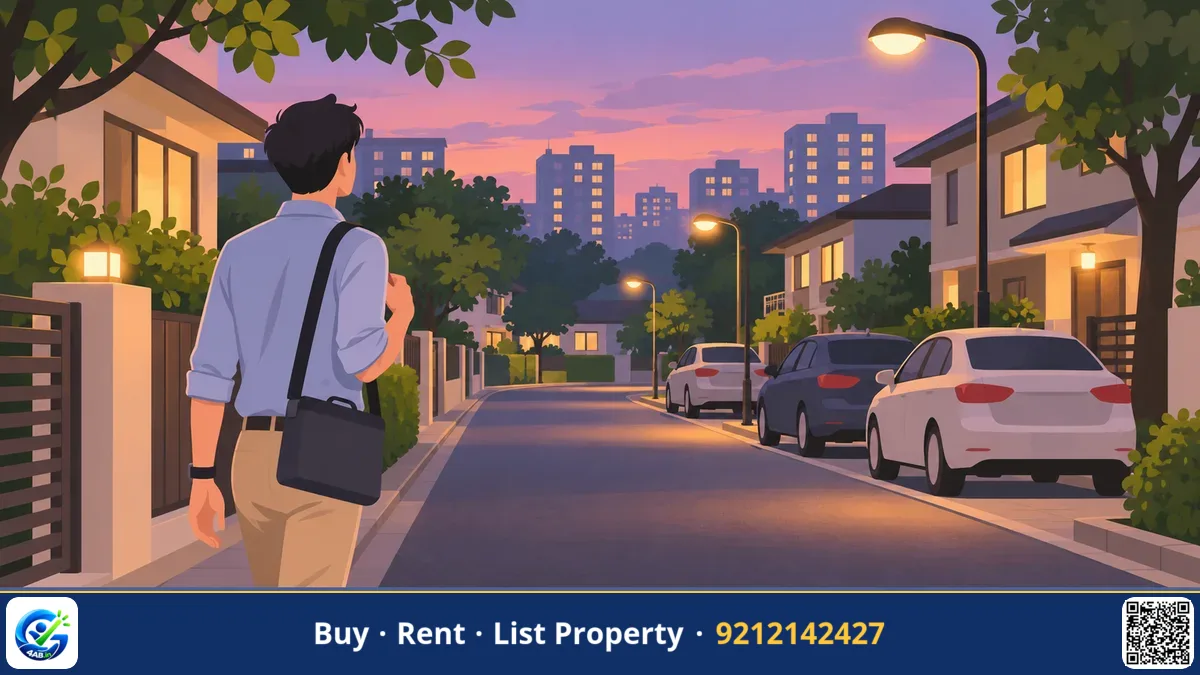
A flat looks calm at noon on a Sunday. It may look very different at 7 pm on a Tuesday.
This guide gives you 15 things to check on an evening visit, and how to read what you see.
Why a weekday evening tells you the truth
Most buyers see a property in the daytime on a holiday. Offices are shut, schools are quiet, and the street is half empty. That is the easiest version of any locality.
On a weekday evening, everyone returns home at the same time. Cars queue at the gate. Shops fill up. Children play on the road. This is the load your future home must handle every day, so this is when you should look.
Some simple rules before you go:
- Go on a working day, not a weekend or festival week.
- Arrive early, around 6 pm, and stay until after dark.
- Park a little away and walk the last stretch. You see more on foot.
- Carry a notebook or use your phone to write down what you notice. Memory fades fast.
- If you are serious about the property, visit a second time on a different weekday.
The method is the same whether you are looking in Dwarka in Delhi, along the Dwarka Expressway, or in Gurugram or Noida.
Traffic and access: checks 1 to 4
Traffic decides how tired you feel at the end of each day. Check it with your own eyes, not from a map screenshot.
- The route from your workplace. Travel it at the same hour you would normally return. Note the real time taken, not what the seller says.
- The approach road to the building or society gate. Is it wide enough for two cars to cross? Do vehicles queue on the main road to enter? A long queue at the gate often means a long wait for you too.
- Public transport. Look for a metro station, bus stop or auto stand. Check how easy it is to get an auto or cab at this hour, and how far you must walk.
- The last stretch of road. Look for broken surfaces, open drains and marks on walls that suggest water collects there in the rains. Ask a shopkeeper nearby if the lane floods.
Noise, air and light: checks 5 to 7
These three are easy to miss during a short daytime visit.
- Noise inside the flat. Stand in the bedroom and living room with windows closed, then open. Listen for horns, loudspeakers, generator sets, construction or a nearby market. Check which side the bedroom faces.
- Smell and air. Notice any smell of garbage, drains or burning waste. Look for open dumping spots, a nullah (open drain) or a workshop nearby. Smell is hard to fix once you live there.
- Street lighting. As it gets dark, see whether the street lights work. Look at the stretch between the main road and the gate, and the lanes around it. Dark patches matter, especially if someone in your family walks home alone.
Parking and daily services: checks 8 to 10
Parking is one of the most common daily irritations in Delhi NCR. Evening is when you see the real position.
- Resident parking. Count how many cars are parked on the road or in no-parking spots. If residents park on the lane, visitors and delivery vehicles will block it too. Ask whether your flat comes with a fixed parking space, and look at where it is.
- Visitor and delivery access. Watch how delivery riders, cabs and school vans stop near the gate. Can an ambulance or a fire vehicle get in if the lane is full?
- Daily needs within walking distance. Find a grocery shop, a vegetable seller, a pharmacy, a school and a clinic. Check that they are open and busy in the evening. Note how far each one is.
Safety, water and neighbours: checks 11 to 15
- Gate and security. See whether guards ask visitors to sign in or call the resident. A register that is actually used is a good sign. An unmanned gate or a guard asleep tells you something too.
- Who is on the street. At dusk, look for families, women, children and older people walking or sitting outside. A street that is only crowded with idle groups, or one that empties completely after dark, deserves a second thought.
- Stray animals and open spaces. Notice stray dogs near the gate or park, and whether any open plot or empty building nearby is unlit or unguarded.
- Water and power. Evening is when many homes use water at once. Ask residents about the water supply at this hour and about power backup during a cut. Look at the water tank area and the lift if the building has one.
- Talk to people who live there. Speak to a guard, a shopkeeper, a tea seller and at least two residents. Ask what they like, what they would change, and how long they have lived there. Ask open questions and do not lead them.
Be polite and do not argue with anyone. You are collecting information, not judging.
How to record and compare what you saw
If you visit more than one locality, memory will blur them. Use a simple table like the one below. Fill it in on the spot or in the car straight after.
| What to check | Good sign | Warning sign |
|---|---|---|
| Traffic at the gate | Vehicles enter smoothly | Queue spills onto the main road |
| Noise | Only normal street sounds | Constant horns, loudspeakers or construction |
| Parking | Marked spaces, clear lanes | Cars on both sides of the lane |
| Lighting | Street lights on, even light | Dark stretches near the gate |
| Security | Visitors are logged | Gate open and unattended |
| Water and power | Residents report steady supply | Regular complaints about tankers or cuts |
Worked example: Suppose you see two flats. Flat A has a quiet inside but a long queue at the gate every evening. Flat B has a little street noise but easy entry and clear parking. Do not choose by feeling alone. Mark each row of your table as good, average or poor, then count the poor marks. Ask yourself which poor marks you can live with, and which ones you cannot fix later.
What to do after the visit
A visit tells you about the surroundings. It does not tell you about the paperwork. Once a locality passes your checklist, move to the document stage and read a guide on the documents to check before buying any property. Keep the two jobs separate: place first, papers next.
If you search for listings on GreatProperty, you can use the locality or landmark search box to look at an area, and the Report option if you see a listing that looks wrong. Every listing there is reviewed by a person before it goes live. Still, your own evening visit is something no listing can replace.
Key takeaways
- Visit on a weekday between about 6 pm and 8 pm, and stay until after dark.
- Check traffic, noise, parking and safety with your own eyes, on foot.
- Use the 15 checks and a simple table so you can compare localities fairly.
- Talk to guards, shopkeepers and residents, and ask open questions.
- If a problem is visible at peak hour, treat it as a daily problem, not a one-time event.
Frequently asked questions
Why should I not visit on a Sunday?
On a holiday, roads are empty, offices are closed and parking looks easy. A weekday evening shows the real daily load on traffic, parking and noise. Visit on a Sunday too if you like, but only as an extra visit.
How long should an evening visit take?
Plan for at least an hour and a half. Arrive while there is still light, walk the lanes, see the flat, and stay after dark to check lighting and security.
Should I visit more than once?
Yes, if you are serious. A second visit on a different weekday, ideally at a slightly different hour, shows whether what you saw was normal or just one unusual evening.
Can I ask residents about the building and the neighbours?
Yes. Most people are happy to share what daily life is like. Ask about water, power, parking and security. Treat their answers as opinions and match them with what you saw yourself.
Does a good locality visit mean the property is safe to buy?
No. The visit only checks the surroundings. Ownership papers and approvals need separate checking, and for that you should use a documents checklist and take proper professional help.
What to do next. Try it yourself on the page below.
Great Property Guides →