The major product formed in the following reaction is: PhSNa · ABC26OR0175
Subject: Organic Chemistry · Chapter: Reagents, Reaction Mechanisms & Named Reactions · Topic: Named Reactions · Exam: CSIR NET JUNE 2011 · Marks: 2 · Difficulty: Medium
The major product formed in the following reaction is: 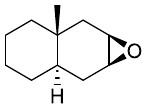 PhSNa
PhSNa(a)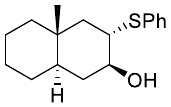
(b)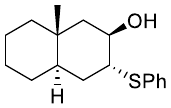
(c)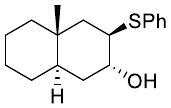
(d)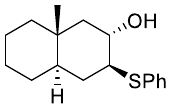
Answer
Answer: B ✓ checked by 4AB · confidence high
The source book printed C; on checking, B is correct — see the explanation.
The scan draws the epoxide with bold wedges, so it is 2β,3β, on the same face as the angular methyl, not 2α,3α. Trans-diaxial (Fürst–Plattner) opening puts the nucleophile on C-3 from the α face, giving 2β-OH and 3α-SPh, which is option (b). The original key was also B.
Explanation
Fürst–Plattner rule: an epoxide on a rigid cyclohexane opens trans-diaxially. The scan draws the epoxide with bold wedges, so it is 2β,3β (the same face as the angular methyl) on a trans-decalin. In this ring the axial positions are C-10 β, C-1 α, C-2 β and C-3 α. For a diaxial product, PhS⁻ must attack C-3 from the α face, and the oxygen stays on C-2 as an axial β-OH. Product: 2β-OH (wedge, on the carbon nearer the angular methyl) and 3α-SPh (hash), which is option (b).
Study loop for Reagents, Reaction Mechanisms & Named Reactions