Q22 · CSIR NET Chemistry, June 2015
Paper: CSIR NET June 2015 · Subject: Organic Chemistry · Chapter: Reagents, Reaction Mechanisms & Named Reactions · Topic: Reduction Reagents · Marks: 2 · Difficulty: Medium
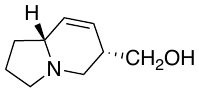
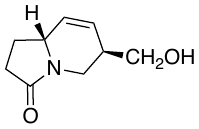
The structures of A and B in the following reaction sequence are 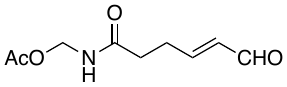
 2. heat A $\xrightarrow[\text{2. }\mathrm{H_3O^+}]{\text{1. }\mathrm{LiAlH_4}}$ B
(a)A = 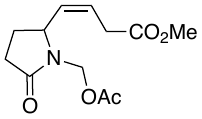 B =
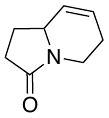
B = (b)A = 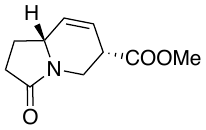 B =
B = (c)A = 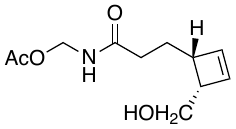 B =
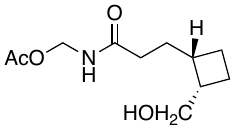
B = (d)A = 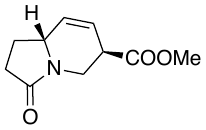 B =
B = Answer
Answer: B ✓ checked by 4AB · confidence medium
Key B kept. The explanation was rewritten because the N-acylimine is the dienophile; it does not form a 2-azadiene. The text also now says why (d) is excluded.
Explanation
Ph₃P=CHCO₂Me, a stabilised ylide, converts the aldehyde into the (E,E)-dienoate. On heating, the N-(acetoxymethyl)amide loses AcOH to give an N-acylimine (CH₂=N–C=O). This acts as the dienophile in an intramolecular aza-Diels–Alder reaction with the dienoate, giving indolizidinone A, a lactam that carries the CO₂Me group and the ring C=C. LiAlH₄ then reduces both the lactam C=O, giving the tertiary amine, and the ester, giving CH₂OH, which yields amino alcohol B. Option (d) is excluded because its B still contains the lactam C=O, which LiAlH₄ would reduce. Options (a) and (c) do not form the bicyclic ring. Answer: (b).
Study loop for Reagents, Reaction Mechanisms & Named Reactions