The major product formed in the following reaction is · ABC26OR0610
Subject: Organic Chemistry · Chapter: Reagents, Reaction Mechanisms & Named Reactions · Topic: Reagents, Reaction Mechanisms & Named Reactions – General · Exam: GATE 2000-2022 · Marks: 2 · Difficulty: Easy
The major product formed in the following reaction is 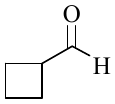
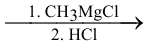
(a)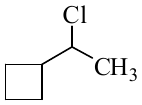
(b)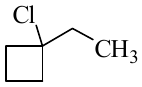
(c)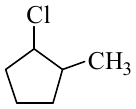
(d)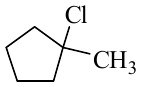
Answer
Answer: D ✓ checked by 4AB · confidence high
The source book printed no answer; this one was worked out and checked — see the explanation.
The scan is Q53: CH₃MgCl then HCl. The secondary cation next to the cyclobutane ring-expands to the 2-methylcyclopentyl cation, and a 1,2-H shift gives the tertiary cation, which Cl⁻ traps to give 1-chloro-1-methylcyclopentane (d). The stored A belonged to another question.
Explanation
CH₃MgCl adds to the aldehyde to give 1-cyclobutylethanol. HCl protonates the OH and water leaves, giving a secondary carbocation next to the strained four-membered ring. A ring C–C bond migrates, and the ring expansion relieves strain, giving the 2-methylcyclopentyl cation. A 1,2-hydride shift then forms the tertiary 1-methylcyclopentyl cation, which chloride traps: 1-chloro-1-methylcyclopentane. Answer: (d).
Study loop for Reagents, Reaction Mechanisms & Named Reactions