In the reaction sequence [X] [Y] the major products, [X] and [Y] respectively, are · ABC26OR0676
Subject: Organic Chemistry · Chapter: Reagents, Reaction Mechanisms & Named Reactions · Topic: Reagents, Reaction Mechanisms & Named Reactions – General · Exam: GATE 2000-2022 · Marks: 2 · Difficulty: Medium
In the reaction sequence 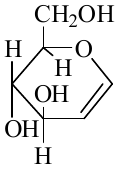
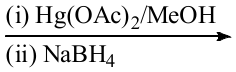 $[\mathrm{X}]$
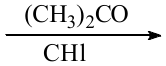 $[\mathrm{Y}]$ the major products, $[\mathrm{X}]$ and $[\mathrm{Y}]$ respectively, are
$[\mathrm{X}]$ $[\mathrm{Y}]$ the major products, $[\mathrm{X}]$ and $[\mathrm{Y}]$ respectively, are(a)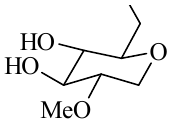 and
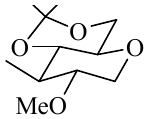
and (b)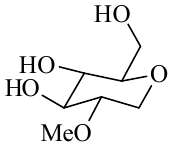 and
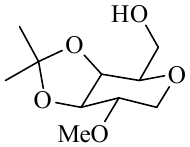
and (c)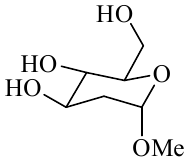 and
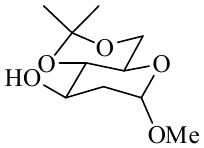
and (d)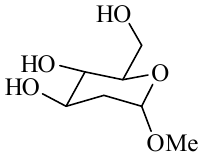 and
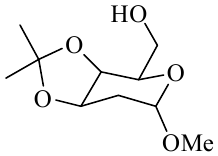
and Answer
Answer: C ✓ checked by 4AB · confidence high
The source book printed D; on checking, C is correct — see the explanation.
The key was overridden to (d), but (d)'s Y is the 3,4-O-isopropylidene (five-membered dioxolane on the trans-diequatorial 3,4-diol, CH2OH free). The thermodynamic acetone acetal of a methyl 2-deoxy-glucoside is the 4,6-O-isopropylidene with 3-OH free, drawn in (c). The original printed key (raw bank) is also C.
Explanation
Oxymercuration–demercuration of the glycal (D-glucal) in MeOH: Hg²⁺ adds at C-2 and methanol at C-1 (stabilised by the ring-oxygen oxocarbenium). NaBH₄ then replaces Hg by H, giving X = methyl 2-deoxy-glucopyranoside (OMe at C-1, CH₂ at C-2). Acetone with acid catalyst forms the six-membered 4,6-O-isopropylidene acetal (the 3,4-diol is trans-diequatorial and does not readily form a dioxolane), leaving 3-OH free. Y = methyl 2-deoxy-4,6-O-isopropylidene-glucopyranoside. Answer (c).
Study loop for Reagents, Reaction Mechanisms & Named Reactions