The β-hydrogen elimination will be facile in · ABC26IN0249
Subject: Inorganic Chemistry · Chapter: Organometallic Compounds · Topic: Oxidative Addition Reductive Elimination · Exam: CSIR NET 2015 · Marks: 2 · Difficulty: Medium
The $\beta$-hydrogen elimination will be facile in
(a)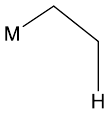
(b)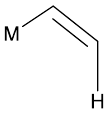
(c)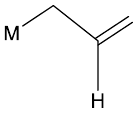
(d)
Answer
Answer: A ✓ checked by 4AB · confidence high
Explanation
β-Hydride elimination needs an sp³ C–H on the β-carbon that can rotate syn-coplanar with M and reach a vacant site through a four-membered M–C–C–H transition state.
(a) M–CH₂–CH₃ (ethyl): the β-carbon is sp³ with three H atoms, so elimination to the alkene is facile.
(b) M–CH=CH₂ (vinyl): the β-H sits on an sp² carbon held rigidly in the plane, so elimination (to an alkyne) is unfavourable.
(c) M–CH₂–CH=CH₂ (allyl): the β-H is on an sp² carbon. Elimination would give an allene, and the allyl group prefers to bind η³ instead, so it does not β-eliminate readily.
(d) M–C≡C–H (alkynyl): the linear sp chain holds the β-H far from the metal, so elimination is impossible.
Answer: (a).
Study loop for Organometallic Compounds