The pericyclic reaction given below is an example of · ABC26OR0574
Subject: Organic Chemistry · Chapter: Pericyclic Reactions · Topic: Sigmatropic Shifts · Exam: GATE 2000-2022 · Marks: 2 · Difficulty: Easy
The pericyclic reaction given below is an example of 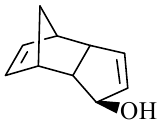
(a)$[1,3]$–sigmatropic shift
(b)[1, 5]-sigmatropic shift
(c)$[3,5]$–sigmatropic shift
(d)$[3,3]$–sigmatropic shift
Answer
Answer: D ✓ checked by 4AB · confidence high
The source book printed B; on checking, D is correct — see the explanation.
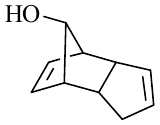
Atom mapping shows a Cope [3,3] shift. The 1,5-diene runs from the norbornene C=C through the bridgehead–junction σ bond to the cyclopentene C=C. Breaking that σ bond and forming the new one turns the CH(OH) carbon into the one-carbon bridge of a new norbornene, exactly as in the drawn product. No [1,5] H or C shift produces this skeleton.
Explanation
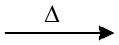
Label the endo-dicyclopentadienol. In the norbornene part, C5=C6–C1 has bridgehead C1 bonded to ring-fusion C2. C2 carries the cyclopentene C=C (C8=C9), and C9 is next to the CH(OH) carbon C10. C5=C6–C1–C2–C8=C9 is a 1,5-diene held face-to-face by the endo geometry. On heating, the C1–C2 σ bond breaks and a new C5–C9 bond forms, with new π bonds C6=C1 and C2=C8. This is a [3,3] sigmatropic (Cope) rearrangement. The former CH(OH) carbon C10 becomes the one-carbon bridge of the new norbornene, which is why OH appears on the bridge in the product. Answer (d) [3,3].
Study loop for Pericyclic Reactions