The major product formed in the following reaction is · ABC26OR0653
Subject: Organic Chemistry · Chapter: Reagents, Reaction Mechanisms & Named Reactions · Topic: Reagents, Reaction Mechanisms & Named Reactions – General · Exam: GATE 2000-2022 · Marks: 2 · Difficulty: Easy
The major product formed in the following reaction is 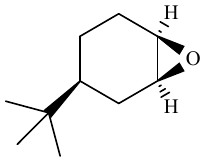
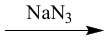
(a)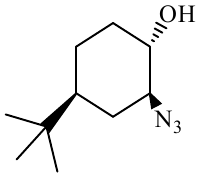
(b)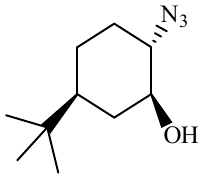
(c)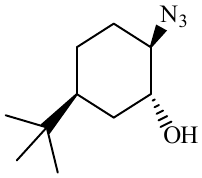
(d)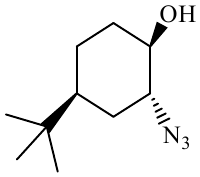
Answer
Answer: D ✓ checked by 4AB · confidence low
Explanation
The t-butyl group locks the ring with t-Bu equatorial; the epoxide O is cis to t-Bu. Azide opens the epoxide by anti (SN2) attack through the chair-like transition state (Fürst–Plattner rule), so the product is formed trans-diaxial. In that chair, an axial group on C-1 (the epoxide carbon 1,4 to t-Bu) is cis to t-Bu, and an axial group on C-2 (1,3 to t-Bu) is trans to it. The oxygen keeps its face (cis to t-Bu), so OH is on C-1 and N₃ enters C-2, trans to t-Bu: OH wedged on the remote carbon, N₃ hashed on the carbon nearer t-Bu. Answer (d).
Study loop for Reagents, Reaction Mechanisms & Named Reactions