An organic compound having molecular formula C₈ H₁₂ O₂ exhibits the following peacks in IR and ¹ H NMR… · ABC26OR0706
Subject: Organic Chemistry · Chapter: Organic Spectroscopy · Topic: Organic Spectroscopy – General · Exam: GATE 2000-2022 · Marks: 2 · Difficulty: Medium
An organic compound having molecular formula $\mathrm{C}_{8} \mathrm{H}_{12} \mathrm{O}_{2}$ exhibits the following peacks in IR and ${ }^{1} \mathrm{H}$ NMR spectra. IR : $1720\left(\mathrm{cm}^{-1}\right)$ ${ }^{1} \mathrm{H} \mathrm{NMR}: 6.95(1 \mathrm{H}, \mathrm{d}, \mathrm{J}=8.5 \mathrm{Hz}) 5.90(1 \mathrm{H}, \mathrm{d}, \mathrm{J}=8.5 \mathrm{Hz}), 4.53(1 \mathrm{H}, \mathrm{q}, \mathrm{J}=6 \mathrm{Hz})$, $1.41(3 \mathrm{H}, \mathrm{d}, \mathrm{J}=6 \mathrm{Hz}), 1.20(3 \mathrm{H}, \mathrm{s}), 1.15(3 \mathrm{H}, \mathrm{s})$
(a)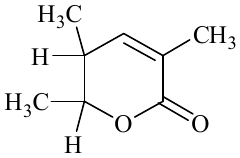
(b)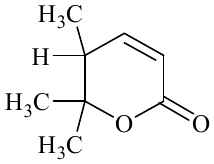
(c)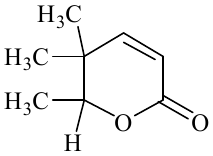
(d)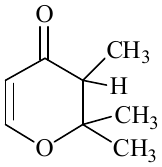
Answer
Answer: C ✓ checked by 4AB · confidence high
Explanation
C₈H₁₂O₂ has 3 degrees of unsaturation (C=O, C=C and the ring). IR at 1720 cm⁻¹ fits an α,β-unsaturated δ-lactone. The two vinyl doublets at 6.95 and 5.90 (J = 8.5 Hz) couple only with each other, so the CH=CH is flanked by C=O and a quaternary carbon. That quaternary carbon (C-5) carries the two CH₃ singlets at 1.20 and 1.15. O–CH(CH₃) accounts for the q at 4.53 (1H) and the d at 1.41 (3H). The compound is 5,5,6-trimethyl-5,6-dihydro-2H-pyran-2-one. Answer: (c).
Study loop for Organic Spectroscopy