An organic compound Q exhibited the following spectral data: IR: 1760 cm⁻¹ ¹ H NMR: δ(ppm) : 7.2(1 H, d… · ABC26OR0730
Subject: Organic Chemistry · Chapter: Organic Spectroscopy · Topic: Organic Spectroscopy – General · Exam: GATE 2000-2022 · Marks: 2 · Difficulty: Medium
An organic compound Q exhibited the following spectral data: IR: $1760 \mathrm{cm}^{-1}$ ${ }^{1} \mathrm{H} \mathrm{NMR}: \delta(\mathrm{ppm}) \quad: 7.2(1 \mathrm{H}, \mathrm{d}, \mathrm{J}=16.0 \mathrm{Hz}), 5.1(1 \mathrm{H}, \mathrm{m}), 2.1(3 \mathrm{H}, \mathrm{s}), 1.8(3 \mathrm{H}, \mathrm{d}, \mathrm{J}=7.0 \mathrm{Hz})$ ${ }^{13} \mathrm{C} \mathrm{NMR}: \delta(\mathrm{ppm}) \quad: 170$ (carbonyl carbon), Compound Q is
(a)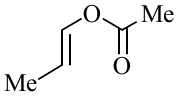
(b)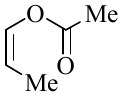
(c)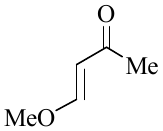
(d)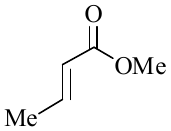
Answer
Answer: A ✓ checked by 4AB · confidence high
Explanation
1760 cm⁻¹ is a vinyl (enol) acetate; δ 7.2 (d, J = 16 Hz) is the OCH= proton trans-coupled to the 5.1 vinyl H, 2.1 s is the acetate CH₃ and 1.8 d the allylic CH₃ — (E)-prop-1-enyl acetate (a).
Study loop for Organic Spectroscopy