The appropriate reagents required for carrying out the following transformation are · ABC26OR0877
Subject: Organic Chemistry · Chapter: Reagents, Reaction Mechanisms & Named Reactions · Topic: Reagents, Reaction Mechanisms & Named Reactions – General · Exam: JAM 2005-2022 · Marks: 2 · Difficulty: Medium
The appropriate reagents required for carrying out the following transformation are 

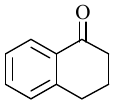
(a)(i) succinic anhydride, $\mathrm{AlCl}_{3}$; (ii) $\mathrm{Zn} / \mathrm{Hg}, \mathrm{HCl}$; (iii) polyphosphoric acid
(b)(i) maleic anhydride, $\mathrm{AlCl_3}$; (ii) $\mathrm{H_2N\text{-}NH_2}$, $\mathrm{KOH}$; (iii) $\mathrm{H_2SO_4}$
(c)(i) succinic anhydride, $\mathrm{FeCl}_{3}$; (ii) $\mathrm{LiAlH}_{4}$; (iii) $\mathrm{H}_{2} \mathrm{SO}_{4}$
(d)(i) Phthalic anhydride, $\mathrm{F_3B\cdot OEt_2}$; (ii) $\mathrm{HS(CH_2)_2SH}$, $\mathrm{H^{+}}$; (iii) Raney Ni; (iv) polyphosphoric acid
Answer
Answer: A ✓ checked by 4AB · confidence medium
Explanation
The classical Haworth route to α-tetralone: Friedel–Crafts acylation with succinic anhydride/AlCl₃, Clemmensen reduction of the keto acid (Zn/Hg, HCl) and intramolecular acylation in polyphosphoric acid.
Study loop for Reagents, Reaction Mechanisms & Named Reactions