Q15 · CSIR NET Chemistry, December 2014
Paper: CSIR NET December 2014 · Subject: Organic Chemistry · Chapter: Reagents, Reaction Mechanisms & Named Reactions · Topic: Reagents, Reaction Mechanisms & Named Reactions – General · Marks: 2 · Difficulty: Medium
The products A and B in the following reaction sequence are: 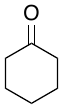 LDA
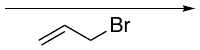 A $\xrightarrow[\mathrm{CuCl,\ DMF\text{-}H_2O}]{\mathrm{PdCl_2,\ O_2}}$ B $\xrightarrow[2.\ \mathrm{H_3O^+}]{1.\ \mathrm{NaOEt}}$
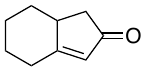
LDA A $\xrightarrow[\mathrm{CuCl,\ DMF\text{-}H_2O}]{\mathrm{PdCl_2,\ O_2}}$ B $\xrightarrow[2.\ \mathrm{H_3O^+}]{1.\ \mathrm{NaOEt}}$ (a)A = 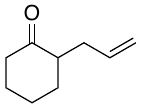 B =
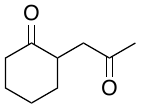
B = (b)A = 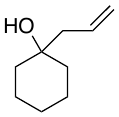 B =
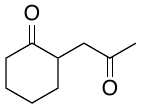
B = (c)A = 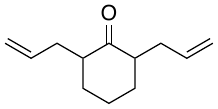 B =
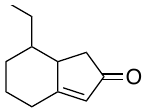
B = (d)A = 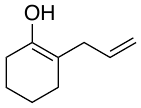 B =
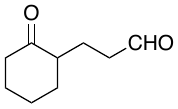
B = Answer
Answer: A ✓ checked by 4AB · confidence high
Explanation
LDA/allyl bromide gives 2-allylcyclohexanone (A); Wacker oxidation converts the terminal alkene into the methyl ketone (B); NaOEt intramolecular aldol condensation gives the bicyclic enone (a).
Study loop for Reagents, Reaction Mechanisms & Named Reactions