Q18 · CSIR NET Chemistry, June 2015
Paper: CSIR NET June 2015 · Subject: Organic Chemistry · Chapter: Reagents, Reaction Mechanisms & Named Reactions · Topic: Reagents, Reaction Mechanisms & Named Reactions – General · Marks: 2 · Difficulty: Medium
The products A and B in the following reaction sequence are 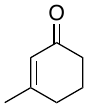
 2. allyl bromide $\mathrm{A}$
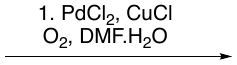 2. ethanolic KOH $\mathrm{B}$
2. allyl bromide $\mathrm{A}$ 2. ethanolic KOH $\mathrm{B}$(a)$\mathrm{A}=$ 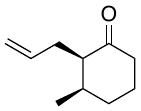 $\mathrm{B}=$
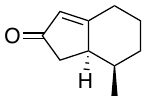
$\mathrm{B}=$ (b)$\mathrm{A}=$ 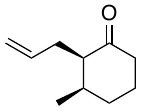 $\mathrm{B}=$
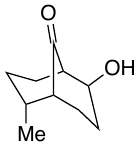
$\mathrm{B}=$ (c)$\mathrm{A}=$ 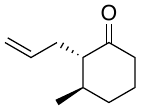 $\mathrm{B}=$
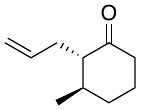
$\mathrm{B}=$ (d) B =
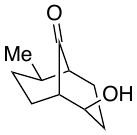
B = Answer
Answer: D ✓ checked by 4AB · confidence high
Explanation
Li/NH₃ reductive alkylation gives the trans-2-allyl-3-methylcyclohexanone (allyl and Me trans, A); Wacker oxidation converts the alkene into the methyl ketone and KOH aldol condensation closes the cyclopentenone (B) — (d).
Study loop for Reagents, Reaction Mechanisms & Named Reactions