Third Law Entropy and Residual Entropy of CO and Ice (S = R ln w)
The third law of thermodynamics says that the entropy of a perfect crystal is zero at absolute zero. Real crystals do not always reach that perfect order. Carbon monoxide, nitrous oxide and ordinary ice keep some disorder frozen in as they are cooled, and so have a non-zero residual entropy at 0 K. This topic links the third law to Boltzmann's S = k ln W and is a favourite for numericals in IIT-JAM, GATE, CSIR-NET and CUET-PG physical chemistry.

The key equations
Sm (residual) = R ln w where w = number of equally likely arrangements per molecule
Debye T3 law: Cp ≈ aT3 ⇒ S(T) = ∫0T (Cp/T) dT = Cp(T)/3
- W is the number of microstates (arrangements) of the whole sample. For N independent molecules, each with w choices, W = wN.
- kB = 1.380649 × 10⁻²³ J K−1; R = 8.3145 J K−1 mol−1 = NAkB.
- Since ln(wN) = N ln w, the molar residual entropy is NA kB ln w = R ln w.
Why does residual entropy exist?
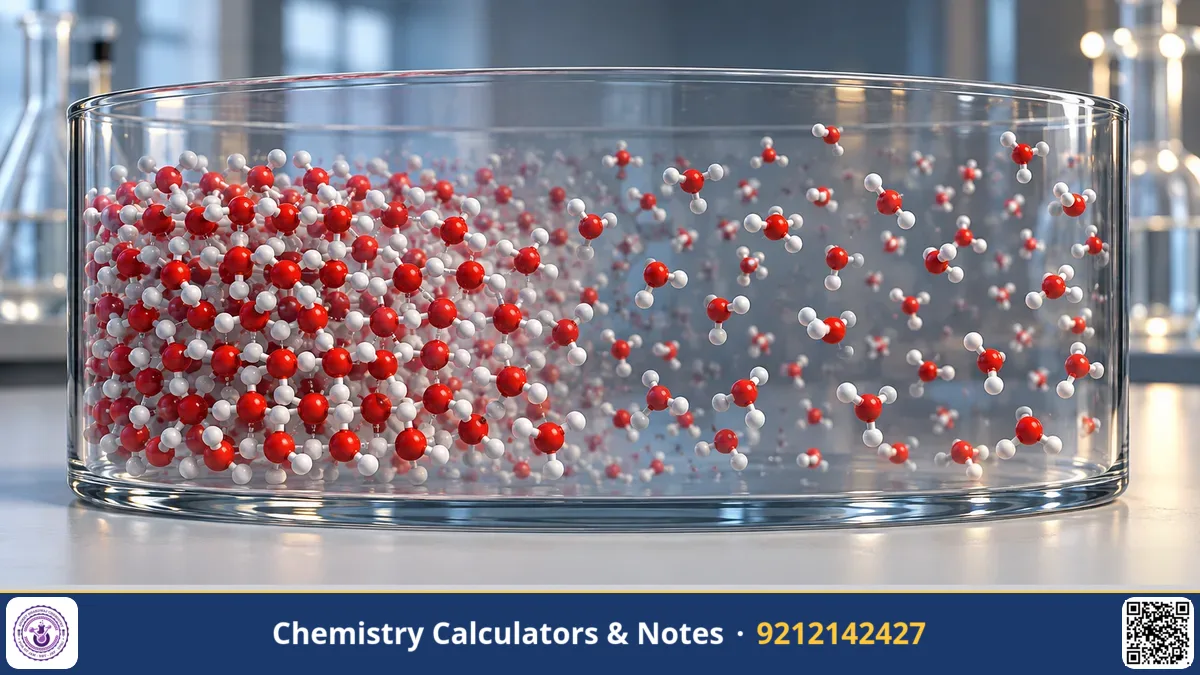
A molecule such as CO is almost symmetric: the C–O dipole is small and the two ends are similar in size. As the crystal forms, each molecule can sit in the lattice as CO or OC with almost equal energy. When the sample is cooled quickly, the molecules freeze in whichever orientation they happen to have, so the crystal at 0 K is a random mixture and not a perfect crystal. The calorimetric entropy (obtained by integrating Cp/T from near 0 K) misses this frozen-in disorder. The statistical (spectroscopic) entropy, calculated from molecular data, includes it.
For ice, each oxygen is bonded to two hydrogens by short covalent bonds and to two other hydrogens by hydrogen bonds. Many arrangements of the hydrogens obey these “ice rules” with nearly equal energy, so the crystal is disordered in its hydrogen positions even at very low temperature.
Example 1: residual entropy of CO. Each CO molecule can freeze in one of 2 orientations (CO or OC). Find the molar residual entropy.
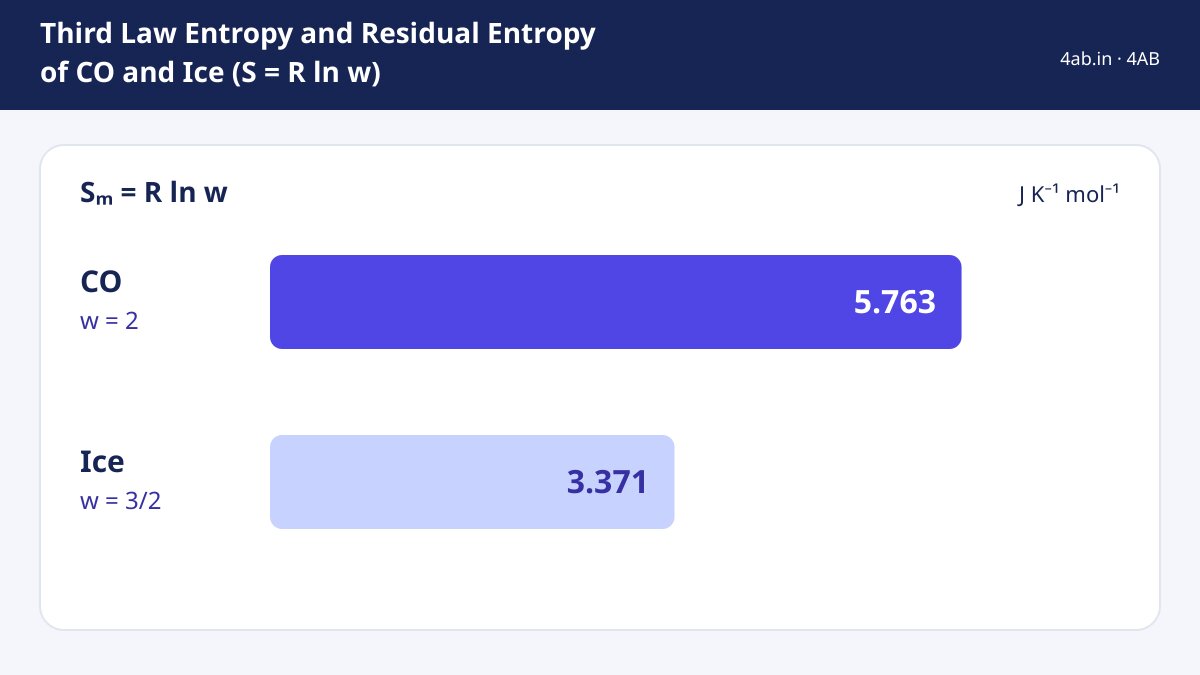
w = 2, so Sm = R ln 2 = 8.3145 × 0.6931 = 5.763 J K−1 mol−1.
Per molecule: kB ln 2 = 1.3806 × 10−23 × 0.6931 = 9.570 × 10⁻²⁴ J K−1. Multiplying by NA = 6.022 × 10²³ gives 5.763 J K−1 mol−1, the same, as expected.
Example 2: Pauling's estimate for ice. Each oxygen is joined to 4 neighbours, so there are 2 hydrogen-bond links per molecule on average. The proton on each link can sit at either of 2 positions, giving 22 = 4 choices per molecule. Of the 16 ways to place protons on the 4 links around one oxygen, only 6 follow the ice rule (exactly 2 protons near that oxygen). Pauling's argument multiplies the 4 choices by the allowed fraction 6/16, so w = 4 × 6/16 = 3/2.
Pauling's counting gives w = 3/2 per molecule, so
Sm = R ln(3/2) = 8.3145 × 0.4055 = 3.371 J K−1 mol−1.
This is close to the residual entropy found experimentally for ice. Use the result w = 3/2 directly in an exam if the question says “Pauling”; you are not expected to derive the count.
Example 3: a molecule with 4 equally likely orientations, and the effect of ordering. Suppose a solid contains molecules that can freeze in 4 equivalent orientations. Find the molar residual entropy. Then find what it becomes if a heavy atom makes only 1 orientation possible.
With w = 4: Sm = R ln 4 = 8.3145 × 1.3863 = 11.53 J K−1 mol−1. This is exactly 2 × R ln 2 = 2 × 5.763, as ln 4 = 2 ln 2.
With w = 1: Sm = R ln 1 = 0. The crystal is perfect and obeys the third law with S(0) = 0.
Example 4: Debye T3 extrapolation. A crystal has Cp = 0.45 J K−1 mol−1 at 12 K. Below 12 K the Debye law Cp = aT3 applies. Find the entropy between 0 and 12 K.
a = 0.45 / 123 = 0.45 / 1728 = 2.604 × 10⁻⁴ J K−4 mol−1.
S = ∫012 (aT3/T) dT = a ∫ T2 dT = aT3/3 = Cp(12 K)/3 = 0.45 / 3 = 0.150 J K−1 mol−1.
This is how calorimetric third-law entropies are built: measured data from about 12 K upward plus a Debye extrapolation below. Note that this method assumes a perfect crystal, so it cannot detect residual entropy.
Common mistakes
- Saying the third law is violated by residual entropy. The law refers to a perfect crystal; a disordered crystal is not one.
- Using w = 2 for N2 or Cl2. Identical ends mean the two orientations are the same, so w = 1 and no residual entropy.
- Forgetting that the total W for N molecules is wN, not w × N.
- Using kB for a molar answer, or R for a per-molecule answer.
- Writing the Debye result as S = Cp instead of S = Cp/3.
- Using the temperature of the measurement as the lower limit of the integral; the integral starts at 0 K.
Exam-relevance table
| Case | w | Residual Sm (J K−1 mol−1) |
|---|---|---|
| Perfect crystal | 1 | 0 |
| CO or N2O (two orientations) | 2 | 5.76 |
| Ice (Pauling estimate) | 3/2 | 3.37 |
| Four equivalent orientations | 4 | 11.53 |
The source of the extra entropy is always the same: S = kB ln W with W counting the frozen-in arrangements. Check the current official syllabus of your exam for the depth expected, and use the constants given in your paper.
Look up R, Boltzmann constant and Avogadro constant to full precision before you calculate.
Open the Scientific Constants Tool →Turn this concept into marks: solve previous-year CSIR-NET questions and take a timed quiz.
More Thermodynamics articles