Q73 · CSIR-NET Chemistry, December 2012
Paper: CSIR-NET December 2012 · Subject: Organic Chemistry · Chapter: Organic Spectroscopy · Topic: Combined Structure Elucidation · Marks: 2 · Difficulty: Hard
An organic compound $\left(\mathrm{C}_{\mathrm{9}} \mathrm{H}_{\mathrm{10}} \mathrm{O}_{\mathrm{3}}\right)$ exhibited the following spectral data: IR: $\mathrm{3400} , \mathrm{1680} ~ c m^{- 1} ;{ }^{\mathrm{1}} \mathrm{H ~ NMR}: \delta 7.8(\mathrm{1H}, \mathrm{d}, \mathrm{J}=\mathrm{8} \mathrm{Hz}), \mathrm{7 . 0}(\mathrm{1} ~ H, \mathrm{d}, \mathrm{J}=\mathrm{8Hz}), \mathrm{6 . 5}(\mathrm{1H}, \mathrm{s}), \mathrm{5 . 8}(\mathrm{1 ~ H}, \mathrm{s}$, $\mathrm{D}_{2} \mathrm{O}$ exchangeable), $3.9(3 \mathrm{H}, \mathrm{s}), 2.3(3 \mathrm{H}, \mathrm{s})$. The compound is
(a)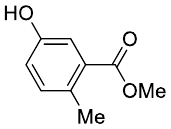
(b)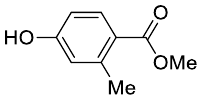
(c)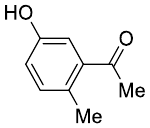
(d)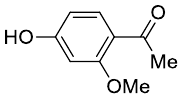
Answer
Answer: D ✓ checked by 4AB · confidence low
Explanation
ν 1680 cm⁻¹ (an aryl ketone hydrogen-bonded or para-OH) and the 7.8 d / 7.0 d / 6.5 s ring pattern fit a 4-hydroxy aryl methyl ketone that carries OMe: 1-(4-hydroxy-2-methoxyphenyl)ethanone (d). Methyl 4-hydroxy-2-methylbenzoate (b) is a close alternative.
Study loop for Organic Spectroscopy