Q101 · CSIR-NET Chemistry, December 2016
Paper: CSIR-NET December 2016 · Subject: Physical Chemistry · Chapter: Polymer Chemistry · Topic: Polymer Chemistry – General · Marks: 2 · Difficulty: Medium
Distribution of molar masses in a typical polymer sample is shown below 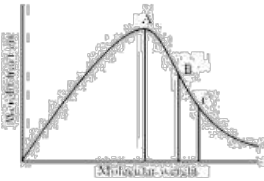 The A, B and C represent
The A, B and C represent(a)$\overline{\mathrm{M}}_{\mathrm{w}}, \overline{\mathrm{M}}_{\mathrm{v}}$ and $\overline{\mathrm{M}}_{\mathrm{n}}$ Respectively
(b)$\overline{\mathrm{M}}_{\mathrm{n}}, \overline{\mathrm{M}}_{\mathrm{v}}$ and $\overline{\mathrm{M}}_{\mathrm{w}}$ Respectively
(c)$\overline{\mathrm{M}}_{\mathrm{v}}, \overline{\mathrm{M}}_{\mathrm{w}}$ and $\overline{\mathrm{M}}_{\mathrm{n}}$ Respectively
(d)$\overline{\mathrm{M}}_{\mathrm{n}}, \overline{\mathrm{M}}_{\mathrm{w}}$ and $\overline{\mathrm{M}}_{\mathrm{v}}$ Respectively
Answer
Answer: B ✓ checked by 4AB · confidence high
Explanation
For a typical polydisperse polymer Mn < Mv < Mw, so along the molar-mass axis the markers A, B, C are Mn, Mv and Mw (b).
Study loop for Polymer Chemistry