Q25 · CSIR-NET Chemistry, December 2019
Paper: CSIR-NET December 2019 · Subject: Organic Chemistry · Chapter: Reagents, Reaction Mechanisms & Named Reactions · Topic: Named Reactions · Marks: 2 · Difficulty: Hard
The correct order of the reactions involved in the following transformation is: 
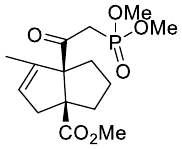
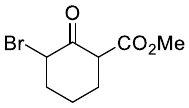
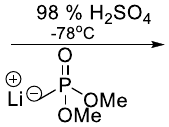
(a)Michael addition, Quasi-Favorskii rearrangement, Aldol Condensation
(b)Quasi-Favorskii rearrangement, Michael addition, Aldol Condensation
(c)Michael addition, Aldol Condensation, Quasi-Favorskii rearrangement
(d)Aldol Condensation, Quasi-Favorskii rearrangement, Michael addition
Answer
Answer: C ✓ checked by 4AB · confidence medium
Explanation
Step 1 – Michael addition: in 98% H₂SO₄ the β-keto ester (C-6, bearing CO₂Me) adds to methyl vinyl ketone, installing a 3-oxobutyl chain on C-6.
Step 2 – Aldol condensation: the methyl ketone of that chain condenses with C-2 (the α-bromo carbon, alpha to the ring C=O), closing a bridged cyclohexenone ring and making C-2 quaternary (C–Br, ring C=O, new C(Me)=C).
Step 3 – Quasi-Favorskii (semibenzilic) rearrangement: the lithiated dimethyl methylphosphonate adds to the ring ketone; the alkoxide pushes the C1–C6 bond onto C-2 and Br⁻ leaves. The six-membered ring contracts, C-6 becomes bonded to C-2, and C-1 leaves as the exocyclic C(=O)CH₂P(O)(OMe)₂. This gives the cis-fused bicyclo[3.3.0]octene shown.
Order: Michael addition → Aldol condensation → Quasi-Favorskii rearrangement. Answer: (c).
Study loop for Reagents, Reaction Mechanisms & Named Reactions