Q26 · CSIR-NET Chemistry, December 2019
Paper: CSIR-NET December 2019 · Subject: Organic Chemistry · Chapter: Reagents, Reaction Mechanisms & Named Reactions · Topic: Reagents, Reaction Mechanisms & Named Reactions – General · Marks: 2 · Difficulty: Medium
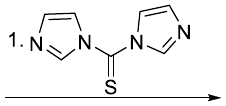
The major product A and the byproducts B formed in the following reaction are 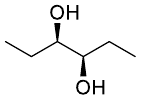


(a)
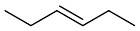 $\mathrm{B}=\mathrm{CO}_{2}, \mathrm{S}=\mathrm{P}(\mathrm{OMe})_{3}$
$\mathrm{B}=\mathrm{CO}_{2}, \mathrm{S}=\mathrm{P}(\mathrm{OMe})_{3}$(b)
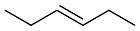 $\mathrm{B}=\mathrm{O}=\mathrm{C}=\mathrm{S}, \mathrm{S}=\mathrm{P}(\mathrm{OMe})_{3}$
$\mathrm{B}=\mathrm{O}=\mathrm{C}=\mathrm{S}, \mathrm{S}=\mathrm{P}(\mathrm{OMe})_{3}$(c)
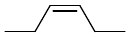 $\mathrm{B}=\mathrm{CO}_{2}, \mathrm{S}=\mathrm{P}(\mathrm{OMe})_{3}$
$\mathrm{B}=\mathrm{CO}_{2}, \mathrm{S}=\mathrm{P}(\mathrm{OMe})_{3}$(d)
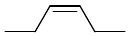 $\mathrm{B}=\mathrm{O}=\mathrm{C}=\mathrm{S}, \mathrm{S}=\mathrm{P}(\mathrm{OMe})_{3}$
$\mathrm{B}=\mathrm{O}=\mathrm{C}=\mathrm{S}, \mathrm{S}=\mathrm{P}(\mathrm{OMe})_{3}$Answer
Answer: A ✓ checked by 4AB · confidence high
The source book printed C; on checking, A is correct — see the explanation.
Both OH groups are drawn on wedges in the zigzag. CIP gives C-3 = R and C-4 = R, so this is the chiral (dl) diol, not meso. Corey–Winter syn-elimination of a dl-diol gives the E-alkene: (E)-hex-3-ene + CO₂ + S=P(OMe)₃ = (a), which matches the printed key A.
Explanation
Assign the diol: in the zigzag drawing both OH groups are on wedges. CIP gives C-3 = R and C-4 = R, so this is the chiral (3R,4R)-hexane-3,4-diol, not the meso isomer (meso would have one wedge and one dash).
Corey–Winter olefination: 1,1′-thiocarbonyldiimidazole converts the diol into a cyclic thionocarbonate. P(OMe)₃ removes the sulfur (as S=P(OMe)₃), and the resulting carbene/ylide fragments by a concerted syn-elimination that releases CO₂.
Syn-elimination is stereospecific: a dl (R,R) diol gives the trans alkene, and a meso diol would give the cis alkene. A = (E)-hex-3-ene; byproducts B = CO₂ and S=P(OMe)₃. Answer: (a).
Study loop for Reagents, Reaction Mechanisms & Named Reactions