Q13 · CSIR-NET Chemistry, June 2011
Paper: CSIR-NET June 2011 · Subject: Organic Chemistry · Chapter: General Organic Chemistry · Topic: Carbocation Stability · Marks: 2 · Difficulty: Medium
The relative rates of solvolysis of iodides A-C are 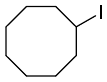
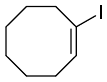
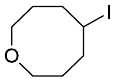
(a)C $>$ A $>$ B
(b)$\mathrm{C}>\mathrm{B}>\mathrm{A}$
(c)B $>$ C $>$ A
(d)B $>$ A $>$ C
Answer
Answer: A ✓ checked by 4AB · confidence medium
Explanation
The vinylic iodide B cannot ionise to a stabilised cation and is slowest. In the oxacyclooctyl iodide C the ring oxygen gives transannular (neighbouring-group) assistance, so C reacts faster than cyclooctyl iodide A: C > A > B (a).
Study loop for General Organic Chemistry