Q12 · CSIR-NET Chemistry, June 2012
Paper: CSIR-NET June 2012 · Subject: Organic Chemistry · Chapter: Reagents, Reaction Mechanisms & Named Reactions · Topic: Reagents, Reaction Mechanisms & Named Reactions – General · Marks: 2 · Difficulty: Medium
Under review — part of this question (a structure or an option) is not clear in the source scan. 4AB is checking it against the original book; the answer shown may change.
For the following two reactions A and B, the correct statement is: 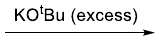
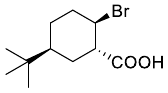

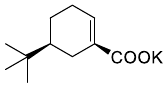
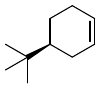
(a)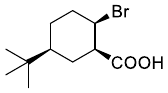


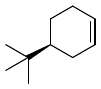
(b)
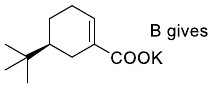
(c)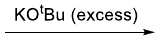
 Both A and B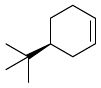
Both A and B (d)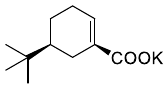 Both A and B
Both A and BAnswer
Under review — not yet confirmed.
Answer: B
Explanation
With t-Bu equatorial the bromine is axial in both isomers. In A the carboxylate is equatorial, so the axial C-4 H is anti-periplanar to Br and E2 gives the conjugated cyclohexene carboxylate; in B the carboxylate is axial and anti-periplanar to Br, so decarboxylative anti-elimination gives the simple cyclohexene (b).
Study loop for Reagents, Reaction Mechanisms & Named Reactions