Q15 · CSIR-NET Chemistry, June 2012
Paper: CSIR-NET June 2012 · Subject: Organic Chemistry · Chapter: Reagents, Reaction Mechanisms & Named Reactions · Topic: Reagents, Reaction Mechanisms & Named Reactions – General · Marks: 2 · Difficulty: Medium
The major products A and B in the following reaction sequence are 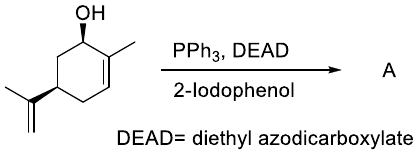


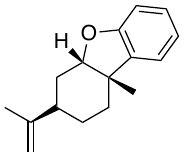



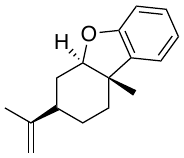

(a)
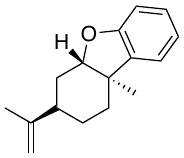
(b)
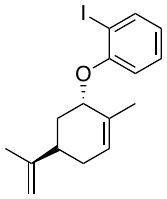
 A =
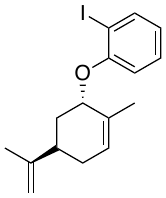
A =
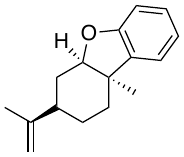
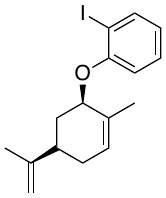
A =(c)
Answer
Answer: A ✓ checked by 4AB · confidence high
The source book printed B; on checking, A is correct — see the explanation.
Radical 5-exo cyclisation of the aryl ether gives a cis-fused hydrodibenzofuran, so the ring-fusion H and the angular Me must be cis (both wedged), as in (a). In (b) they are trans (H wedge, Me dashed). The original printed key was also A.
Explanation
Mitsunobu reaction (PPh₃, DEAD, 2-iodophenol) replaces the allylic OH with inversion, so in A the aryl ether is on the dashed bond, opposite to the original wedged OH; this rules out (c) and (d). Bu₃SnH/AIBN generates the aryl radical, which cyclises 5-exo-trig onto the ring C=C at the methyl-bearing carbon. The five-membered ring can only be fused cis: the new C–aryl bond forms on the same face as the C–O bond. So the ring-fusion H (on the O-bearing carbon) and the angular methyl are cis, both wedged, as in (a). In (b) the H is wedged and the Me dashed, which would be a trans-fused 5/6 system. Answer: (a)
Study loop for Reagents, Reaction Mechanisms & Named Reactions