Q16 · CSIR-NET Chemistry, June 2012
Paper: CSIR-NET June 2012 · Subject: Organic Chemistry · Chapter: Reagents, Reaction Mechanisms & Named Reactions · Topic: Named Reactions · Marks: 2 · Difficulty: Medium
The major product formed in the following reaction is: 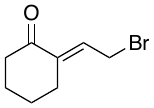
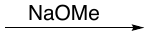
(a)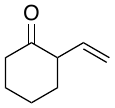
(b)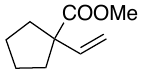
(c)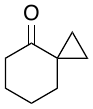
(d)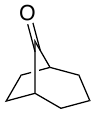
Answer
Answer: B ✓ checked by 4AB · confidence high
Key (b) confirmed. The old explanation mixed two mechanisms ('methoxide adds to the carbonyl' leading to a 'cyclopropanone-type' intermediate). The pathway that gives (b) is the semibenzilic (quasi-Favorskii) migration, which has no cyclopropanone.
Explanation
Methoxide adds to the ketone C=O, giving a tetrahedral alkoxide at C-1. The alkoxide re-forms the C=O while the C-1–C-6 ring bond migrates to C-2. At the same time the exocyclic C=C shifts outward and bromide leaves from the CH₂Br end (S_N2′-type). This is a vinylogous quasi-Favorskii (semibenzilic) ring contraction; no cyclopropanone is involved. C-2 now carries both the CO₂Me group and a vinyl group in a five-membered ring: methyl 1-vinylcyclopentane-1-carboxylate (b). Answer: (b)
Study loop for Reagents, Reaction Mechanisms & Named Reactions