Q11 · CSIR-NET Chemistry, June 2017
Paper: CSIR-NET June 2017 · Subject: Organic Chemistry · Chapter: Reagents, Reaction Mechanisms & Named Reactions · Topic: Reagents, Reaction Mechanisms & Named Reactions – General · Marks: 2 · Difficulty: Medium
The correct combination of reagents A and B to effect the following transformations are 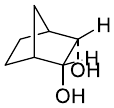 <- B <-
  -- A -->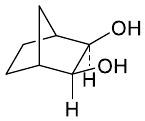
<- B <- -- A --> (a)A = cat.OsO4, NMO B = i) $\mathrm{I_{2}}$, PhCO2Ag ii) aq.NaOH
(b)A = alkaline $\mathrm{KMnO_{4}}$ B = i) $\mathrm{I_{2}}$, PhCO2Ag, $\mathrm{H_{2}O}$ ii) aq.NaOH
(c)A = i) $\mathrm{I_{2}}$, PhCO2Ag ii) aq.NaOH B = cat $\mathrm{OsO_{4}}$, TMEDA, NMO
(d)A = m-CPBA, ii) aq.NaOH B = alkaline $\mathrm{KMnO_{4}}$
Answer
Answer (as printed): B
Explanation
Transformation A gives the cis-exo-2,3-diol (both OH on the exo face). Cold alkaline KMnO₄ is a syn dihydroxylation and attacks norbornene from the less hindered exo face.
Transformation B gives the cis-endo diol. Under Woodward conditions (I₂, PhCO₂Ag with H₂O, then aq. NaOH), iodine adds to the exo face. Neighbouring-group participation by the benzoate through a dioxolanium ion places oxygen on the endo face, water traps it as the cis-hydroxy benzoate, and NaOH hydrolyses the ester to the cis-endo diol.
Why the others fail: (a) Prévost conditions without water give a trans diol; (c) puts a trans diol for A and OsO₄ gives the exo, not endo, diol for B; (d) m-CPBA then NaOH gives a trans diol for A. Answer: (b).
Study loop for Reagents, Reaction Mechanisms & Named Reactions