Electrolysis products of aqueous sodium hydroxide — CSIR NET 2013 PYQ solved
This question tests your ability to predict electrolytic products in aqueous media.
You will learn how competitive electrode reactions govern which species discharge during electrolysis.
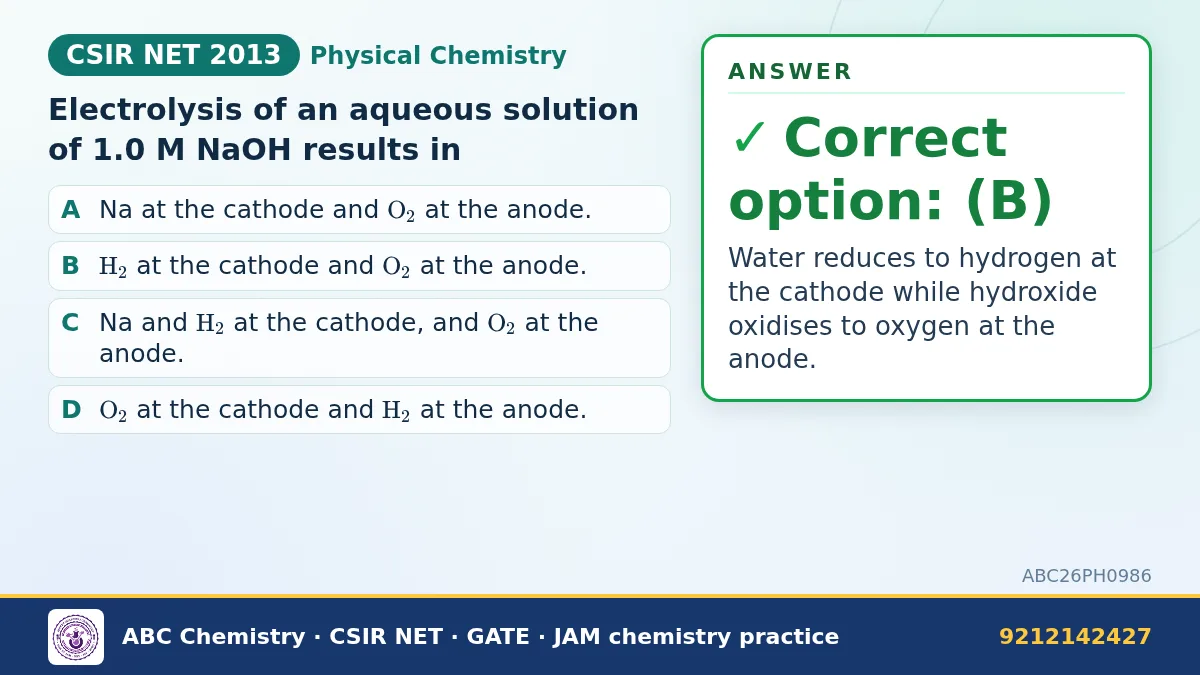
Correct option: (B) — H₂ at the cathode and O₂ at the anode.
What selective discharge during aqueous electrolysis is
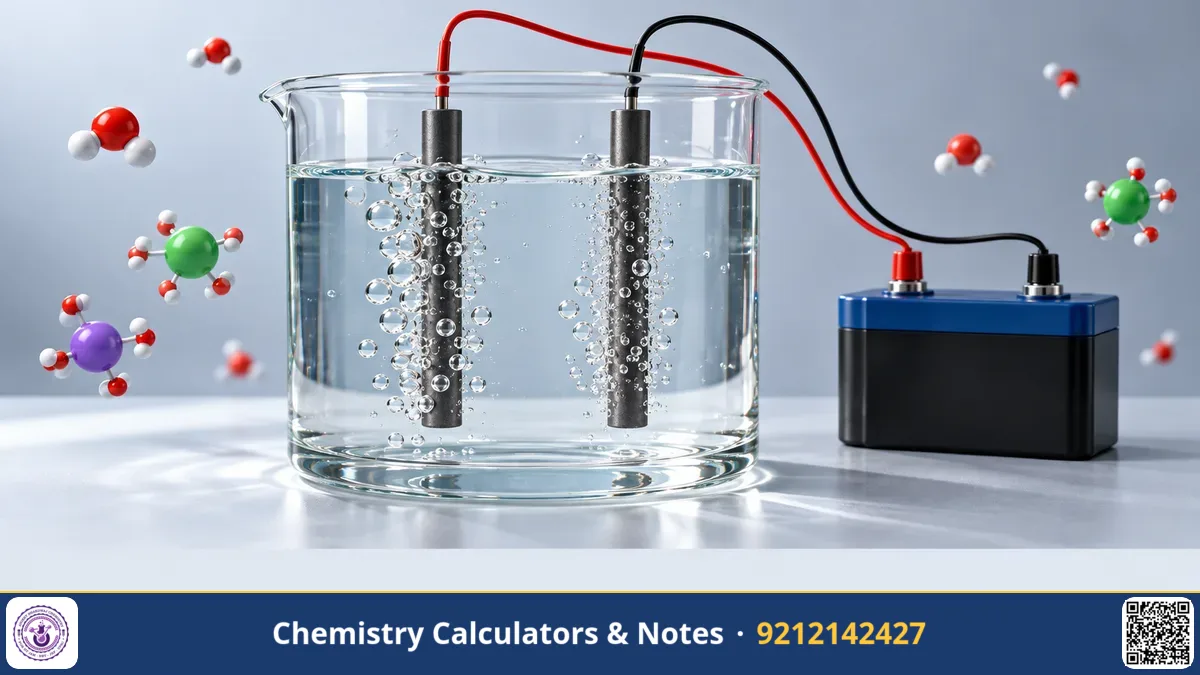
Electrolysis uses electrical energy to drive a non-spontaneous redox reaction via two conductive electrodes.
An aqueous electrolyte contains dissolved solute ions and water molecules. Under an applied voltage, ions migrate toward the charged electrodes. Selective discharge dictates which species gains electrons at the cathode and which loses electrons at the anode.
The electrode interface favors the pathway requiring the lowest electrical energy. At the cathode, the species with the greater reduction tendency accepts electrons first. At the anode, the species that oxidises most readily releases electrons first. Unreacted ions remain in solution as spectators to maintain electrical neutrality.
How it works
In 1.0 M aqueous sodium hydroxide, the solute dissociates completely into sodium cations and hydroxide anions:
NaOH(aq) → Na+(aq) + OH−(aq)
Water also self-ionizes:
H2O(l) ⇌ H+(aq) + OH−(aq)
At the negative cathode, reduction occurs. Two pathways compete for incoming electrons:
Na+(aq) + e− → Na(s)
2H2O(l) + 2e− → H2(g) + 2OH−(aq)
Sodium ions have an extremely negative reduction potential compared to water. Water molecules accept electrons far more readily, evolving hydrogen gas at the cathode.
At the positive anode, oxidation occurs. Hydroxide ions surrender electrons:
4OH−(aq) → O2(g) + 2H2O(l) + 4e−
With 1.0 M hydroxide available, this oxidation proceeds readily to release oxygen gas at the anode.
Multiplying the cathode reaction by 2 balances electron transfer with the anode, giving the net cell process:
2H2O(l) → 2H2(g) + O2(g)
The net outcome is the decomposition of water into hydrogen and oxygen gases. Sodium and hydroxide ions serve as non-consumed charge carriers.
Why it behaves this way
The selectivity of aqueous electrolysis depends on thermodynamic driving forces and kinetic barriers.
Sodium atoms lose their valence electron readily, so sodium cations hold electrons weakly. Forcing sodium ions to accept electrons in water requires an extremely negative potential. Water reduces at a far less negative potential, dominating the cathode.
Furthermore, metallic sodium cannot persist in water. Any sodium metal formed reacts immediately with water to regenerate sodium ions and release hydrogen gas.
This preference holds on common inert electrodes like platinum, nickel, or carbon. A mercury cathode creates a large overpotential for hydrogen evolution, allowing sodium to discharge as an amalgam. On standard inert surfaces, hydrogen evolution proceeds without hindrance.
Where the idea comes from
The concept of selective discharge arose from early studies using Faraday's laws of electrolysis. Passing current through salt solutions revealed a sharp divide between metals.
Solutions of copper or silver salts deposited pure metal at the cathode. In contrast, solutions of sodium or potassium salts yielded no metal, producing only hydrogen gas at the cathode and oxygen gas at the anode.
These observations proved that the solvent acts as an electroactive reactant rather than a passive medium. This established the electrochemical series, ordering half-reactions by relative reduction tendencies.
Where it is used
Selective discharge governs major industrial and laboratory processes.
Commercial alkaline water electrolyzers use concentrated sodium hydroxide solutions to generate pure hydrogen for clean energy. The dissolved base provides high conductivity while remaining unconsumed.
In the chlor-alkali industry, membrane cells use selective discharge to generate chlorine at the anode and hydrogen at the cathode from aqueous sodium chloride.
In metal extraction, selective discharge explains why electropositive metals like sodium cannot be plated from water. Their extraction requires molten salt baths free of water.
A fresh worked example
An electrolytic cell containing an alkaline solution operates under a steady current of 2 A for 9650 seconds. Find the moles of hydrogen gas evolved at the cathode and oxygen gas evolved at the anode.
Step 1: Calculate the charge passed through the cell.
Charge = current × time = 2 A × 9650 s = 19300 C
Step 2: Calculate moles of electrons transferred using Faraday's constant of 96500 C mol−1.
Moles of electrons = 19300 C / 96500 C mol−1 = 0.2 mol
Step 3: Calculate moles of hydrogen gas formed at the cathode.
Cathode reaction: 2H2O + 2e− → H2 + 2OH−.
Since 2 moles of electrons yield 1 mole of H2:
Moles of H2 = 0.2 mol / 2 = 0.1 mol
Step 4: Calculate moles of oxygen gas formed at the anode.
Anode reaction: 4OH− → O2 + 2H2O + 4e−.
Since 4 moles of electrons yield 1 mole of O2:
Moles of O2 = 0.2 mol / 4 = 0.05 mol
Step 5: Determine the gas molar ratio.
Ratio of H2 to O2 = 0.1 mol / 0.05 mol = 2 : 1
The cathode yields 0.1 mol of hydrogen gas and the anode yields 0.05 mol of oxygen gas, confirming the 2 : 1 ratio of water splitting.
Solving the question step by step
- Identify species in the electrolyte: The 1.0 M aqueous sodium hydroxide solution contains sodium cations (Na+), hydroxide anions (OH−), and water molecules (H2O).
- Identify possible cathode reactions: Cations and neutral molecules migrate to the cathode. The competing reductions are sodium ions forming sodium metal and water molecules forming hydrogen gas.
- Select the favored cathode product: Water reduces at a far less negative potential than sodium ions. Water reduces preferentially, evolving hydrogen gas (H2) at the cathode.
- Identify the favored anode product: Hydroxide ions (OH−) migrate to the anode and oxidise readily to form oxygen gas (O2) and water.
- Establish overall products: The cathode evolves H2 gas and the anode evolves O2 gas.
- Match with the options: This combination corresponds to option (b).
Why the other options fail
Option (a) fails because it assumes sodium ions discharge as metallic sodium. Water reduces far more easily than sodium cations, preventing metal deposition.
Option (c) fails because it suggests simultaneous discharge of sodium ions and water. With its vastly more negative reduction potential, sodium remains in solution as spectator ions.
Option (d) fails because it reverses the two electrodes, placing oxidation at the cathode and reduction at the anode.
| Option | Cathode product | Anode product | Validity | Reason for failure |
|---|---|---|---|---|
| (a) | Na | O2 | Incorrect | Sodium ions cannot reduce before water in aqueous media. |
| (b) | H2 | O2 | Correct | Water reduces at the cathode and hydroxide oxidises at the anode. |
| (c) | Na and H2 | O2 | Incorrect | Sodium ions do not co-discharge alongside water. |
| (d) | O2 | H2 | Incorrect | Inverts reduction and oxidation sites across the two electrodes. |
Common mistake
A frequent mistake is treating aqueous sodium hydroxide as a molten salt. In molten sodium hydroxide, no water exists, so sodium cations accept electrons to form sodium metal. In aqueous solution, water molecules are abundant and reduce far more readily than sodium cations. Students often overlook the solvent as an active reactant, mistakenly predicting solid sodium deposition.
Key takeaways
- Aqueous electrolysis involves competition between dissolved ions and water molecules at both electrodes.
- Alkali metal cations remain in solution because water reduces preferentially to form hydrogen gas.
- In basic solutions, hydroxide ions discharge at the anode to produce oxygen gas and water.
- Electrolysis of aqueous sodium hydroxide results in the net decomposition of water into hydrogen and oxygen gases.
Frequently asked questions
How is selective discharge tested in CSIR NET?
In CSIR NET 2013 and related sessions, questions test whether students can predict electrode products in aqueous solutions versus molten salts. The exam evaluates your ability to compare reduction tendencies, identify spectator ions, and recognize when water participates directly in electrode processes.
Why cannot sodium metal be obtained from aqueous solutions?
Sodium ions possess an exceptionally negative reduction potential compared to water. When voltage is applied, water molecules accept electrons at the cathode long before sodium ions can discharge. Any sodium metal that formed transiently would instantly react with water to regenerate sodium ions and release hydrogen gas.
What is the role of sodium hydroxide if it is not consumed?
Pure water conducts electricity poorly due to low auto-ionization. Dissolving 1.0 M sodium hydroxide provides abundant mobile sodium and hydroxide ions. These ions transport charge through the solution between electrodes, lowering resistance and allowing efficient electrolytic splitting of water at practical cell voltages.
Related previous-year questions
- For an aqueous solution at 25ºC, the Debye-Huckel limiting law is given by CSIR NET
- The temperature-dependence of an electrochemical cell potential is ∆€ CSIR NET
- Debey-Hückel screening length (𝜅 −1 ) is a measure of size of diffuse ion cloud around an ion, provided −1 2𝑒… CSIR NET
- If the ratio of composition of oxidized and reduced species in electrochemical cell, is given as = 𝑒 2 the… CSIR NET
- Question record ABC26PH0986 with the original answer
- All electrochemistry previous-year questions
- CSIR NET previous-year question papers
- Is this in the syllabus? Chemistry syllabus tool
Practise this chapter. Solve more electrochemistry previous-year questions with answers, free.
All electrochemistry questions →