Mole concept MCQs: 5 questions on Avogadro's number and molar mass
This post gives you five MCQs on the mole concept, each with a worked answer.
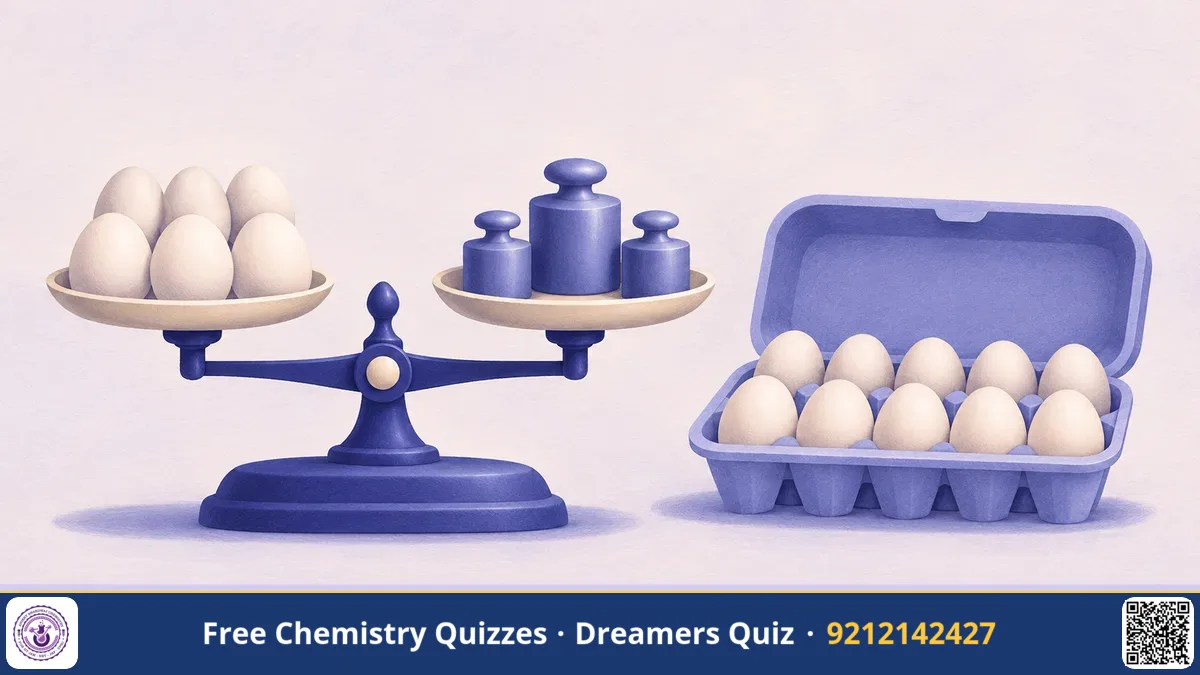
Try each question first, then read the steps and see where you slipped.
The three links you must remember
A mole is a counting unit, like a dozen. A dozen means twelve items. A mole means 6.022 × 10²³ items. This number is Avogadro's number, written NA. The items can be atoms, molecules or ions.
Molar mass is the mass of one mole of a substance, in grams per mole (g/mol). You get it by adding the atomic masses of all the atoms in the formula. Take the atomic masses from the table given in your paper or your NCERT book. This post keeps the steps in symbols, so you can practise the method with any table.
Two relations carry the whole chapter:
- Moles = given mass ÷ molar mass
- Number of particles = moles × NA
If a question gives mass and asks for particles, go mass → moles → particles. Do not skip the middle step. Students who jump directly usually make a slip in the power of ten.
What to do for each type of question
Before you solve, decide what the question wants. This table shows the usual types and the first step for each.
| Question gives | Question asks | First step |
|---|---|---|
| Mass | Moles | Divide by molar mass |
| Moles | Mass | Multiply by molar mass |
| Moles | Molecules | Multiply by NA |
| Molecules | Atoms | Multiply by atoms in one molecule |
| Equal masses | Which has more particles | Compare molar masses |
Write this row on your rough sheet before you touch the numbers. It takes five seconds and saves marks.
Question 1: atoms in one mole of oxygen gas
How many oxygen atoms are present in one mole of oxygen gas (O2)?
- NA
- 2 NA
- 3 NA
- NA ÷ 2
Answer: option 2.
One mole of O2 has NA molecules.
Each molecule has two atoms.
Atoms = 2 × NA.
Trap: option 1 is the number of molecules. Oxygen, hydrogen and nitrogen gases exist as two-atom molecules, so atoms are double the molecules.
Question 2: mass of one mole of carbon atoms
The atomic mass of carbon-12 is defined as 12 u. What is the mass of one mole of carbon-12 atoms?
- 1 g
- 12 g
- 12 u
- 6.022 × 10²³ g
Answer: option 2.
The molar mass in g/mol has the same number as the atomic mass in u. So one mole of carbon-12 atoms weighs 12 g.
Trap: option 3 is the mass of a single atom, expressed in atomic mass units. A mole is a large collection, so its mass is in grams. Watch the unit, not just the number.
Question 3: moles when mass is a multiple of molar mass
A sample has a mass equal to twice the molar mass of the substance. How many moles does it contain?
- Half a mole
- 1 mol
- 2 mol
- 4 mol
Answer: option 3.
Moles = mass ÷ molar mass.
Here mass = 2 × molar mass, so moles = (2 × molar mass) ÷ molar mass = 2.
Check: the units work out. Grams divided by grams per mole gives moles. If your units do not give moles, your formula is upside down.
Question 4: atoms in half a mole of water
How many atoms are present in half a mole of water (H2O)?
- NA ÷ 2
- NA
- 3 NA ÷ 2
- 3 NA
Answer: option 3.
Molecules in half a mole = NA ÷ 2.
Each water molecule has three atoms: two of hydrogen and one of oxygen.
Atoms = 3 × (NA ÷ 2) = 3 NA ÷ 2.
Trap: option 1 is the number of molecules. When the question says "atoms", multiply by the atoms in one molecule. When it says "molecules", stop earlier.
Question 5: which sample has more molecules
Equal masses of gas A and gas B are taken. The molar mass of A is half the molar mass of B. Which statement is correct?
- A has half as many molecules as B
- A and B have the same number of molecules
- A has twice as many molecules as B
- A has four times as many molecules as B
Answer: option 3.
Number of molecules is proportional to moles. For the same mass, moles = mass ÷ molar mass.
A has half the molar mass, so it gives twice the moles. Twice the moles means twice the molecules.
Trap: option 2 is true only for equal moles, not equal mass. A light substance packs more particles into the same mass.
Mistakes to avoid in mole MCQs
- Mixing atoms and molecules. Underline the word "atoms" or "molecules" in the question before you start.
- Wrong molar mass. Write the formula, count each atom, then add. For example, molar mass of H2O = 2 × (atomic mass of H) + (atomic mass of O). Do this on paper even if it feels slow.
- Dividing when you should multiply. Moles come from mass ÷ molar mass. Mass comes from moles × molar mass. Say the units aloud to check.
- Power-of-ten errors. Keep the answer in the form a × 10n. Multiply the numbers first, then fix the power.
- Skipping the sense check. Half a mole should give half of NA. If your answer is far from that, recheck.
How to practise after reading this
Cover the answers and solve all five again on rough paper tomorrow. Time yourself. Then try more questions on the Dreamers Quiz portal. On the chemistry quiz page, you pick a class or exam, attempt the set against the clock, then see your score and the answer key. You can attempt as many times as you like.
Use it for chapter revision before a school test, a quick check after a class, or speed practice for the NEET and CUET MCQ sections. After each attempt, note which step went wrong: molar mass, mole conversion or the final multiplication. Fix that one step before the next attempt.
Key takeaways
- One mole has 6.022 × 10²³ particles, and its mass in grams is the molar mass.
- Moles = mass ÷ molar mass; particles = moles × NA.
- Read whether the question asks for molecules or atoms before you calculate.
- For equal masses, the substance with the smaller molar mass has more molecules.
- Check every answer with a simple fraction, such as half a mole giving half of NA.
Frequently asked questions
What is Avogadro's number?
It is 6.022 × 10²³, the number of particles in one mole of any substance. The particles may be atoms, molecules or ions.
What is the difference between molar mass and molecular mass?
Molecular mass is the mass of one molecule, in atomic mass units (u). Molar mass is the mass of one mole of the substance, in g/mol. The number is the same for both, but the units differ.
Why do one mole of water and one mole of carbon dioxide have the same number of molecules?
One mole of any substance has NA particles. The masses differ because the molar masses differ, but the count is the same.
Should I use 6.022 × 10²³ or a rounded value in exams?
Follow the value given in your question paper or your teacher's instruction. If nothing is stated, use 6.022 × 10²³ and keep the same value throughout your answer.
Can I use these steps for ionic compounds like sodium chloride?
Yes. Add the atomic masses in the formula unit to get the molar mass, then use the same two relations. The particles you count are formula units rather than molecules.
What to do next. Try it yourself on the page below.
Chemistry Quiz — Free Timed Chemistry Quizzes →