Aldehydes and Ketones Class 12: Addition Reactions, Dwarka
This guide explains nucleophilic addition in Class 12 aldehydes and ketones for CBSE board preparation. Parents and students in Dwarka and Gurugram will learn core mechanisms, tests, conversions, and a home study routine.
Why nucleophilic addition confuses Class 12 chemistry students
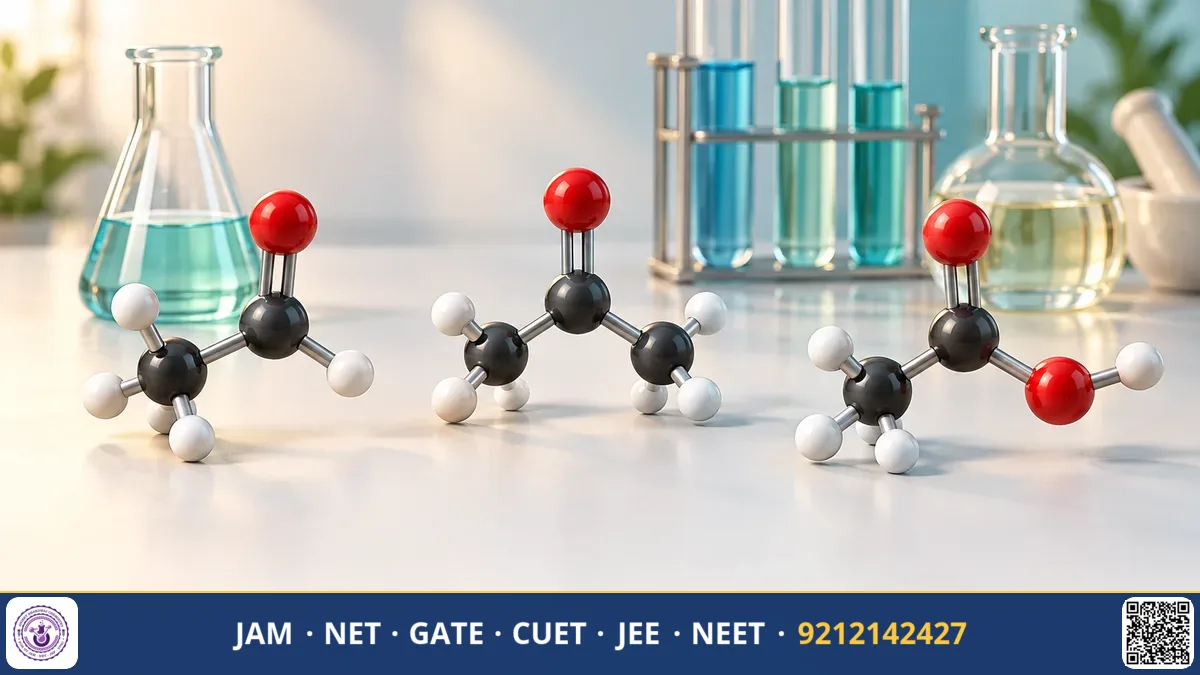
The carbonyl group contains a carbon atom double-bonded to an oxygen atom. Oxygen is more electronegative than carbon, pulling bonding electrons toward itself. This unequal sharing creates a permanent dipole across the bond. Oxygen carries a partial negative charge, while carbon carries a partial positive charge. Lacking electron density, this carbon acts as an electrophile, meaning an electron-seeking centre that invites attack from electron-rich species.
In Class 11, students studied alkenes, where an electron-rich carbon-carbon double bond undergoes electrophilic addition. In Class 12, students often confuse these mechanisms. The carbon-oxygen double bond behaves differently. An electron-rich species, called a nucleophile, attacks the electron-deficient carbonyl carbon first. This process is nucleophilic addition.
Students also struggle with relative reactivity. Aldehydes contain a hydrogen atom on the carbonyl carbon, whereas ketones contain two alkyl groups. Alkyl groups release electrons through an inductive effect, reducing the positive charge on carbon. Two bulky alkyl groups also create steric hindrance, which is physical crowding that impedes an incoming nucleophile. Aldehydes face less crowding and retain a stronger positive charge, making them more reactive than ketones. Benzaldehyde reacts more slowly than aliphatic aldehydes because resonance delocalises electron density into the ring.
Step-by-step mechanism and primary addition reagents
The addition mechanism proceeds in two stages. The starting carbonyl carbon is sp2 hybridised with a planar geometry. A nucleophile attacks this carbon perpendicularly to the plane, breaking the pi bond and transferring both electrons to oxygen.
The carbon shifts to tetrahedral sp3 hybridisation, forming an alkoxide intermediate with a negatively charged oxygen. The alkoxide oxygen then captures a proton from the medium, producing a neutral addition compound.
The NCERT chemistry syllabus tests four primary addition reagents:
- Hydrogen cyanide: Base generates cyanide ions, which attack the carbonyl carbon to form a cyanohydrin containing hydroxyl and nitrile groups on the same carbon.
- Sodium hydrogen sulphite: Saturated aqueous sodium hydrogen sulphite adds across aldehydes and methyl ketones to form crystalline bisulphite addition compounds, used to separate and purify carbonyl compounds.
- Organomagnesium halides: Organometallic reagents supply an alkyl carbanion equivalent. Addition followed by hydrolysis yields an alcohol: methanal gives primary alcohols, other aldehydes give secondary alcohols, and ketones give tertiary alcohols.
- Alcohols: Aldehydes react with dry alcohol in hydrogen chloride gas to form hemiacetals and acetals. Ketones react with ethylene glycol to yield cyclic ketals.
Connecting addition reactions to qualitative tests and board conversions
In CBSE examinations, questions link addition mechanisms to qualitative tests and conversions. Reagents derived from ammonia add across the carbonyl double bond through their basic nitrogen atom. The intermediate eliminates water to form a stable carbon-nitrogen double bond, producing crystalline derivatives like oximes and hydrazones.
These crystalline derivatives confirm the presence of a carbonyl group. To distinguish aldehydes from ketones, students use mild oxidising reagents. Aldehydes contain a carbonyl hydrogen, reducing ammoniacal silver nitrate solution to form a silver mirror coating. Aldehydes also reduce alkaline copper sulphate solution to form a red cuprous oxide precipitate. Ketones lack this oxidisable hydrogen and fail both tests.
| Reagent | Nucleophile | Substrate | Product | Practical board application |
|---|---|---|---|---|
| Hydrogen cyanide with base | Cyanide ion | Ethanal | Ethanal cyanohydrin | Extending the carbon chain by one carbon atom |
| Sodium hydrogen sulphite | Bisulphite ion | Aldehydes, methyl ketones | Bisulphite adduct | Separation and chemical purification |
| Methylmagnesium halide | Methyl carbanion equivalent | Methanal | Ethanol | Synthesising primary alcohols in conversions |
| Ethylene glycol with dry acid | Diol oxygen lone pairs | Propanone | Cyclic ketal | Protecting carbonyl groups during reduction steps |
| Hydrazine derivatives | Substituted nitrogen nucleophile | Aldehydes and ketones | Coloured hydrazone derivative | Qualitative confirmation of carbonyl group |
Worked conversion example: Convert ethanal into 2-hydroxypropanoic acid (lactic acid).
- Step 1: Addition of hydrogen cyanide. Treat ethanal with hydrogen cyanide and base to form ethanal cyanohydrin.
- Step 2: Acidic hydrolysis of the nitrile group. Heat ethanal cyanohydrin with dilute mineral acid to convert the nitrile group into a carboxylic acid group, producing 2-hydroxypropanoic acid.
How one-to-one home tuition in Dwarka resolves student hurdles
Class 12 students in Dwarka and nearby areas like Janakpuri or Sector 10 Dwarka manage demanding schedules. Commuting between schools in South West Delhi and crowded coaching institutes causes fatigue. In large batches, teachers write mechanisms quickly on boards without inspecting each student's notebook.
Organic chemistry requires active pencil-and-paper practice. If a student draws a curved arrow incorrectly, forgets formal charges, or omits reagents, examiners deduct marks. One-to-one home tuition provides direct observation where these errors are resolved immediately.
Parents can request a tutor through Great Home Tutors by selecting Class 12, CBSE board, Chemistry, and their locality, including Sector 6 Dwarka, Sector 10 Dwarka, Janakpuri, or Sector 108 to Sector 113 in Gurugram. Tutors checked by Great Home Tutors carry a Verified mark, confirming their identity, qualification, and teaching abilities have been reviewed. Experienced teachers like Aniket Bhardwaj, who teaches chemistry in Dwarka, walk students through NCERT pathways step by step. A first class at home allows parents and students to evaluate the teaching fit before setting a long-term plan.
A practical weekly study routine for chemistry students
Mastering Class 12 organic chemistry requires a disciplined weekly schedule:
- Monday and Tuesday: Read the NCERT section on aldehydes and ketones. Draw nucleophilic attack pathways and tetrahedral intermediates from memory.
- Wednesday and Thursday: Build reaction flowcharts linking carbonyls to alcohols and acids. Complete conversions using cyanohydrins and organomagnesium reagents.
- Friday: Solve past CBSE question papers on addition reactions and distinction tests like the silver mirror test.
- Saturday: Review difficult mechanisms with your home tutor. Take a timed written test and receive feedback on arrow notation.
- Sunday: Spend thirty minutes reviewing reagent conditions, colour changes in test tubes, and systematic chemical nomenclature.
Key takeaways
- Nucleophilic addition occurs at the carbonyl carbon due to the strong electronegativity difference across the carbon-oxygen double bond.
- Aldehydes react faster than ketones because of reduced steric hindrance and weaker electron-donating inductive effects.
- Cyanohydrin and organomagnesium reactions extend carbon chains, whereas bisulphite and hydrazine derivatives serve as practical identification tools.
- One-to-one home tuition in Dwarka and Gurugram provides individualized feedback on mechanisms, helping students eliminate careless errors before board exams.
Frequently asked questions
Why do aldehydes react faster than ketones in nucleophilic addition reactions?
Aldehydes have only one alkyl group attached to the carbonyl carbon, whereas ketones have two. Alkyl groups release electrons through inductive effects, diminishing the positive charge on carbon. Two alkyl groups also create steric hindrance, making it harder for an attacking nucleophile to approach.
How does the addition of sodium hydrogen sulphite help in laboratory purification?
When treated with saturated sodium hydrogen sulphite, aldehydes and methyl ketones form solid crystalline bisulphite addition compounds. Non-carbonyl impurities do not react and can be washed away. Treating the purified solid with dilute acid or alkali regenerates the pure carbonyl compound.
How can parents in Dwarka arrange verified home tuition through Great Home Tutors?
Parents can submit a request on Great Home Tutors by selecting Class 12, CBSE board, Chemistry, and their locality, such as Dwarka or Gurugram. Great Home Tutors matches an educator who has been checked for identity, qualification, and teaching ability, starting with a first class at home before regular sessions are arranged.
What to do next. Try it yourself on the page below.
Great Home Tutors — home tuition at your home · 4AB →