Amines Class 12: Basicity Order and Conversions, Gurugram
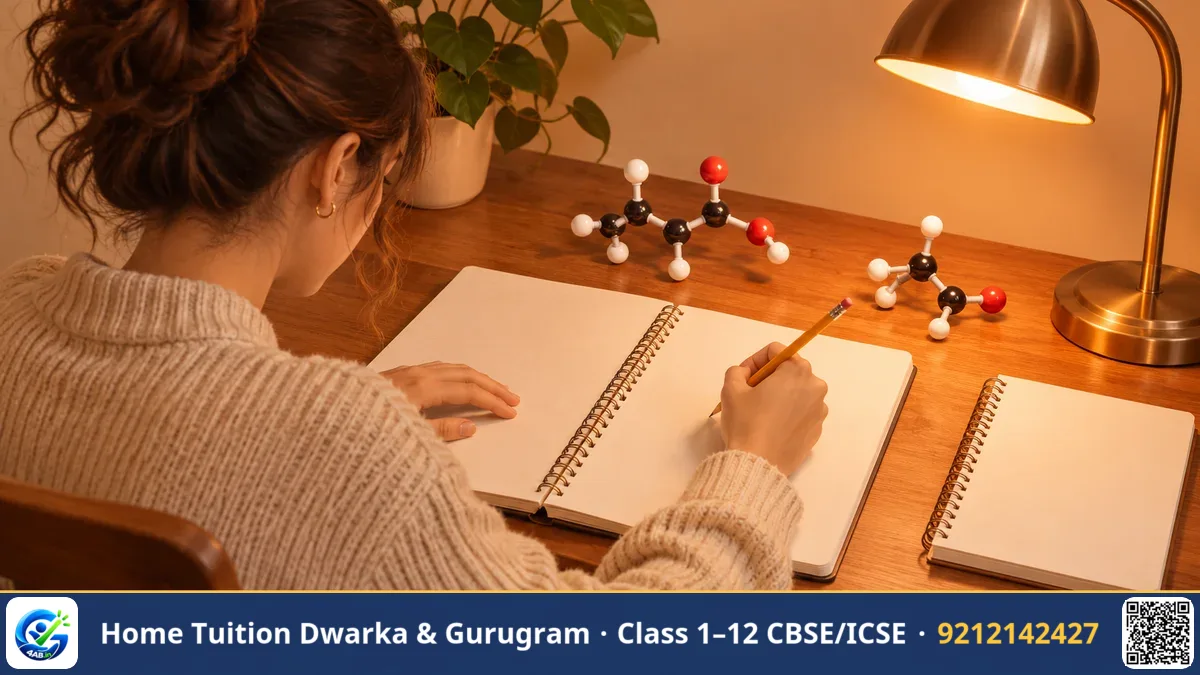
This guide explains how Class 12 chemistry students master basicity trends and multi-step conversions in the amines chapter. Parents in Gurugram will discover where syllabus marks are lost and how home tuition builds exam confidence.
Why amines confuse class 12 students in Gurugram
Amines are organic compounds derived from ammonia (NH3) by replacing hydrogen atoms with alkyl or aryl groups. In the Class 12 CBSE chemistry syllabus, amines form a vital part of organic chemistry. Many students across Gurugram, including Sector 108, Sector 109, and Sector 112, find this chapter challenging.
The main difficulty is that basicity does not follow a single linear pattern. In water, basicity results from three competing factors operating at once. Students who memorise sequences without understanding these interactions lose marks on board exam reasoning questions.
Organic conversions create equal difficulty. A conversion is a chemical reaction sequence used to transform a starting compound into a target molecule. Board questions require altering carbon chain lengths and handling functional groups. Without step-by-step guidance, students hesitate during exams and make avoidable synthetic errors.
Understanding basicity order in aqueous solutions
Basicity refers to the tendency of nitrogen to donate its unshared electron pair (lone pair) to a proton (H+). The more available the lone pair and the more stable the resulting cation, the stronger the base.
In the gas phase, basicity follows an expected order: tertiary (3°) > secondary (2°) > primary (1°) > ammonia (NH3). Alkyl groups release electron density toward nitrogen through the inductive effect (+I effect), increasing lone pair availability.
In aqueous solution, three distinct factors interact simultaneously:
- Inductive effect: Alkyl groups push electron density toward nitrogen, stabilizing the cation: 3° > 2° > 1° > NH3.
- Solvation effect: Water molecules stabilize ions through hydrogen bonding. Primary ammonium cations form three hydrogen bonds, while tertiary cations form only one. Hydration energy favours: 1° > 2° > 3°.
- Steric hindrance: Bulky alkyl groups crowd the nitrogen atom, obstructing incoming protons and water molecules: 1° > 2° > 3°.
The secondary amine balances these three forces and is always the strongest base in water. The size of the alkyl group determines whether the primary or tertiary amine takes second place.
| Condition or Group | Basicity Order | Governing Mechanism |
|---|---|---|
| Gas phase (any alkyl) | 3° > 2° > 1° > NH3 | Inductive effect (+I) dominates |
| Ethyl group in water | (C2H5)2NH > (C2H5)3N > C2H5NH2 > NH3 | Combined balance: 2° > 3° > 1° > NH3 |
| Methyl group in water | (CH3)2NH > CH3NH2 > (CH3)3N > NH3 | Combined balance: 2° > 1° > 3° > NH3 |
| Aniline in water | Aliphatic amines > NH3 > C6H5NH2 | Resonance delocalisation into benzene ring |
Aromatic amines like aniline (C6H5NH2) are weaker bases than aliphatic amines and ammonia. The lone pair on nitrogen is delocalised over the benzene ring through resonance, making it less available for protonation.
Roadmaps for multi-step organic conversions
To master conversions, students must understand two fundamental transformations: altering carbon chain length and converting functional groups.
When an exam problem requires ascending the carbon series (adding a carbon atom), students introduce a nitrile group (-CN). Treating an alkyl halide with potassium cyanide (KCN) adds one carbon. Reducing the resulting nitrile with lithium aluminium hydride (LiAlH4) yields a primary amine with an increased chain length.
When descending the carbon series (removing a carbon atom), students apply the bromamide degradation reaction. An acid amide reacts with bromine (Br2) and aqueous sodium hydroxide (NaOH) to produce a primary amine with one fewer carbon atom.
Worked conversion 1: Converting chloromethane to ethanamine (stepping up)
- React chloromethane (CH3Cl) with ethanolic potassium cyanide (KCN) to obtain ethanenitrile (CH3CN).
- Reduce ethanenitrile using lithium aluminium hydride (LiAlH4) to yield ethanamine (CH3CH2NH2).
Worked conversion 2: Converting ethanoic acid to methanamine (stepping down)
- Treat ethanoic acid with thionyl chloride (SOCl2) and ammonia (NH3) to form ethanamide.
- Heat ethanamide with bromine (Br2) and aqueous sodium hydroxide (NaOH) to obtain methanamine (CH3NH2).
How a home tutor builds a weekly revision routine
Class 12 students in Gurugram sectors such as Sector 110, Sector 111, and Sector 113 face demanding school schedules. Commuting to crowded coaching centres leaves little energy for self-study. In large batches, a student who hesitates to clarify doubts falls behind.
One-to-one home tuition eliminates travel exhaustion and replaces passive listening with active problem-solving. Aniket Bhardwaj, a verified chemistry tutor, recommends establishing a focused weekly study plan:
- Schedule dedicated chemistry sessions: Dedicate the first session to conceptual reasoning. Dedicate the second session entirely to written conversion chains.
- Maintain a reaction notebook: Require the student to write every conversion step with full reaction conditions, aligning with the NCERT textbook.
- Conduct verbal explanation checks: A tutor asks the student to justify reagent choices aloud to solidify chemical logic.
- Solve past board questions: Practice conversion problems weekly to build speed and accuracy.
Great Home Tutors connects families with verified home tutors for Class 12 CBSE chemistry across Gurugram and Dwarka. You can select your class, subject, board, and locality, including Sector 108 or Sector 109. A representative calls back to discuss requirements, and a first class at home allows you to evaluate the teaching fit before continuing.
Key takeaways
- Basicity in water is governed by inductive effect, solvation energy, and steric hindrance acting together.
- Secondary amines are the strongest bases in water for both ethyl and methyl series.
- Ascend carbon chains using potassium cyanide reduction, and descend carbon chains using bromamide degradation.
- One-to-one home tuition builds a disciplined routine of weekly conversion drills and conceptual reasoning.
Frequently asked questions
Why does the methyl series differ from the ethyl series in aqueous basicity?
The larger ethyl group exerts a stronger inductive (+I) effect, placing triethylamine ahead of ethylamine. In the methyl series, weaker inductive stabilization and steric crowding in trimethylamine hinder solvation, making methylamine more basic than trimethylamine.
Why is aniline a weaker base than aliphatic amines and ammonia?
In aniline, the lone pair on nitrogen is delocalised over the benzene ring through resonance. Because the lone pair is distributed into the ring, it is less available to accept a proton.
How can a student master conversions without memorising every reaction?
Students should classify reactions by functional objective: chain lengthening, chain shortening, and functional group interchange. Practicing reaction roadmaps on paper reinforces how reagents connect functional groups.
How does one-to-one home tuition work with Great Home Tutors?
Parents submit class, subject, board, and locality details. Great Home Tutors calls back to understand student needs and arranges a verified home tutor for a first trial class at home.
What to do next. Try it yourself on the page below.
Great Home Tutors — home tuition at your home · 4AB →