Class 12 Chemistry Home Tutor Dwarka: Alcohols, Phenols, Ethers
This post is for parents in Dwarka and Gurugram whose child is in Class 12 and finds organic chemistry heavy.
You will see why alcohols, phenols and ethers cause trouble, how a home tutor helps, and a weekly routine you can start now.
Why this chapter feels difficult in Class 12
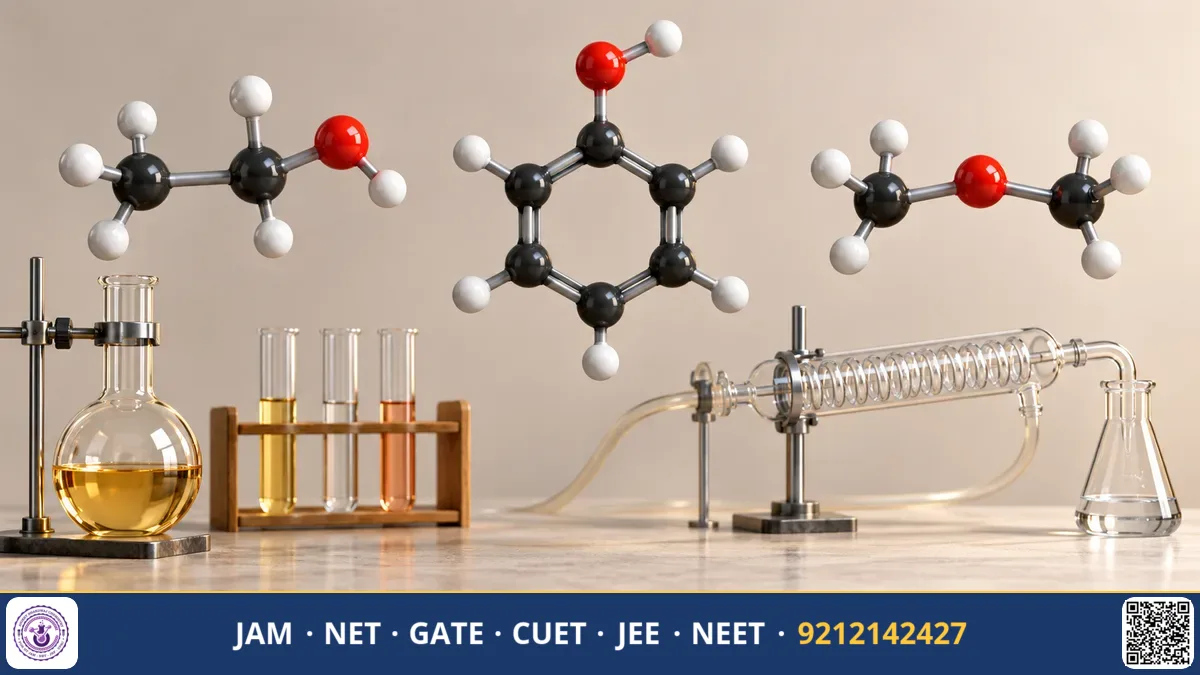
Alcohols, phenols and ethers are three families of compounds that contain oxygen. An alcohol has an -OH group on a saturated carbon. A phenol has the -OH group directly on a benzene ring. An ether has an oxygen joined to two carbon groups (R-O-R).
The chapter looks short, but it asks the student to do four things together:
- Name compounds correctly using the international naming rules taught in the NCERT book.
- Remember several ways to prepare each family.
- Explain physical properties such as boiling point and solubility.
- Write the product of many reactions, often in a multi-step conversion.
Students usually try to memorise everything in one go. By the time of the pre-board examination, the reactions blur into each other. This is the main pain point I see.
Where marks are usually lost
Naming
Students pick the wrong parent chain, or forget that the -OH group gets the lowest possible number. Naming errors are easy to fix, but only with daily practice on written examples.
Acidity of alcohols and phenols
Phenol is more acidic than ethanol. The phenoxide ion (the ion left after phenol loses H+) is stabilised by resonance, which means its negative charge spreads over the ring. In an alcohol, the alkyl group pushes electrons towards oxygen and makes the ion less stable. A group such as -NO2 on the ring increases the acidity of phenol further. A student who only remembers that phenol is acidic cannot handle a question that asks to rank several compounds by acidity.
Boiling point and solubility
Alcohol molecules form hydrogen bonds with each other, so alcohols boil at much higher temperatures than ethers of similar mass. Ether molecules cannot form hydrogen bonds with each other. The lower alcohols dissolve in water because they form hydrogen bonds with water molecules. In the answer, write the words hydrogen bonding and say between which molecules.
Reaction steps
Dehydration of alcohols and cleavage of ethers by HI are the two places where students jump straight to the product. Board examiners look for the reasoning, so the steps matter.
A comparison to keep on one page
Most short-answer questions in this chapter compare two families. Build this table yourself, then check it against the NCERT text.
| Property | Alcohol | Phenol | Ether |
|---|---|---|---|
| Where the oxygen sits | -OH on a saturated carbon | -OH on a benzene ring | Oxygen between two carbon groups |
| Acidity | Very weakly acidic | More acidic than alcohols, because of resonance in the ion | Not acidic |
| Hydrogen bonding between its own molecules | Yes | Yes | No |
| Boiling point for similar mass | High | High | Much lower |
A worked example: one alcohol, two products
Question: What happens when ethanol is heated with concentrated H2SO4?
Answer: The product depends on the temperature and on which reactant is in excess.
- At 443 K, with excess acid, one molecule of ethanol loses water and forms ethene (an alkene).
- At 413 K, with excess alcohol, two molecules join and lose one water molecule. The product is ethoxyethane (diethyl ether).
Why it matters: The same reagents give different products under different conditions. Write the temperature above the arrow. Marks are lost when the condition is missing.
Phenol reactions that need extra attention
The -OH group makes the benzene ring very reactive towards substitution. Keep these in a separate list and revise them often:
- Bromine water: phenol gives a white precipitate of 2,4,6-tribromophenol.
- Nitration: dilute nitric acid gives a mixture of ortho and para nitrophenols. Concentrated nitric acid replaces three hydrogens on the ring.
- Phenol with chloroform and sodium hydroxide: after acid treatment, this gives salicylaldehyde.
- Sodium phenoxide with carbon dioxide: after acid treatment, this gives salicylic acid.
Draw the ring and mark the ortho and para positions before you write the product. This one habit removes most position errors.
Ethers: the short part that still gives marks
An ether can be made when an alkoxide (the ion left when an alcohol loses its hydrogen) reacts with an alkyl halide. The key rule is to use a primary alkyl halide. With a secondary or tertiary halide, elimination competes and you get an alkene instead. Examiners like to test this rule by giving several pairs of reactants and asking which pair will work.
Ethers are also cleaved by HI. Students should know which side the iodine ends up on when one group is alkyl and the other is aryl. Practise this with written examples rather than reading the rule alone.
How a home tutor helps with this chapter
A group batch moves at the speed of the class. At home, the tutor moves at the speed of one student. For this chapter, that means:
- Checking the student's rough work, not only the final answer, so the wrong step is found quickly.
- Asking why after each reaction until the student can state the reason in one sentence.
- Setting short written drills on naming and conversions, and correcting them the same day.
- Following the NCERT pattern, so that revision matches what the school teaches.
Great Home Tutors offers home tuition only, with no coaching centre and no group batch. You tell us the class, subject, board and your locality. A person from the team calls you back to understand the student. We say plainly whether a tutor is verified by us or not yet, and the first class is for seeing the fit before anything is fixed. You can book a free Chemistry demo from the Great Home Tutors page, and Class 12 Chemistry is listed there for Dwarka.
A weekly routine for this chapter
This is a simple plan. Adjust it to the school timetable.
- Two days for preparation methods. Read the NCERT text, close the book, and write each method from memory.
- Two days for properties and reasons. Cover acidity, boiling point and solubility. Write each answer in two sentences.
- One day for the phenol reactions and the ether rules. Write conditions next to every arrow.
- One day for mixed conversions. Example: convert ethanol to ethoxyethane, or phenol to salicylic acid.
- One day for the NCERT in-text and exercise questions, with the tutor checking the answers.
Keep a one-page sheet of reactions with conditions written next to each arrow. Read it for five minutes each night.
Key takeaways
- Learn the reason behind each property or reaction, not only the product.
- Write reaction conditions, such as temperature and reagent, above the arrow.
- Phenol's acidity and its ring reactions come from the -OH group and resonance.
- Use a primary alkyl halide when making an ether from an alkoxide.
- Short daily written practice works better than one long weekend session.
Frequently asked questions
How many weeks does this chapter need?
It depends on the student's base. Most students need steady work over a few weeks, with weekly revision. A tutor can judge this after seeing the student's rough work in the first class.
Is this chapter important for the board examination?
It is part of the Class 12 organic chemistry portion, and it supports later chapters on aldehydes, ketones and acids. Follow the latest syllabus and marking scheme given by your school and board.
My child understands in class but forgets later. What should we do?
Ask your child to write the reactions from memory every few days, with conditions. Forgetting usually means the reason was not understood. A tutor can find which reactions are weak and revisit them.
Can I choose the board?
Yes. The Great Home Tutors request form lets you choose CBSE, ICSE, a state board or IB/IGCSE, along with the class and your locality.
Is home tuition available in Gurugram as well as Dwarka?
Yes, the Great Home Tutors page lists both Dwarka and Gurgaon. Share your sector or PIN in the request form so the right tutor can be matched.
What to do next. Try it yourself on the page below.
Great Home Tutors — home tuition at your home · 4AB →