What Gurugram Parents Should Check in a Class 11 and 12 Chemistry Tutor

This guide explains how parents in Gurugram can evaluate and select a chemistry home tutor for Class 11 and Class 12. You will learn the major syllabus hurdles, what qualifications to check, and how to organize a weekly study routine at home.
The jump from Class 10 to senior secondary chemistry
Many students score high marks in Class 10 science and expect senior secondary chemistry to follow the same pattern. Within two months of Class 11, that expectation fails. Class 10 chemistry is largely descriptive science where students memorize definitions and simple reactions. In Class 11, the subject branches into three distinct areas, each demanding a different analytical mindset.
The first branch is physical chemistry. This discipline applies mathematical calculations to chemical behavior. Students must handle the mole concept, which is the standard scientific unit used to measure amounts of atoms, ions, or molecules. It also requires stoichiometry, which refers to calculating relative quantities of reactants and products in chemical reactions. A student weak in basic algebra finds physical chemistry challenging.
The second branch is inorganic chemistry. This field covers the periodic table, chemical bonding, and properties of elements. Students must understand periodic trends, electron configurations, and molecular shapes rather than relying on rote memorization.
The third branch is organic chemistry, which studies the structure, properties, and reactions of carbon compounds. Here, memorization fails. Students must understand reaction mechanisms, which are step-by-step pathways showing how electron pairs shift and chemical bonds break and form. Falling behind in Class 11 organic principles makes Class 12 significantly harder.
Core syllabus pain points across Class 11 and Class 12
Senior school chemistry has distinct chapters where students frequently lose ground. Recognizing these areas helps parents and tutors intervene early.
In Class 11, major difficulties arise in chemical thermodynamics and chemical equilibrium. Thermodynamics examines heat, work, and energy changes in chemical reactions. Students must understand state functions, enthalpy, entropy, and free energy. Chemical equilibrium deals with the dynamic state where forward and reverse reaction rates balance. Students struggle to connect equilibrium constants with calculations such as pH values and buffer solutions.
In Class 12, focus shifts to numerical accuracy. Physical chemistry covers solutions, electrochemistry, and chemical kinetics. Electrochemistry studies how chemical energy converts into electrical energy and vice versa. Chemical kinetics measures reaction rates. Both chapters demand accurate calculation skills and unit conversions.
Inorganic chemistry in Class 12 features coordination compounds. These are complex structures where a central metal atom binds to surrounding molecules or ions known as ligands. Topics like nomenclature, isomerism, and bonding theories require solid conceptual visualization.
Organic chemistry expands into functional groups including haloalkanes, alcohols, aldehydes, ketones, and carboxylic acids. Students must master multi-step synthetic conversions, name reactions, and chemical distinction tests.
The table below summarizes these key areas across both years and indicates how one-to-one home guidance helps:
| Branch | Class 11 syllabus focus | Class 12 syllabus focus | Role of a home tutor |
|---|---|---|---|
| Physical Chemistry | Mole concept, atomic structure, thermodynamics, equilibrium | Solutions, electrochemistry, chemical kinetics | Builds methodical numerical calculation habits and unit analysis |
| Inorganic Chemistry | Periodic properties, chemical bonding, molecular geometry | d-block and f-block elements, coordination compounds | Clarifies electronic configurations, ligand bonding, and reasoning answers |
| Organic Chemistry | Systematic nomenclature, electronic effects, reaction mechanisms | Haloalkanes, functional groups, multi-step conversions, biomolecules | Guides students to trace electron movement and construct reaction roadmaps |
What parents in Gurugram should check before hiring a tutor
Selecting a private tutor in Gurugram requires thorough vetting. Focus on concrete qualifications and verified teaching practices rather than informal claims.
First, verify educational background and credentials. A senior school tutor must hold an advanced degree in chemistry or related sciences. Great Home Tutors checks tutor identity, verifies qualifications, and conducts a short teaching conversation before listing any instructor. Tutors who complete these checks carry a Verified mark, giving parents transparency about the teacher entering their home.
Second, ensure the tutor teaches all three branches thoroughly. Some educators prefer physical chemistry problems but skip mechanisms in organic chemistry, or rush through inorganic chapters. A tutor must give balanced attention to all three divisions.
Third, verify strict adherence to the NCERT syllabus. School and board examinations rely directly on NCERT explanations, in-text examples, and chapter-end problems. A tutor who relies only on assorted worksheets without finishing textbook exercises leaves the student unprepared for formal grading.
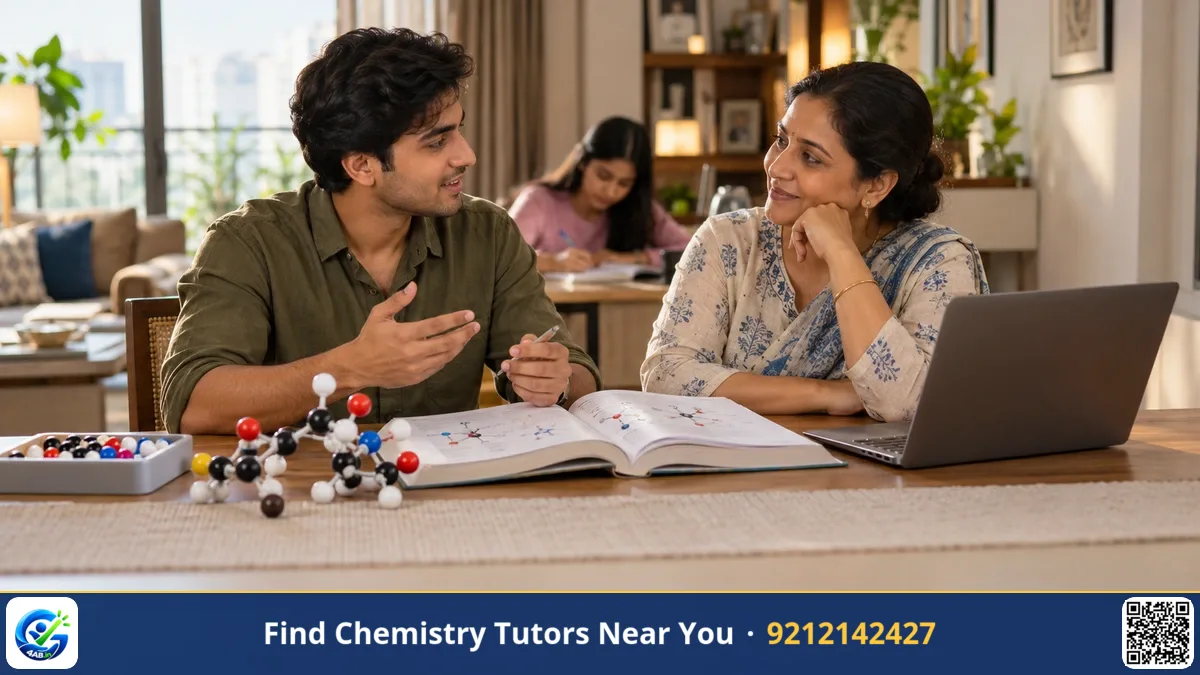
Fourth, observe the tutor's teaching approach during lessons. Meaningful tutoring requires active paper-and-pen work. The tutor must explain derivations, write reaction mechanisms clearly, and observe the student solving numericals in real time. Watching where a student hesitates reveals exact learning gaps.
Fifth, utilize an introductory trial class. Great Home Tutors offers a first class to evaluate the fit before anything is decided. Use this session to verify whether the teacher communicates clearly, answers doubts patiently, and adapts to the student's pace.
Structuring an effective weekly home tuition routine
Steady consistency produces far better results than irregular sessions before exams. Senior secondary chemistry requires continuous practice and review.
For Class 11 and Class 12 students, a schedule of two to three sessions per week, with each session running for ninety minutes, provides effective coverage without exhausting the student.
A productive 90-minute session structure:
- First 15 minutes: Review assigned homework, examine previous test questions, and address doubts from school classes.
- Next 45 minutes: Teach new concepts, derive essential formulas, or write out organic reaction mechanisms step by step.
- Final 30 minutes: Supervised problem-solving. The student solves numericals and writes chemical equations independently while the tutor corrects mistakes immediately.
Between sessions, students should maintain three dedicated notebooks: one for physical formulas and numericals, one for inorganic tables and reasoning, and one for organic mechanisms. Reviewing them daily reinforces the tutor's lessons.
Key takeaways
- Class 11 splits chemistry into physical, inorganic, and organic branches, requiring distinct study approaches for each area.
- Key syllabus hurdles include the mole concept, equilibrium, thermodynamics, electrochemistry, and organic reaction mechanisms.
- Parents must confirm tutor qualifications, ensure NCERT coverage, and verify that the tutor covers all three branches equally.
- Great Home Tutors checks identity and qualifications, marks vetted teachers as Verified, and provides a trial class to assess fit.
- A routine of two to three 90-minute sessions per week combining conceptual explanations with active problem solving yields steady progress.
Frequently asked questions
Why do students find Class 11 chemistry harder than Class 10?
Class 10 science treats chemistry descriptively with minimal math. Class 11 introduces heavy numerical problem-solving in the mole concept, abstract energy principles in thermodynamics, and complex reaction mechanisms in organic chemistry.
How does one-to-one home tuition differ from coaching institutes?
In group classes, teachers follow a set pace to finish the syllabus, often leaving individual questions unanswered. One-to-one home tuition provides personalized attention, allowing the tutor to identify where the student makes mistakes during calculations or chemical derivations.
Can parents evaluate a home tutor before making a final commitment?
Yes. Great Home Tutors arranges a first class to see the fit before anything is fixed. This lets parents and students assess the tutor's communication, subject grasp, and teaching style at home.
What should a student have ready for every tuition session?
The student should review previous lesson notes, finish assigned practice questions, and keep NCERT textbooks and notebooks ready with specific doubts marked in advance.
What to do next. Try it yourself on the page below.
Great Home Tutors — home tuition at your home · 4AB →