How to revise Class 10 Science chapter by chapter in 30 days
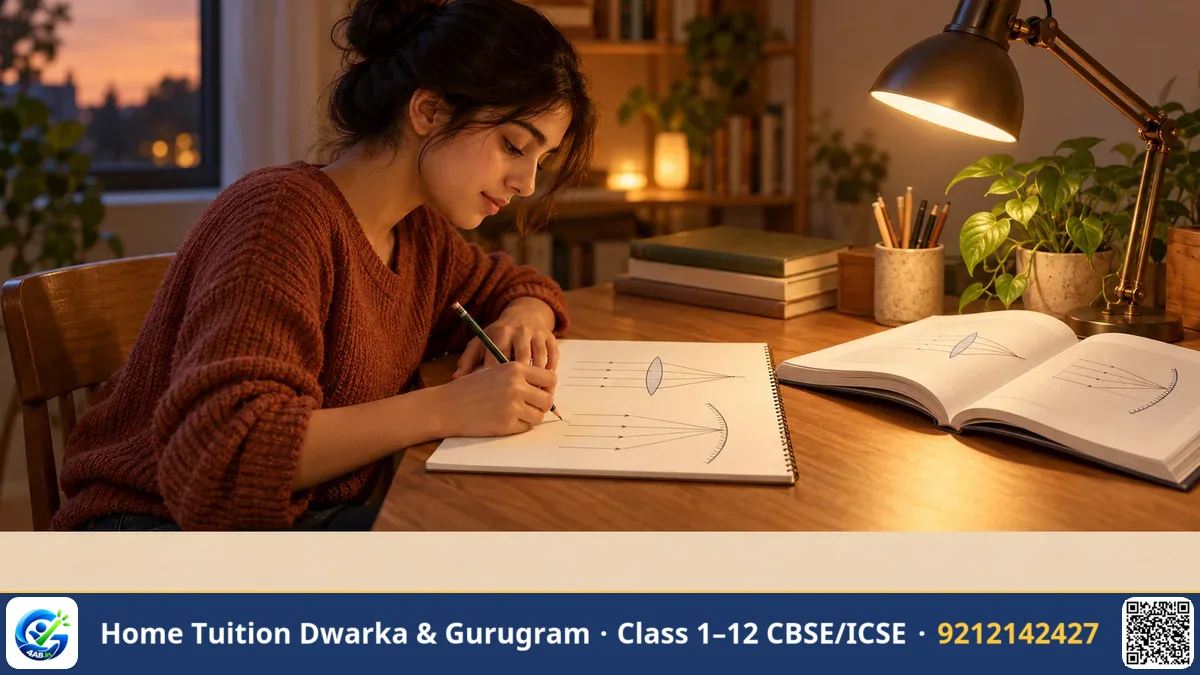
This guide outlines a 30-day revision plan for Class 10 science, arranged chapter by chapter for the board exam. Parents in Dwarka and Gurugram will see where students lose marks and how a disciplined routine fixes those gaps.
Common syllabus pain points in Class 10 science
Class 10 science combines chemistry, physics, and biology into a single paper. Each discipline demands a different study technique. Students often lose marks from treating all three subjects identically.
In chemistry, balancing chemical equations is a frequent stumbling block. In the first chapter, students must distinguish an exothermic reaction (a chemical change that releases energy as heat) from an endothermic reaction (a chemical change that absorbs energy from its surroundings). In acids, bases, and salts, remembering indicators, pH changes, and salt preparation causes confusion. The study of metals and non-metals requires clarity on the reactivity series and extraction of metals. In carbon and its compounds, students encounter structural formulas, homologous series, and saponification (the chemical reaction between an ester and an alkali that forms soap and alcohol). Students often lose marks by omitting physical state symbols like solid, liquid, gas, or aqueous in chemical equations.
In physics, numerical problems and sign conventions cause errors. In the chapter on light reflection and refraction, students confuse the mirror formula with the lens formula. They often misplace the negative sign in focal length calculations. They also forget the rules of refraction (the bending of light waves as they pass from one medium into another of different optical density). In electricity, calculating equivalent resistance in parallel circuits and applying the formula for the heating effect of electric current require systematic calculation. Students frequently omit units like volts, amperes, and ohms, which leads to step deductions.
In biology, long theoretical processes require precise terminology. In life processes, students must describe digestion, respiration, double circulation, and the nephron (the basic microscopic filtering unit of the kidney). Many confuse transpiration (the loss of water vapour from plant leaves) with translocation (the transport of soluble food products through phloem tissue). In chapters on reproduction and heredity, neat diagrams with correct labels are essential. Marks slip away when students write descriptive paragraphs instead of standard scientific keywords.
A four-week chapter revision plan
Revising the complete science syllabus in 30 days requires an organized calendar. The table below outlines a structured four-week schedule covering the complete NCERT syllabus with built-in review.
| Timeline | Chapters covered | Daily targets and revision focus |
|---|---|---|
| Week 1 | chemical reactions, acids, bases and salts, metals and non-metals, carbon compounds | Write and balance five equations daily; memorize salt preparation methods; practice electron dot structures and chemical properties. |
| Week 2 | life processes, control and coordination, reproduction, heredity | Draw and label heart, nephron, reflex arc, and flower diagrams; summarize monohybrid crosses and inherited traits. |
| Week 3 | light reflection and refraction, human eye, electricity, magnetic effects of electric current | Practice ray diagrams for concave mirrors and convex lenses; solve numerical exercises on resistance, electric current, and electric power. |
| Week 4 | our environment and comprehensive syllabus review | Review food chains, trophic levels, and ozone depletion; re-read NCERT summary boxes and resolve lingering doubts. |
| Final days | full mock papers and error correction | Solve previous board papers under timed examination limits; correct presentation mistakes, step working, and calculation slips. |
Worked example: step-by-step problem solving
Board examiners evaluate each intermediate step in numerical calculations. Skipping intermediate working or omitting units costs valuable marks. Below is the standard presentation format for a parallel circuit problem.
Problem: Three resistors of 2 ohms, 3 ohms, and 6 ohms are connected in parallel across a 12-volt battery. Calculate: (a) equivalent resistance, and (b) total current from the battery.
Step 1: Write the formula.
For parallel resistors, the reciprocal of equivalent resistance equals the sum of reciprocals of individual resistances:
1 / equivalent resistance = 1 / 2 + 1 / 3 + 1 / 6
Step 2: Calculate equivalent resistance.
1 / equivalent resistance = (3 + 2 + 1) / 6 = 6 / 6 = 1 per ohm
Therefore, equivalent resistance = 1 ohm.
Step 3: Calculate current using the relationship between voltage, current, and resistance.
Potential difference = 12 volts.
Current = potential difference / equivalent resistance = 12 volts / 1 ohm = 12 amperes.
Step 4: State final answers with units.
Equivalent resistance is 1 ohm. Total current is 12 amperes.
Daily study routine and answer-writing discipline
A revision schedule succeeds when paired with a disciplined daily routine. In the final month, focused self-study each day is sufficient when organized into active sessions:
- Morning session: Conceptual reading of NCERT chapters. Read textbook lines carefully, noting reaction conditions, definitions, and diagram details.
- Evening session: Written problem practice. Balance chemical equations, sketch biological diagrams, and solve numerical exercises on paper without looking at solutions.
- Night session: Active recall. Review formula lists and scientific definitions to fix retention before sleeping.
Avoid passive reading. Merely looking through solved answers creates false confidence. Students retain concepts under exam conditions only when they calculate on paper and draw diagrams by hand.
How one-to-one home tuition resolves revision bottlenecks
During the last 30 days before board exams, classroom batches and coaching centres proceed with generic revision that ignores individual weak areas. A student in Dwarka or Gurugram struggling with ray diagrams might spend hours in group lectures on topics they already understand.
Great Home Tutors matches families with checked home tutors for one-to-one tuition at your home. When you request a home tutor, you specify the class, subject, board, and locality. Tutors checked by Great Home Tutors carry a Verified mark. Their identity, qualifications, and teaching approach are evaluated through a personal conversation before they meet a student.
A dedicated home tutor sitting directly with the student provides distinct advantages:
- Targeted diagnosis: Focuses exclusively on chapters and question formats where marks drop.
- Supervised answer writing: Monitors working steps in real time, catching missing units, incorrect ray arrows, and unbalanced equations immediately.
- Consistent accountability: Maintains a regular study pace and removes procrastination during high-stress weeks.
- Tailored trial class: Parents can arrange a first class at home to confirm the tutor fit before setting a revision schedule.
Key takeaways
- Rely strictly on the NCERT textbook, completing all in-text questions and chapter-end exercises.
- Practice ray diagrams, electric circuits, and biological drawings with a pencil and accurate labels.
- Include step formulas and units in physics, and state symbols in chemistry equations.
- Maintain a daily routine alternating morning theory reading with evening written practice.
- Use one-to-one home tuition to fix specific chapter weaknesses under personal supervision.
Frequently asked questions
How should a student revise Class 10 science daily in the last month?
Divide revision time between morning NCERT theory reading, evening written problem practice, and a short night formula review.
Is studying NCERT alone sufficient for the Class 10 science board exam?
Yes. The board examination is based on the NCERT syllabus. Thoroughly understanding the textbook, activities, in-text questions, and exercises ensures comprehensive coverage.
How should science diagrams be practiced for board exams?
Draw diagrams on plain sheets using a pencil. Practice standard labels from memory and include directional arrows on light rays to show optical paths clearly.
How does Great Home Tutors vet teachers for home tuition?
Great Home Tutors checks each tutor through identity verification, qualification checks, and an interview before arranging classes. Verified tutors carry a Verified mark.
What to do next. Try it yourself on the page below.
Great Home Tutors — home tuition at your home · 4AB →