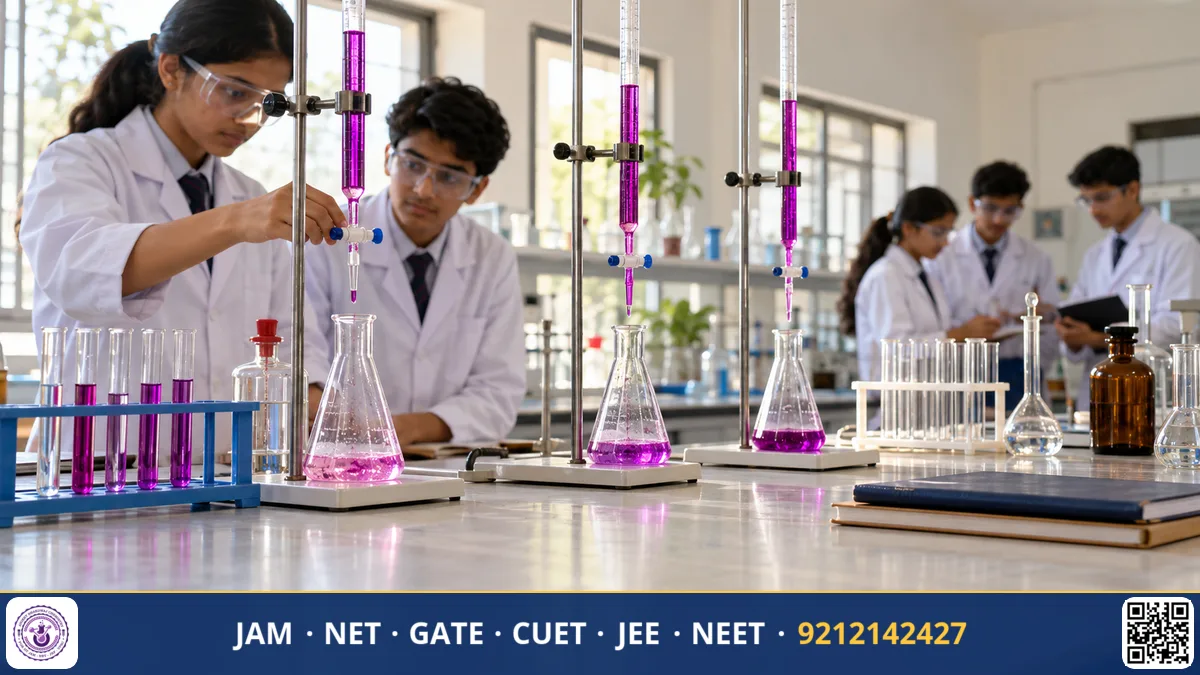
Class 11 Chemistry Titration Practicals: Viva Questions, Gurugram
This guide explains the Class 11 Chemistry titration syllabus, glassware procedures, and core viva questions. Parents in Gurugram and Dwarka will find a structured plan to help students handle practical laboratory assessments with clarity.
Class 11 titration syllabus and practical lab challenges
In Class 11 Chemistry under the CBSE board, practical coursework forms an essential component of the annual evaluation. A substantial part of this practical exam focuses on volumetric analysis, commonly referred to as titration. Titration is a quantitative laboratory method used to determine the unknown concentration of a solution by reacting it completely with a solution of known concentration. The standard NCERT laboratory curriculum requires two fundamental acid-base titrations during the Class 11 academic session:
- Preparing a standard solution of oxalic acid to determine the molarity and strength of an unknown sodium hydroxide solution.
- Preparing a standard solution of sodium carbonate to determine the molarity and strength of an unknown hydrochloric acid solution.
In many school laboratories across Gurgaon and Dwarka, one teacher oversees a large batch of students during a single practical period. With limited time and shared apparatus, students often rush through the physical steps without absorbing the underlying principles. They may pour liquids, add drops, and record numbers mechanically. However, when an external examiner questions them during the viva voce, students frequently struggle to justify what they did at the laboratory bench.
Common laboratory mistakes that lead to mark deductions include:
- Weighing errors: Leaving solid solute behind on the watch glass or failing to dissolve crystals completely before diluting to the mark in the measuring flask.
- Trapped air bubbles: Forgetting to expel the air pocket trapped inside the burette stopcock nozzle, which causes incorrect volume measurements during dispensing.
- Parallax error: Viewing the liquid level at an upward or downward angle instead of placing the eye level with the calibration mark.
- Over-titration: Adding the titrant too quickly near the equivalence point, turning the solution dark pink instead of reaching a very faint, permanent colour change.
- Averaging non-matching values: Calculating a mathematical mean of inconsistent readings instead of repeating runs to achieve concordant values.
Essential laboratory techniques and calculation methods
To perform volumetric analysis correctly, a student must distinguish between primary and secondary standards. A primary standard is a stable, highly pure chemical substance that can be weighed directly because it does not absorb moisture or react with atmospheric gases. Examples include oxalic acid dihydrate, written as H2C2O4·2H2O, and anhydrous sodium carbonate, written as Na2CO3.
In contrast, a secondary standard is a substance whose exact concentration cannot be prepared by direct weighing. Sodium hydroxide is a secondary standard because it is deliquescent, meaning it absorbs moisture and carbon dioxide from the air. Therefore, an aqueous solution of sodium hydroxide must always be standardized against a freshly prepared primary standard solution of oxalic acid.
Correct glassware cleaning and rinsing protocols prevent systematic chemical errors:
- Burette: Wash with water, rinse thoroughly with distilled water, and finally rinse with the titrant solution before filling. Rinsing with the titrant ensures that residual water droplets do not dilute the solution.
- Pipette: Wash with water, rinse with distilled water, and rinse with the specific solution to be transferred. This maintains the exact solution concentration inside the barrel.
- Conical flask: Wash with water and rinse with distilled water only. Never rinse the conical flask with the solution being titrated. Rinsing the flask with the solution leaves extra solute droplets behind, altering the total moles present during the reaction.
Worked example: Determining the molarity and strength of sodium hydroxide
A student transfers 20 mL of a 0.1 M standard oxalic acid solution into a conical flask using a pipette. The student titrates this sample against an unknown sodium hydroxide solution using phenolphthalein indicator. Consecutive titration runs yield a concordant titre value of 20 mL from the burette. Concordant readings refer to identical or closely matching volume readings obtained in repeated trials.
The balanced chemical equation is: H2C2O4 + 2NaOH → Na2C2O4 + 2H2O.
From reaction stoichiometry, one mole of oxalic acid reacts completely with two moles of sodium hydroxide:
(molarity of oxalic acid × volume of oxalic acid) / 1 = (molarity of sodium hydroxide × volume of sodium hydroxide) / 2
Substitute the measured values:
(0.1 × 20) / 1 = (molarity of sodium hydroxide × 20) / 2
molarity of sodium hydroxide = (0.1 × 20 × 2) / 20 = 0.2 M.
Strength represents the mass of solute dissolved per litre of solution in grams per litre (g/L):
strength = molarity × molar mass.
The molar mass of sodium hydroxide is 40 g/mol.
strength = 0.2 × 40 = 8.0 g/L.
Indicator chemistry and core viva voce questions
The viva voce examination tests chemical reasoning rather than rote recitation. Examiners want to see whether a student understands the role of indicators and the chemical changes taking place in the flask. An indicator is a weak organic acid or base that changes colour depending on the hydrogen ion concentration of the solution. The equivalence point is the exact theoretical moment when chemically equivalent amounts of acid and base have reacted. The end point is the visible physical signal, such as a sharp colour transition, indicating that the reaction has reached completion.
The table below summarizes indicator selection and colour transitions for the two prescribed Class 11 titrations:
| Titration pair | Acid-base nature | Indicator | End point colour change | Chemical reason |
|---|---|---|---|---|
| Oxalic acid vs sodium hydroxide | Weak acid vs strong base | Phenolphthalein | Colourless to faint permanent pink | The equivalence point forms a basic salt with a pH above 7; phenolphthalein operates in the alkaline pH range. |
| Sodium carbonate vs hydrochloric acid | Weak base vs strong acid | Methyl orange | Yellow to faint red or pink | The equivalence point forms an acidic solution due to dissolved carbon dioxide with a pH below 7; methyl orange operates in the acidic pH range. |
Examiners frequently ask the following questions during practical assessments:
- Why should you read the lower meniscus for colourless solutions?
The meniscus is the curved surface of a liquid column caused by surface tension and adhesion. For colourless and transparent liquids, the bottom of the curve is sharpest and easiest to align with graduation marks on the burette, preventing optical parallax error. For intensely coloured solutions, the upper meniscus is observed because the bottom edge is obscured. - Why must you avoid blowing out the final drop from a pipette?
Laboratory pipettes are calibrated to deliver their rated volume by gravity drainage. The small volume retained in the jet tip due to capillary attraction is already taken into account during manufacturing calibration. Blowing it out delivers excess volume into the flask. - Why is nitric acid not used in acid-base volumetric titrations?
Nitric acid is a strong oxidising agent in addition to being an acid. It can oxidise and decompose the organic dye molecules that make up indicators, ruining the visible end point colour transition. - Why is a white tile placed beneath the conical flask?
A clean white ceramic tile provides a uniform, neutral background that allows the student to spot the earliest appearance of a faint, permanent colour change. - Why is warm water never used to prepare standard solutions in volumetric flasks?
Volumetric glassware is calibrated at a standard room temperature. Warm liquids cause the glass walls to expand, altering the internal volume calibration and leading to incorrect concentration values.
How one-to-one home tuition supports practical and viva preparation
Parents in Gurgaon residential communities such as Sector 108, Sector 109, Sector 110, Sector 111, Sector 112, and Sector 113 often observe that group coaching centres concentrate almost entirely on objective entrance tests. Large coaching classrooms rarely review school practical requirements, laboratory notebook formats, or viva questioning. As a result, students feel anxious when school laboratory tests approach.
One-to-one home tuition bridges this divide by providing focused academic mentoring. A dedicated chemistry tutor supports the student in several direct ways:
- Reviewing the NCERT laboratory manual theory and reaction mechanisms before school sessions, ensuring the student enters the lab with complete procedural clarity.
- Conducting oral viva drills where the student explains procedures aloud, replacing hesitation with fluent scientific vocabulary.
- Checking step-by-step mathematical calculations, unit balancing, and significant figures to eliminate avoidable arithmetic mistakes.
- Guiding the student in maintaining an accurate, well-organized practical notebook containing balanced chemical equations, clean observation tables, and correct formula units.
Through Great Home Tutors, parents can request a home tutor matched by class, subject, and locality. Tutors carrying a Verified mark have undergone individual checks of identity, academic qualifications, and teaching ability before visiting a home. Aniket Bhardwaj, a verified tutor with more than twenty years of teaching experience, assists Class 11 and Class 12 students across Dwarka and Gurgaon in mastering chemistry theory, mathematical derivations, and laboratory viva preparation. An introductory home class allows families to assess the teaching style and mutual comfort before establishing a long-term study schedule.
A practical revision routine for school students
Developing a consistent routine helps students master laboratory practicals without last-minute panic before term assessments:
- Pre-lab study: Read the experiment in the NCERT manual before entering the school laboratory. Write out the balanced chemical equations, note the required apparatus, and write down the expected indicator colour transitions in rough notes.
- Laboratory discipline: Inspect the burette nozzle to ensure no air bubbles remain. Rinse glassware according to the proper protocol. Add the titrant dropwise as the colour change nears, swirling the flask continuously, and record concordant readings.
- Same-day calculations: Complete all molarity and strength calculations on the same afternoon while the raw observations are fresh. Check that units such as moles per litre and grams per litre are noted clearly.
- Notebook maintenance: Keep the practical record book updated weekly. Ensure teacher signatures, balanced reactions, and clear observation tables are present for every completed experiment.
- Oral viva practice: Practice explaining the core chemical principles aloud with a home tutor or study partner. Speaking through questions on indicator ranges, primary standards, and errors builds composure during viva examinations.
Key takeaways
- Class 11 volumetric analysis requires careful preparation of standard primary solutions like oxalic acid and sodium carbonate.
- Hygroscopic substances like sodium hydroxide require standardization because they absorb moisture and carbon dioxide from the air.
- Glassware rinsing rules are strict: rinse the burette and pipette with their working solutions, but rinse the conical flask with distilled water only.
- Viva examiners focus on the scientific reasons behind manual steps, including meniscus alignment, indicator selection, and gravity drainage in pipettes.
- Personalized home tuition in Gurgaon and Dwarka helps students master practical calculations, notebook records, and oral viva questioning.
Frequently asked questions
Why do students lose marks during the chemistry viva voce?
Students lose marks when they memorize steps without understanding chemical principles. Examiners look for conceptual explanations, such as why a specific indicator suits a reaction or why particular glassware must be rinsed with titrant.
Which acid-base titrations are prescribed for CBSE Class 11 Chemistry?
The NCERT Class 11 syllabus prescribes two primary titrations: standardizing an unknown sodium hydroxide solution using a standard solution of oxalic acid, and determining the strength of an unknown hydrochloric acid solution using standard sodium carbonate solution.
How can parents in Gurgaon arrange a verified chemistry home tutor?
Parents can submit a tuition request through Great Home Tutors by specifying the class, subject, and area, such as Sector 108 or Sector 112 Gurgaon. Great Home Tutors matches an educator holding a Verified mark and organizes an initial home session to check teaching compatibility.
What should a student do if titration readings do not match?
A student should never take a mathematical average of widely divergent readings. The correct laboratory procedure is to repeat the titration until consecutive trials produce concordant results that agree closely.
What to do next. Try it yourself on the page below.
Great Home Tutors — home tuition at your home · 4AB →