Introduction to 3D geometry in Class 11: Gurugram home tutor help
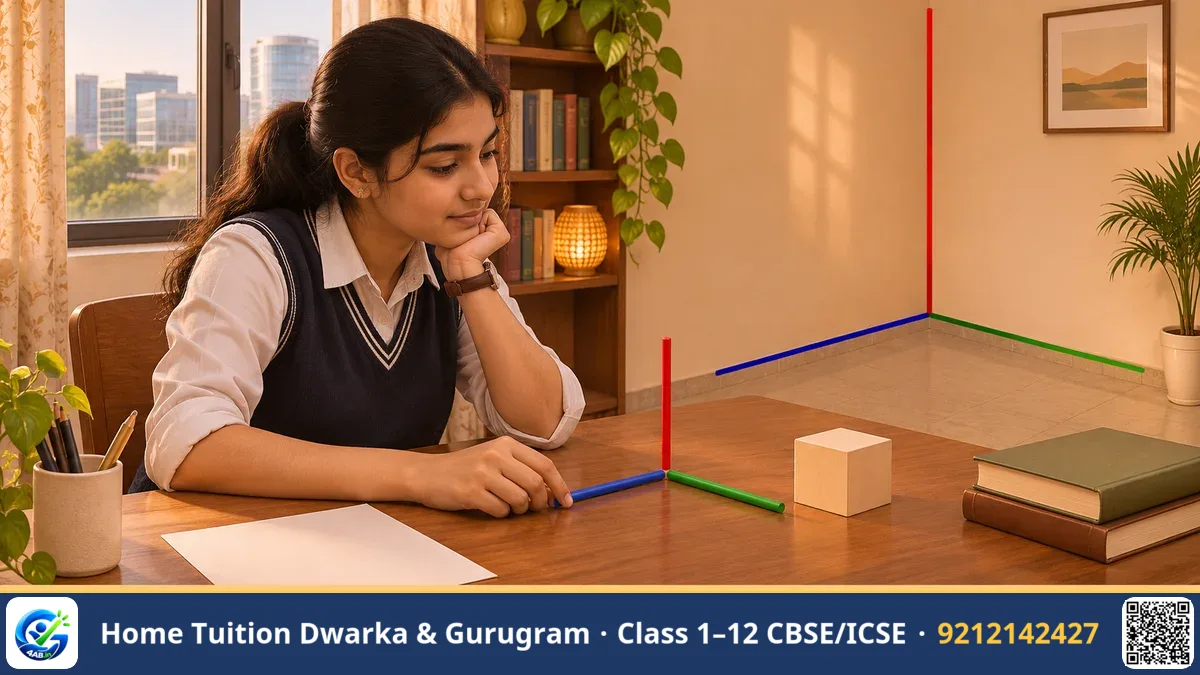
This post explains what Class 11 introduces in 3D geometry and why it matters for Class 12.
You will also get a simple weekly routine that parents in Dwarka and Gurugram can follow at home.
What Class 11 actually covers
In Class 11 CBSE maths, 3D geometry is a short introductory chapter in the NCERT book. Because it is short, many families treat it lightly. That is a mistake. The ideas are few, but each one is used again later.
The chapter covers these ideas:
- The three coordinate axes (x, y and z) and the three coordinate planes.
- The eight octants, which are the eight parts of space cut by the three planes.
- The coordinates of a point as an ordered triple (x, y, z). "Ordered" means the position of each number matters.
- The distance between two points in space.
- The section formula, which finds the point that divides a line segment in a given ratio.
Every one of these extends what your child already knows from 2D coordinate geometry. The new part is the third direction, and that is where the trouble begins.
Why students find it hard
In 2D, the page and the graph are the same thing. In 3D, the page shows a flat drawing of something that is not flat. The student must imagine depth, and nobody has taught them how to do that.
These are the common pain points:
- Plotting a point. Students cannot tell where (2, 3, 4) sits, so they only memorise the formula.
- Signs and octants. A point with a negative z lies below the xy-plane. Students forget this and name the wrong octant.
- Mixing up planes. The xy-plane has z = 0. The yz-plane has x = 0. The zx-plane has y = 0. Many students swap these.
- Copying 2D habits. Some students draw a 3D figure like a 2D graph and then cannot read their own diagram.
The problem is rarely the formula. The formulas are short. The real problem is that the student has never built a mental picture of space. Until that picture exists, every question feels like guesswork.
The axes and planes: what each point looks like
Learn this table well. It also helps to check any answer.
| Where the point lies | What is true of its coordinates |
|---|---|
| On the x-axis | y = 0 and z = 0 |
| On the y-axis | x = 0 and z = 0 |
| On the z-axis | x = 0 and y = 0 |
| In the xy-plane | z = 0 |
| In the yz-plane | x = 0 |
| In the zx-plane | y = 0 |
Ask your child to explain each row in plain words, not just read it. For example, a point in the xy-plane lies flat on the floor of the room, so it has no height. A student who can say this in their own words has understood the row.
Worked examples: distance and section formula
The distance between two points is the 2D distance formula with one extra term. For points (x1, y1, z1) and (x2, y2, z2), the distance is the square root of (x2 − x1)2 + (y2 − y1)2 + (z2 − z1)2.
Find the distance between A(1, 2, 3) and B(4, 6, 15).
- Find the differences: 4 − 1 = 3, 6 − 2 = 4, 15 − 3 = 12.
- Square them: 9, 16 and 144.
- Add: 9 + 16 + 144 = 169.
- Take the square root: 13.
The distance AB is 13 units. Notice that 3, 4, 12 and 13 form a neat set. Students who spot such patterns check their arithmetic faster.
Now the section formula. If a point divides the line joining two points internally in the ratio m : n, each coordinate comes from the same rule: (m × second + n × first) divided by (m + n). Apply it separately to x, y and z.
Find the point that divides P(2, 4, 6) and Q(8, 10, 12) internally in the ratio 1 : 2.
- For x: (1 × 8 + 2 × 2) ÷ 3 = 12 ÷ 3 = 4.
- For y: (1 × 10 + 2 × 4) ÷ 3 = 18 ÷ 3 = 6.
- For z: (1 × 12 + 2 × 6) ÷ 3 = 24 ÷ 3 = 8.
The point is (4, 6, 8). Doing one coordinate at a time avoids most mistakes.
Why this matters before Class 12
In Class 12, the NCERT syllabus has a chapter on vectors and another on three dimensional geometry. They use direction, lines and planes in space. A student who still cannot place a point in space will struggle to follow a line in space.
Class 11 is the right time to build the picture, because the load is light. There are no long equations of lines or planes yet. The student can spend time on understanding rather than speed.
3D thinking is not only for maths. In chemistry, molecular shapes and crystal structures need the same skill. A student who can see space finds those topics easier too.
How a home tutor helps
This chapter suits one-to-one teaching, because every child's difficulty is different. One child cannot picture the octants. Another cannot keep the planes straight. A tutor sitting beside the student can see which it is within a few minutes.
A good tutor will:
- Use a real object, such as the corner of a room, to show the three axes.
- Ask the student to describe a point aloud before writing anything.
- Check the answer against the table of planes, not only the formula.
- Link each Class 11 idea to the Class 12 topic it leads to, so the student sees why it is worth learning.
Great Home Tutors offers one-to-one tuition at your home. It is home tuition only, with no coaching centre and no group batch. You tell us the class, subject, board and your locality. A person from the team calls to understand the student. We tell you plainly whether a tutor is verified by us or not yet, and there is a first class to see the fit before anything is fixed.
A simple weekly routine for parents
You do not need to teach maths. You only need to keep a steady rhythm. This routine takes little time each day.
- Day 1: build the frame. Use the corner of a room. The floor is the xy-plane. The two walls are the other planes. Ask your child to point to the x, y and z directions.
- Day 2: plot by hand. Give five points, some with negative values. Ask which octant each lies in.
- Day 3: distance practice. Do three distance problems. Insist that each difference is written down before squaring.
- Day 4: section formula. Do two problems, one coordinate at a time.
- Day 5: explain it back. Ask your child to teach you one idea in their own words. If they stumble, that is the topic to take to the tutor.
Keep a small notebook for mistakes. Most errors repeat: a lost minus sign, a swapped plane, a skipped square. Seeing the pattern is half the cure.
Key takeaways
- Class 11 3D geometry is short, but it is the base for Class 12 vectors and 3D geometry.
- The main difficulty is picturing space, not remembering formulas.
- Learn the plane table: each coordinate plane has one coordinate equal to zero.
- Use a room corner and everyday objects to build the mental picture.
- One-to-one home tuition helps because the tutor can find exactly where the picture breaks.
Frequently asked questions
Is 3D geometry in Class 11 difficult?
The formulas are short and follow from 2D geometry. The difficulty is imagining depth. With some practice using real objects, most students become comfortable.
When should my child start?
Start when the school begins the chapter, and revise it again before Class 12 begins. A short revision helps more than a long one done late.
Does this chapter connect to Class 12?
Yes. Class 12 NCERT has chapters on vectors and on three dimensional geometry, and both assume that the student can handle points and distances in space.
Can a tutor visit us in Dwarka or Gurugram?
Great Home Tutors lists home tutors across Dwarka and also has pages for Gurgaon. Tell us your class, subject and locality, and a person from the team will call you back.
Should my child draw figures?
Yes. A rough sketch of the axes and the point is enough. Drawing forces the student to decide where each coordinate goes, and that builds the picture.
What to do next. Try it yourself on the page below.
Great Home Tutors — home tuition at your home · 4AB →