JEE Main maths chapter order: what to study first, Dwarka
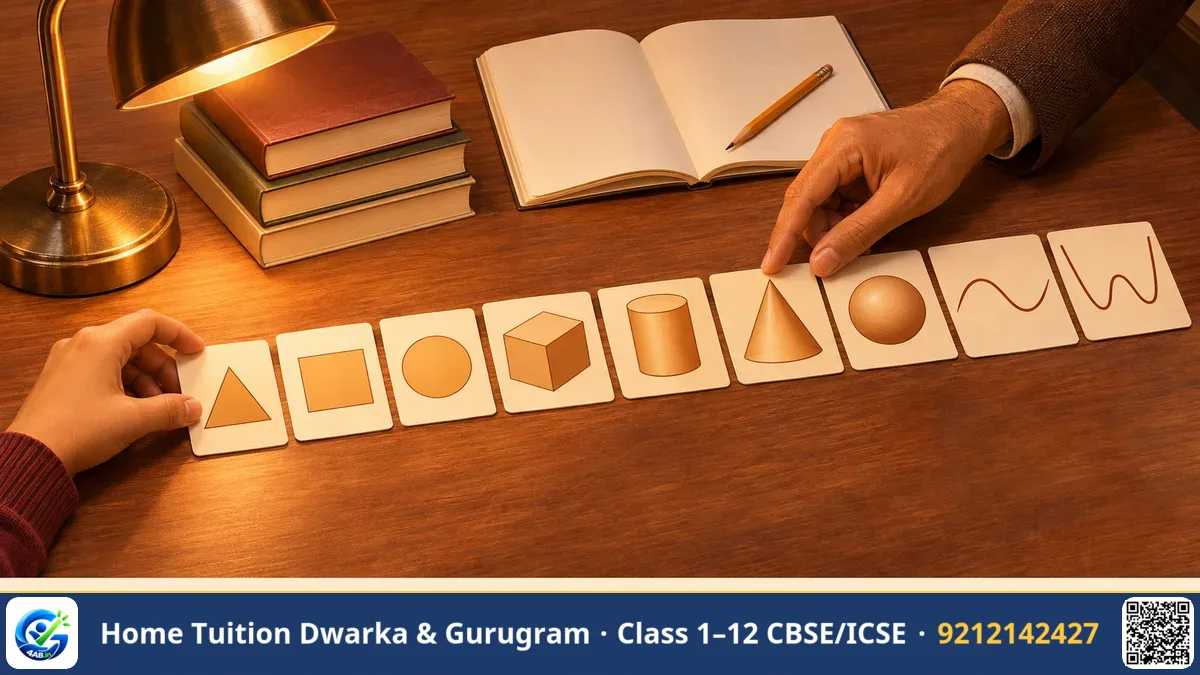
This guide outlines the exact chapter sequence for JEE Main mathematics so your child avoids confusion and builds solid problem-solving skills. You will learn which foundation topics to study first, how chapters connect, and how one-to-one home guidance sets a calm weekly routine.
Why chapter sequence decides your score in JEE Main mathematics
Many Class 11 and Class 12 students in Dwarka and nearby localities such as Janakpuri or Gurugram struggle in mathematics because they study chapters out of sequence. A prerequisite is a foundational topic that must be mastered before studying an advanced one. Without these tools, routine problems feel overwhelming.
Large coaching batches follow rigid timetables and jump directly into calculus or coordinate geometry. A student whose grip on functions or algebra is shaky falls behind. The subject of mathematics is hierarchical. Multi-step JEE Main problems combine concepts across units. For instance, finding a domain in calculus requires solving inequalities with the wavy curve method from algebra.
Skipping foundation steps creates unnecessary fear. Parents watch their children spend hours studying without seeing test marks improve. Following a planned, dependency-based order restores clarity and confidence.
A four-stage study order for JEE Main mathematics
Divide the syllabus into four distinct stages based on conceptual dependency and difficulty.
Stage one (foundation tools): Begin with sets, relations, and functions. A function is a mathematical rule that assigns each input exactly one output. Master domain, range, and graphs. Next, study quadratic equations and inequalities. Learn the wavy curve method, which is a graphical technique on a number line to determine where an algebraic expression is positive or negative. Follow with sequences and series, and finish with trigonometric functions. Mastering trigonometric identities is essential for calculus transformations.
Stage two (geometry and vectors): Start with straight lines to master slopes and distance formulas. Move to circles, and then proceed to conic sections: parabolas, ellipses, and hyperbolas. Conclude with vectors and three-dimensional geometry. These topics rely on clear algebraic formulas and offer steady scoring.
Stage three (calculus): The study of calculus examines continuous change and accumulation. Never begin calculus before completing stage one. Start with limits, continuity, and differentiability. Study the application of derivatives, covering tangents, normals, and maxima and minima. Complete the stage with indefinite and definite integration, differential equations, and area under curves.
Stage four (standalone units): Conclude with units that have few dependencies. Topics covering matrices and determinants require systematic arithmetic and are very manageable. Next, cover the binomial theorem, permutations and combinations, and probability. Finish with statistics, focusing on mean and variance.
| Stage | Chapters | Prerequisites | Study focus |
|---|---|---|---|
| Stage one (foundation tools) | sets, relations, functions, quadratic equations, trigonometry, sequences | Class 10 algebra | domain, sign schemes, and trigonometric formulas |
| Stage two (geometry and vectors) | straight lines, circles, conic sections, vectors, three-dimensional geometry | coordinate plane basics | standard curve equations and vector products |
| Stage three (calculus) | limits, continuity, derivatives, integrals, differential equations | functions and trigonometry | rate of change, substitution, and area bounding |
| Stage four (standalone units) | matrices, determinants, binomial theorem, probability, statistics | basic algebra | linear systems, counting, and variance formulas |
Syllabus pain points and a worked dependency example
Students preparing for board exams alongside entrance tests face two distinct demands. Board exams like CBSE or ICSE require step-by-step derivations from NCERT textbooks. Entrance examinations demand combining multiple concepts quickly under timed conditions. Without structured guidance, students read solutions passively instead of solving problems independently.
Another major hurdle across South West Delhi, including Dwarka Sector 6 and Sector 10, and Gurugram sectors like Sector 108 to Sector 113, is travel fatigue. Long commutes to coaching centres drain energy needed for homework and revision.
Here is a standard problem showing why prerequisite order matters:
Problem: Find all real values of x in [0, 2π] satisfying: 2 sin2(x) - 3 sin(x) + 1 ≤ 0.
Step one (quadratic substitution): Let y = sin(x). The expression becomes 2y2 - 3y + 1 ≤ 0.
Step two (inequality solving): Factoring gives (2y - 1)(y - 1) ≤ 0. By sign analysis, the expression is non-positive when y lies between 1/2 and 1. Thus, 1/2 ≤ sin(x) ≤ 1.
Step three (trigonometric evaluation): In [0, 2π], sin(x) = 1/2 at x = π/6 and x = 5π/6, and reaches 1 at x = π/2. Because the sine function is continuous, the solution interval is π/6 ≤ x ≤ 5π/6.
Why dependency matters: If a student has not mastered quadratic factorization and inequalities from algebra, they get stuck midway, even with trigonometric formulas memorized.
How one-to-one home tuition builds a calm routine in Dwarka
Home tuition solves pacing mismatches and eliminates travel fatigue. In a one-to-one setting, the tutor adapts lessons to the student's gaps. If a Class 12 student struggles with integration due to forgotten Class 11 trigonometry, the tutor pauses to rebuild that prerequisite immediately.
Great Home Tutors arranges verified home tuition across Dwarka and Gurugram. Tutors checked carry a Verified mark after verification of identity, qualifications, and a short teaching conversation. Tutors such as Aniket Bhardwaj, a verified tutor in Dwarka Sector 6 teaching mathematics and chemistry, help students balance NCERT board requirements with entrance practice.
Parents can request a home tutor by submitting the student's class, subject, board, and locality. A representative calls back to understand the student's needs. The family then receives a first class at home to check fit before anything is fixed. There are no coaching centres and no group batches.
A steady weekly home routine keeps preparation structured:
- First session (concept foundation): Study theory from NCERT, derive key formulas, and solve foundational problems.
- Second session (graded problem practice): Solve mixed problems connecting current topics with stage one foundation tools.
- Third session (doubt review): Correct homework errors and clarify difficult steps directly at the study table.
- Independent revision: Spend regular evening time solving problems independently without looking at solutions.
Key takeaways
- Master stage one foundational units—sets, relations, functions, quadratic equations, and trigonometry—before attempting calculus or coordinate geometry.
- Entrance questions combine multiple chapters; unaddressed prerequisite gaps lead to hesitation and calculation errors.
- Topics like coordinate geometry, vectors, and three-dimensional geometry offer dependable scoring once basic formulas are mastered.
- One-to-one home tuition eliminates commuting fatigue in Dwarka and Gurugram while providing personalized pacing and instant doubt resolution.
Frequently asked questions
Which mathematics chapter should a student begin with in Class 11?
A student should begin with sets, relations, functions, and quadratic equations. These units establish core skills like domain analysis, sign schemes, and inequality solving used in every subsequent chapter.
Can a student start Class 12 calculus without finishing Class 11 trigonometry?
No. The subject of calculus requires frequent algebraic and trigonometric transformations. Without a firm grasp of trigonometric identities, a student will struggle with derivatives and integrals.
How does Great Home Tutors verify its home tutors?
Great Home Tutors checks each tutor by reviewing identity documents, verifying qualifications, and conducting a short teaching conversation before listing them with a Verified mark.
How can parents in Dwarka and Gurugram request a home tutor?
Parents submit their request with the class, subject, board, and locality. A representative calls back to understand the student, and a first class is arranged at home to check tutor fit before anything is fixed.
What to do next. Try it yourself on the page below.
Great Home Tutors — home tuition at your home · 4AB →