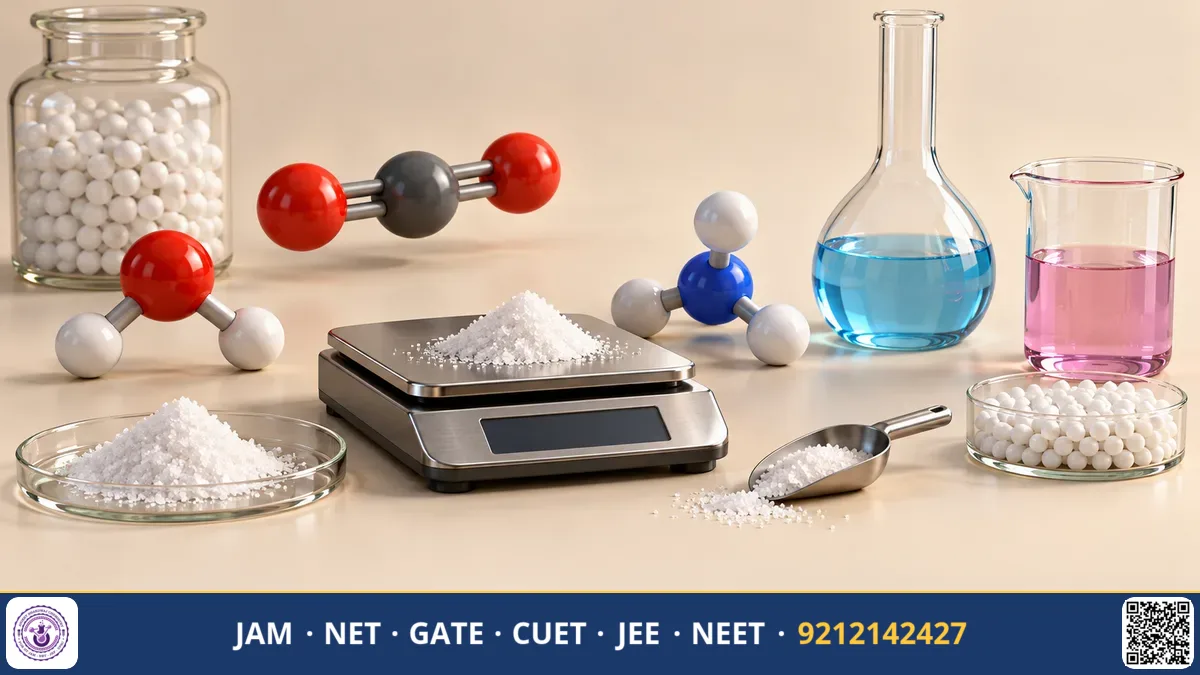
Mole Concept Class 11: Stoichiometry Steps, Dwarka Tutor
This guide explains a reliable four-step method for Class 11 mole concept and stoichiometry numericals.
Parents in Dwarka and Gurugram will discover common syllabus hurdles, a practical study routine, and how one-to-one home tuition builds exam confidence.
Why the Class 11 mole concept challenges school students
The jump from Class 10 science to Class 11 Chemistry is significant. Class 10 reactions are mostly descriptive. In Class 11, the NCERT syllabus introduces quantitative links between mass, volume, and particles. For students across Dwarka, this shift often causes lower marks on early school assessments.
A mole measures the amount of substance. One mole contains exactly 6.022 × 10²³ elementary entities, such as atoms, molecules, or ions. This value is Avogadro's constant. Chemists use the mole to link microscopic particle counts with measurable quantities in grams and liters.
Class 11 students commonly encounter three syllabus hurdles:
- Molar mass versus molecular mass: Molecular mass is the mass of a single molecule in unified atomic mass units. Molar mass is the mass of one mole of substance in grams per mole. Confusing these terms leads to incorrect units during substitutions.
- Molar volume of gases: One mole of an ideal gas occupies 22.4 liters at standard temperature and pressure. Students often mistakenly use this gas rule for liquids or solids.
- The limiting reagent: In a reaction with multiple reactants, the limiting reagent is completely consumed first, setting the maximum product formed. Students often guess that the reactant with less starting mass is limiting, ignoring balanced mole ratios.
A four-step method for stoichiometry calculations
Stoichiometry calculates the quantities of reactants and products in a balanced chemical reaction. A dependable four-step method keeps calculations organized under examination pressure.
- Write and balance the chemical equation: Begin every problem by balancing the reaction. Coefficients represent mole ratios between substances, not mass ratios.
- Convert initial quantities into moles: Divide starting data in grams, liters at standard conditions, or particle counts by molar mass, molar volume, or Avogadro's constant.
- Apply the stoichiometric mole ratio: Use the coefficient ratio from the balanced equation to find the moles of the required substance. If multiple reactant amounts are given, determine the limiting reagent first.
- Convert moles into the target unit: Convert calculated moles into the final requested unit, such as grams or liters.
Worked example: Calculate the mass of water formed by the complete combustion of 32 grams of methane gas in excess oxygen.
Step 1: Write and balance the reaction
CH4 + 2O2 → CO2 + 2H2O
Step 2: Convert given mass to moles
Molar mass of CH4 = 16 g/mol.
Moles of CH4 = 32 g / 16 g/mol = 2 moles.
Step 3: Apply the stoichiometric ratio
From the equation, 1 mole of CH4 produces 2 moles of H2O.
Moles of H2 produced = 2 × 2 = 4 moles.
Step 4: Convert moles of water to grams
Molar mass of H2O = 18 g/mol.
Mass of H2O = 4 moles × 18 g/mol = 72 grams.
Final answer: 72 grams of water are produced.
Core conversion factors and common student pitfalls
Memorizing the relationships between units saves time during exams. The table below outlines how to convert laboratory quantities into moles, along with common pitfalls observed during tuition sessions.
| Given quantity | Conversion operation | Resulting unit | Frequent student pitfall |
|---|---|---|---|
| Mass in grams | Divide by molar mass (g/mol) | Moles of substance | Using atomic mass instead of molecular mass for diatomic gases like oxygen. |
| Gas volume at standard conditions | Divide by molar volume (22.4 L/mol) | Moles of gas | Applying gas volume conversion factors to liquid water or solids. |
| Total particle count | Divide by Avogadro's constant | Moles of particles | Confusing the number of molecules with the total count of constituent atoms. |
| Moles of known reactant | Multiply by stoichiometric coefficient ratio | Moles of target product | Applying mole ratios before balancing the chemical equation. |
| Moles of target substance | Multiply by molar mass (g/mol) | Mass of product in grams | Leaving the answer in moles when the question asks for mass in grams. |
How one-to-one home tuition resolves chemistry roadblocks
In large classrooms or group batches, teachers must complete the syllabus on schedule. An incorrect final test answer rarely reveals where a student's reasoning broke down.
One-to-one tuition at your home provides direct observation. A home tutor watches how the student sets up each equation, distinguishing conceptual chemistry gaps from arithmetic slips or misplaced decimals.
Great Home Tutors connects parents with verified home tutors for one-to-one tuition at your home, with no coaching centres and no group batches. Tutors checked by Great Home Tutors carry a Verified mark and are listed first. Aniket Bhardwaj, a verified tutor in Sector 6 Dwarka, teaches Chemistry and Mathematics for school boards up to competitive levels.
Parents in Dwarka, Janakpuri, and Gurugram can request a tutor through four straightforward steps:
- Tell us what you need: Enter the student's class, subject, school board such as CBSE or ICSE, and locality, such as Sector 10 Dwarka or Sector 108 in Gurgaon.
- We call you back: A coordinator from Great Home Tutors calls to discuss the student's learning requirements.
- Meet the tutor: Great Home Tutors states plainly whether a tutor has completed verification or is not verified yet.
- Start at home: An initial class at home allows the family to evaluate the teaching fit before any regular schedule is confirmed.
Students should complement tuition with a weekly routine: review NCERT definitions on Monday and Tuesday, solve textbook exercises on Wednesday and Thursday while writing out units, log errors on Friday, and use weekend home tuition to solve unseen numericals under timed conditions.
Key takeaways
- Always write and balance the chemical equation before attempting any stoichiometry numerical problem.
- Convert all initial quantities into moles first, because chemical equations relate quantities by moles rather than mass.
- Identify the limiting reagent whenever initial amounts for more than one reactant are specified.
- Maintain a weekly error log and work with a verified home tutor to correct calculation habits early.
Frequently asked questions
Why do Class 11 students find the mole concept difficult?
The mole concept connects macroscopic quantities like grams and liters with microscopic entities like atoms and molecules. This shift demands unit conversion skills and algebraic thinking that were not required in Class 10 science.
What is the difference between molar mass and molecular mass?
Molecular mass is the mass of a single molecule expressed in unified atomic mass units. Molar mass is the mass of one mole of substance (6.022 × 10²³ entities) expressed in grams per mole. While numerical values match for a given molecule, their units represent different physical scales.
How does one-to-one home tuition help with Class 11 Chemistry in Dwarka?
A home tutor observes the student working through numericals in real time at their desk. This feedback distinguishes between misunderstandings of chemistry concepts and routine arithmetic or exponent mistakes.
How can parents request a home tutor through Great Home Tutors?
Parents submit their class, subject, board, and locality on the request form. Great Home Tutors calls back to understand the student's needs, introduces a tutor with clear disclosure of verification status, and arranges an initial home session to check the fit.
What to do next. Try it yourself on the page below.
Great Home Tutors — home tuition at your home · 4AB →