p-Block Class 12: Groups 15 to 18 Revision, Dwarka
This revision guide explains how Class 12 chemistry students can master p-block chemistry across Group 15 to Group 18 systematically. Parents and students will find structured trend comparisons, oxoacid breakdowns, and a practical four-week study plan.
Why the p-block chapter challenges Class 12 chemistry students
In the Class 12 chemistry syllabus, the p-block unit covering Group 15 through Group 18 presents a heavy concentration of theory, chemical reactions, and manufacturing processes. Students open their NCERT textbook to find dozens of chemical equations, preparation methods, and anomalous trends. When faced with this high volume of facts, many students attempt to memorise reactions line by line. This method quickly fails during school examinations and pre-board evaluations, where examiners demand clear conceptual reasoning rather than rote recall.
Parents in Dwarka, across areas like Sector 6 and Sector 10, as well as Gurugram, frequently observe their children spending long hours reading without retaining details. Board examination papers ask students to provide chemical justifications for specific periodic behaviours, such as variations in bond dissociation enthalpy or thermal stability. When a student cannot connect an experimental observation to fundamental atomic structure, marks are lost. Structuring the revision into comparative charts and core reasoning rules across all four groups provides a reliable path to exam readiness.
Fundamental periodic principles that govern p-block reactions
Every group in the p-block follows recurring periodic rules. Once a student grasps these underlying concepts, board questions become predictable and straightforward to answer.
The first rule is the inert pair effect. This term describes the reluctance of valence s-electrons to participate in chemical bonding due to poor nuclear shielding by inner d and f electrons. Down Group 15, the +3 oxidation state gains stability relative to the +5 state. Because of this trend, bismuth in its +5 state acts as a powerful oxidising agent, readily accepting two electrons to reach the more stable +3 state. In the oxygen family, the +4 oxidation state similarly becomes more stable than the +6 state as you move down the group.
The second rule is the anomalous behaviour of second-period elements: nitrogen, oxygen, and fluorine. Each of these elements possesses a small atomic size, high electronegativity (the tendency of an atom to attract a shared pair of electrons towards itself), and an absence of vacant d-orbitals in its valence shell. Without available d-orbitals, nitrogen cannot expand its covalency beyond 4, oxygen cannot form stable hexahalides, and fluorine is strictly restricted to an oxidation state of -1.
The third rule concerns electron gain enthalpy. Chlorine exhibits a more negative electron gain enthalpy than fluorine. In fluorine, the incoming electron enters a compact 2p subshell where it encounters strong interelectronic repulsions. In chlorine, the incoming electron enters a larger 3p subshell where repulsions are lower, making the addition of an electron energetically more favourable.
Comparison of properties from Group 15 to Group 18
Arranging the families into a clear comparative summary highlights patterns in valence electron configurations, oxidation states, and hydride properties.
| Family | Valence shell | Common oxidation states | Hydride trends and physical states | Key anomalous property |
|---|---|---|---|---|
| Group 15 | ns2 np3 | -3, +3, +5 | Thermal stability drops from NH3 to BiH3. NH3 has an elevated boiling point due to hydrogen bonding. | Nitrogen forms strong pπ-pπ multiple bonds; maximum covalency is restricted to 4. |
| Oxygen family | ns2 np4 | -2, +2, +4, +6 | Thermal stability decreases from H2O to H2Te. H2O is a liquid at room temperature due to hydrogen bonding. | Oxygen cannot exhibit high positive oxidation states; lacks vacant d-orbitals. |
| Halogen family | ns2 np5 | -1, +1, +3, +5, +7 | Acid strength increases from HF to HI. HF has a high boiling point due to hydrogen bonding. | Fluorine displays only the -1 oxidation state and acts as the strongest oxidising halogen. |
| Group 18 | ns2 np6 | 0, +2, +4, +6 | Forms no stable binary hydrides. Boiling points increase gradually down the group. | Helium and neon form no stable chemical compounds; xenon forms fluorides and oxides. |
In Group 15, the oxygen family, and the halogen group, the lightest hydrides (NH3, H2O, and HF) show unusually high boiling points because of strong intermolecular hydrogen bonding. At the same time, reducing character increases down each family as the central atom increases in size, which weakens the bond between the central element and hydrogen.
Oxoacids and noble gas structures explained with worked examples
Oxoacids and noble gas compounds require geometric clarity. Board examinations frequently ask students to draw these chemical species and explain their chemical behaviour.
Worked example 1: Basicity and reducing action of phosphorus oxoacids
Basicity corresponds directly to the number of ionisable P-OH hydroxyl groups, while reducing action depends strictly on the presence of direct P-H bonds.
- Orthophosphoric acid (H3PO4): Contains one P=O double bond and three P-OH bonds. It has three replaceable hydrogen atoms, making it tribasic. Because it lacks direct P-H bonds, it exhibits no reducing behaviour.
- Phosphorous acid (H3PO3): Contains one P=O double bond, two P-OH bonds, and one direct P-H bond. It is dibasic and acts as a reducing agent in chemical reactions.
- Hypophosphorous acid (H3PO2): Contains one P=O double bond, one P-OH bond, and two direct P-H bonds. It is monobasic and acts as a strong reducing agent due to its two P-H bonds.
Worked example 2: Predicting xenon compound shapes from electron pairs
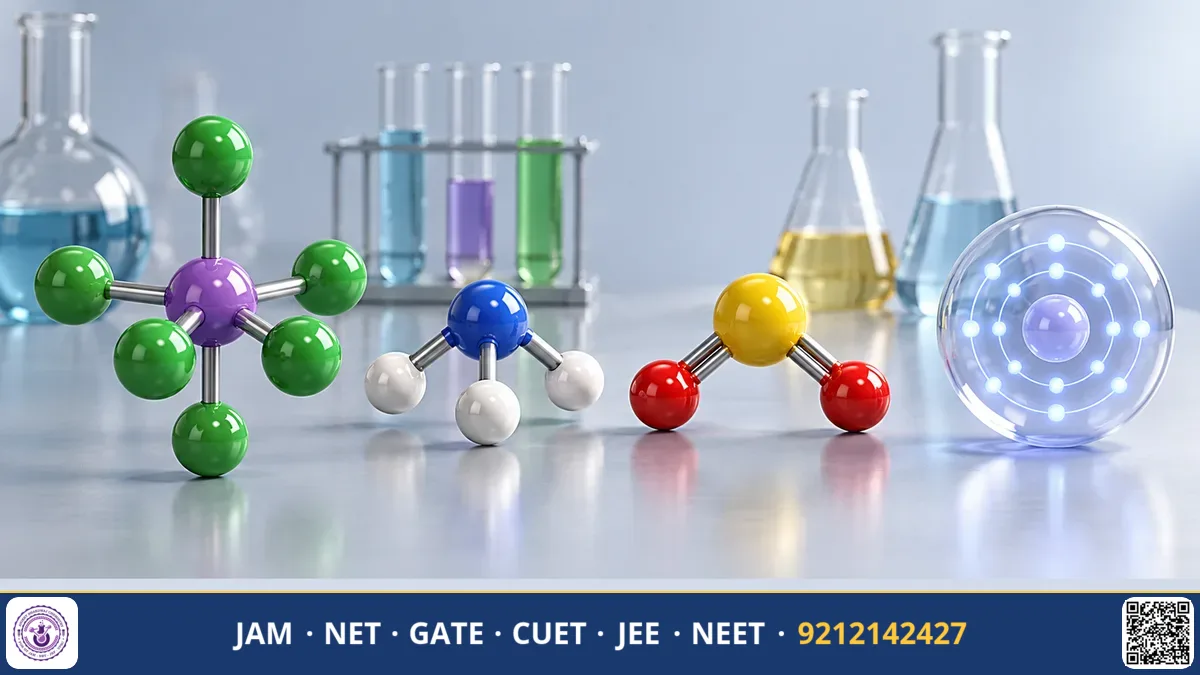
To determine molecular geometry, count the total valence electron pairs around the central xenon atom. Xenon possesses 8 valence electrons.
- Xenon difluoride (XeF2): Xenon shares 2 electrons to form 2 single covalent bonds with fluorine atoms, leaving 6 non-bonding electrons that form 3 lone pairs. The 5 electron pairs adopt a trigonal bipyramidal arrangement with the 3 lone pairs occupying equatorial positions to minimise repulsive forces. The resulting molecular shape is linear.
- Xenon tetrafluoride (XeF4): Xenon forms 4 single covalent bonds with fluorine atoms and retains 2 lone pairs. The 6 electron pairs arrange octahedrally with the 2 lone pairs situated in opposite axial positions. The resulting molecular shape is square planar.
How a verified home tutor structures revision in Dwarka and Gurugram
Achieving mastery in inorganic chemistry demands consistent individual guidance. In crowded school sections or large coaching batches, a teacher cannot monitor whether an individual student understands disproportionation (a reaction where a single element simultaneously undergoes oxidation and reduction, such as the heating of phosphorous acid to form orthophosphoric acid and phosphine).
A qualified home tutor working beside the student identifies conceptual doubts immediately. Through Great Home Tutors, parents can request a home tutor for one-to-one tuition at home across Dwarka (including Sector 6 and Sector 10) and Gurugram (including Sector 108, Sector 109, and Sector 110). Great Home Tutors verifies every tutor through an identity check, qualification verification, and a short teaching conversation. Tutors checked by the platform carry a Verified mark and are listed first.
Parents can arrange a first class to observe how the tutor explains difficult topics and whether the teaching style suits the child. During regular home sessions, the tutor conducts oral reasoning drills, supervises handwritten reaction writing, and ensures the student solves NCERT exercises thoroughly.
A four-week revision routine for board examination preparation
To prevent last-minute stress before board examinations, Class 12 students should divide the p-block syllabus across a structured four-week schedule.
- Week 1 (Group 15): Revise dinitrogen, ammonia synthesis, and nitric acid reactions. Practice drawing phosphorus oxoacids and write equations for the reaction of dilute and concentrated nitric acid with metals such as copper and zinc.
- Week 2 (Oxygen family): Study dioxygen, ozone structure, allotropes of sulphur, and the industrial manufacture of sulphuric acid. Draw the oxoacids of sulphur, noting peroxo and pyrosulphuric acid bonds.
- Week 3 (Halogen family): Master chlorine reactions, hydrogen chloride, and the structures of interhalogen compounds. Practice reasoning questions explaining why interhalogens are generally more reactive than pure halogens.
- Week 4 (Group 18 and comprehensive revision): Draw xenon fluorides and oxofluorides by counting bonding pairs and lone pairs. Solve previous board examination questions covering all four families under timed conditions.
Key takeaways
- Ground your revision in foundational concepts such as the inert pair effect and electronegativity rather than memorising disconnected chemical equations.
- Remember that phosphorus oxoacid basicity depends on ionisable P-OH groups, whereas reducing capability requires direct P-H bonds.
- Use hydrogen bonding to justify the elevated boiling points of NH3, H2O, and HF compared to heavier hydrides in their respective groups.
- Determine noble gas compound shapes systematically by calculating total bonding electron pairs and non-bonding lone pairs around the central xenon atom.
- Follow a disciplined four-week revision timetable with a verified home tutor to identify weak areas and reinforce handwritten reaction skills.
Frequently asked questions
Why is nitrogen a gas while phosphorus is a solid at room temperature?
Nitrogen has a small atomic size and high electronegativity, which allows its atoms to form strong pπ-pπ multiple bonds. This produces discrete diatomic N2 molecules held together by weak intermolecular attractions, so nitrogen exists as a gas. Phosphorus has larger atoms that cannot form effective pπ-pπ multiple bonds; it instead forms single P-P bonds within a tetrahedral P4 unit, resulting in a solid state.
Why is hypophosphorous acid a stronger reducing agent than orthophosphoric acid?
The reducing capacity of phosphorus oxoacids depends entirely on hydrogen atoms bonded directly to the central phosphorus atom. Hypophosphorous acid (H3PO2) has two direct P-H bonds, giving it strong reducing properties. Orthophosphoric acid (H3PO4) contains only P-OH bonds and no direct P-H bond, so it exhibits no reducing behaviour.
How does one-to-one home tuition improve performance in Class 12 inorganic chemistry?
One-to-one home tuition allows an experienced teacher to review handwritten reactions, correct structural formulas, and conduct verbal reasoning drills. The tutor ensures that the student understands NCERT reasoning patterns, preventing careless mistakes on board examinations.
How can parents in Dwarka and Gurugram arrange a verified chemistry home tutor?
Parents can submit a request on Great Home Tutors by selecting the class, subject, and locality. Great Home Tutors checks tutor identity, qualifications, and teaching ability before arranging a first class at home to confirm a good academic match.
What to do next. Try it yourself on the page below.
Great Home Tutors — home tuition at your home · 4AB →