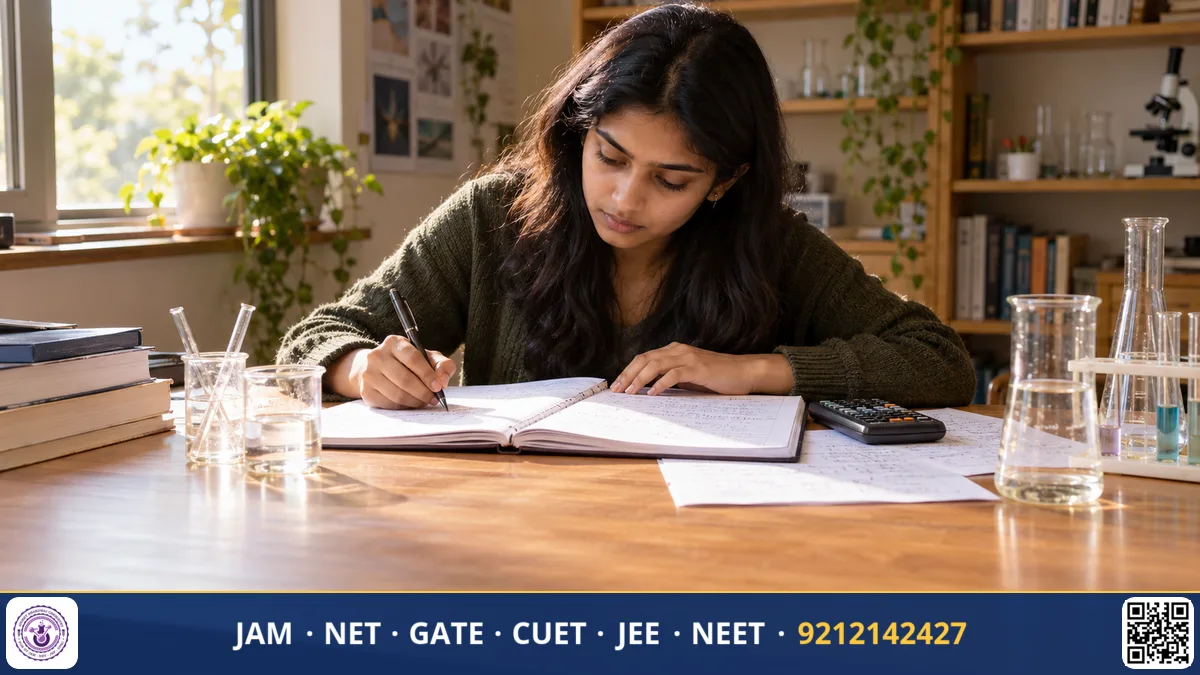
Setting Up a Study Corner for Science Students, Gurugram
This guide explains how to set up an efficient study corner for school science students at home. You will learn how to arrange desk space, organize syllabus materials, and support one-to-one home tuition.
Essential physical setup for a science study corner
Science education requires active engagement. A student does not merely read; they solve numericals, sketch diagrams, and balance chemical reactions. The desk must have sufficient depth and width. A flat tabletop should hold an open textbook, an exercise register, and a rough calculation pad without overlapping.
Ergonomics (designing furniture to support posture and comfort) is essential. A sturdy chair supporting the lower back keeps the student alert. Feet should rest flat on the floor with elbows at desk level. Avoid soft cushions or beds, which encourage lethargy and make writing calculations difficult.
Lighting must be bright and steady. A dedicated desk lamp placed opposite the writing hand prevents shadows across the paper. In Gurugram apartments, natural daylight helps during late afternoons, but evening study requires focused artificial light. Good ventilation and moderate room temperature also reduce fatigue.
Ensure space for two chairs side by side. One-to-one home tuition requires a checked tutor to sit directly beside the student. When a tutor sits beside the learner, they monitor each step of a derivation or calculation. This direct observation catches sign errors, incorrect unit conversions, or skipped steps immediately.
Organizing syllabus materials for class 9 to class 12 science
Science syllabus requirements change sharply between secondary and senior secondary classes. In Class 9 and Class 10, science is taught as an integrated subject under CBSE, ICSE, or State board systems. Mixing Physics, Chemistry, and Biology notes in a single register creates confusion during revision. The study corner must feature separate, labeled notebooks for each branch.
In Class 11 and Class 12, the syllabus volume expands substantially into dedicated subjects: Physics, Chemistry, and Mathematics or Biology. In Chemistry, students must navigate physical chemistry numericals, organic reaction mechanisms (the step-by-step pathways by which chemical reactions occur), and inorganic trends.
To manage this load without cluttering the desk, follow a clear shelf hierarchy:
- The active desk surface: Keep only the current NCERT textbook, the active class register, a rough practice notebook, and basic writing tools on the desk.
- The reachable shelf: Place previous years' question papers, laboratory manuals, and completed registers within arm's reach but off the main desk plane.
- The formula pin board: Mount a soft display board directly in front of the desk for active reference sheets, such as the periodic table, fundamental constants, and mathematical identities.
Keeping unnecessary reference materials off the work surface reduces visual distraction. Piles of unread guides increase cognitive load and hurt concentration.
Comparing study space needs across academic levels
The table below outlines how desk organization, materials, and tutoring needs evolve across different classes under national and state boards:
| Academic stage | Core syllabus focus | Desk and storage requirements | Home tutor arrangement |
|---|---|---|---|
| Class 9 and Class 10 | Foundational science, balancing chemical equations, ray diagrams, and basic units | Separate subject notebooks, NCERT textbook, geometry tools, and drawing space | Side-by-side seating for reviewing diagrams and checking fundamental theory |
| Class 11 and Class 12 | Physics derivations, organic mechanisms, stoichiometry, and calculus integration | Thick calculation registers, formula sheets, NCERT volumes, and past exam sets | Direct desk space for real-time numerical checks and board-level answer writing |
| JEE and NEET preparation | Timed practice, extensive rough work, and rapid problem sets | Dual-pad setup for question paper and rough work, clock for timing | Focused analysis of error logs and step-by-step breakdown of advanced questions |
In senior classes, rough calculation requires special care. Students often make careless errors in stoichiometry (the calculation of relative quantities of reactants and products in chemical reactions) when calculations are scribbled haphazardly in notebook margins. The study table must always accommodate a wide rough pad where steps are written legibly.
Locality considerations for study spaces in Gurugram
Residential areas in Gurugram present specific environmental factors. High-rise developments in sectors such as Sector 108, Sector 109, Sector 110, Sector 111, Sector 112, and Sector 113 are located near wide roadways, where traffic noise can penetrate living spaces.
Position the study corner in an interior room with minimal street-facing noise. Avoid common areas like living or dining rooms where televisions and family conversations break attention. Quiet surroundings are essential when working through concepts like thermodynamics or electromagnetic induction.
When parents in Gurugram or nearby Dwarka arrange home tuition, convenience and safety are priorities. Through Great Home Tutors, parents submit student details, board, and locality to request a checked tutor. A verified tutor visits your residence directly. A dedicated study corner ensures that one-to-one sessions remain focused, productive, and comfortable.
Structuring a daily study routine at the desk
An organized desk produces results only when paired with a disciplined daily routine. Science students cannot master analytical subjects through passive reading alone. They must follow a consistent schedule balancing homework, self-study, and home tuition classes.
Implement a structured evening routine:
- Pre-session preparation: Before study or tuition begins, clear the desk of unrelated materials. Place the relevant NCERT textbook, notes, and doubt list on the table.
- Focused study blocks: Study in concentrated intervals without switching tasks, followed by a brief physical stretch away from the desk. Keep mobile phones and entertainment screens completely out of the room.
- Active recall practice: Use active recall (testing memory from within rather than passively re-reading text) by closing the book and writing out derivations or chemical equations from memory on a blank sheet.
- Post-study reset: At the end of the evening, file away loose sheets, cap pens, and arrange notebooks. A clean desk allows the student to sit down the following day without friction or delay.
Key takeaways
- A flat desk with a task lamp and seating for two provides the foundation for focused science learning and home tuition.
- Keep NCERT textbooks and active registers on the desk, storing reference guides and completed notes on nearby shelves.
- High-rise apartments in Gurugram sectors require study spaces located away from street noise and household traffic.
- Separate notebooks for theory, rough work, and formula sheets prevent careless algebraic and numerical mistakes.
- End each study session with a quick desk reset to keep the work area organized for the next day.
Frequently asked questions
How much desk space does a Class 11 or Class 12 science student need?
A senior science student needs a desk wide enough to hold an open NCERT textbook, a long register, and a rough pad side by side. Floor space should accommodate two chairs so a home tutor can sit comfortably beside the student.
Why is a separate rough notebook necessary for science study?
Science subjects require multi-step derivations, reaction balancing, and unit conversions. Margin calculations lead to transcription mistakes. A dedicated rough notebook ensures clean working, allowing tutors to spot procedural errors immediately.
Where should the study corner be located in a Gurugram apartment?
Place the study corner in an interior room away from balcony traffic noise, televisions, and kitchen movement. In sectors like Sector 108 through Sector 113, keeping the desk away from street-facing windows ensures quiet conditions.
How does one-to-one home tuition benefit from a dedicated study desk?
A dedicated desk allows one-to-one learning without household distractions. The tutor can observe how the student writes formulas, solves problems, and draws diagrams, correcting conceptual and numerical errors immediately.
What to do next. Try it yourself on the page below.
Great Home Tutors — home tuition at your home · 4AB →