Solid State Class 12: Unit Cell Calculations in Gurugram
This guide explains how Class 12 students can master unit cell and density numericals in Solid State Chemistry. Parents in Gurugram and Dwarka will also learn how structured study routines and focused tuition build examination confidence.
Why unit cell numericals challenge Class 12 students
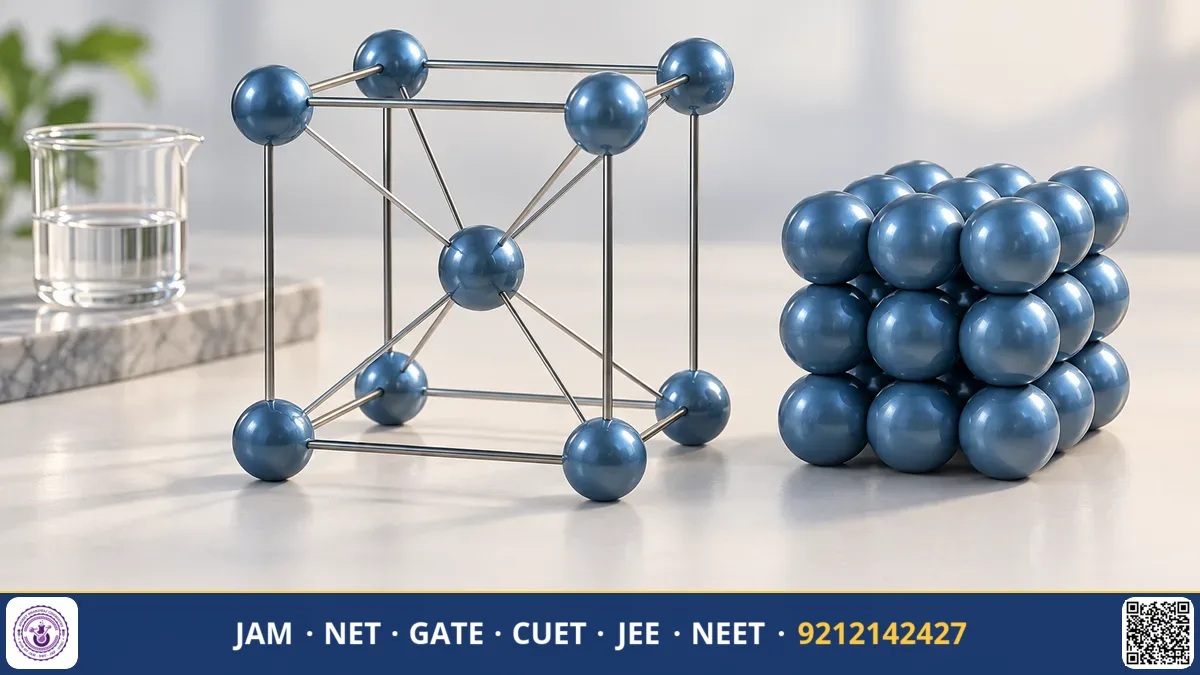
Solid State is a key physical chemistry chapter in Class 12. It moves away from descriptive theory and introduces mathematical descriptions of crystal structures. Students encounter the unit cell, which is the smallest repeating structural unit of a crystalline solid that generates the entire crystal lattice when repeated in three dimensions. Lattice points represent positions where constituent particles, such as atoms, ions, or molecules, reside in space.
While geometric concepts can be visualised with diagrams, numerical problems present real difficulty. In CBSE board examinations, computing devices are not permitted. Students must carry out every mathematical operation by hand in rough work. A typical density problem involves cubing decimal values, multiplying by the Avogadro constant, and dividing large multi-digit numbers.
From twenty years of teaching experience, three friction points arise repeatedly in student work:
- Unit conversion mistakes: Papers usually give edge length in picometres. Students often forget to convert these values into centimetres before cubing, producing incorrect exponent orders.
- Misidentifying lattice particle counts: Confusing the number of effective atoms per cell between simple cubic, body-centred cubic, and face-centred cubic lattices ruins the entire solution.
- Exponent arithmetic slips: Combining negative exponents from the volume term with the positive exponent of the Avogadro constant requires careful handling of powers of ten.
Key formulas and unit cell parameters
Solving numericals efficiently begins with memorising standard formulas and crystal lattice values. In physical chemistry, density relates particle mass to the volume occupied by the unit cell.
The primary equation used in Class 12 examinations is the density formula:
Density (d) = (z × M) / (a3 × NA)
In this formula:
- d is crystal density in grams per cubic centimetre (g cm-3).
- z is the total number of atoms in one unit cell.
- M is molar mass in grams per mole (g mol-1).
- a is unit cell edge length in centimetres (cm).
- a3 is unit cell volume in cubic centimetres (cm3).
- NA is the Avogadro constant, which equals 6.022 × 10²³ mol-1.
Students must also understand packing efficiency, which represents the proportion of unit cell volume occupied by constituent spheres. The coordination number represents the number of nearest neighbouring particles touching any given particle in the lattice.
| Lattice type | Atoms per cell (z) | Edge length and radius relation | Coordination number |
|---|---|---|---|
| Simple cubic (primitive) | 1 | a = 2r | 6 |
| Body-centred cubic | 2 | a = 4r / √3 | 8 |
| Face-centred cubic | 4 | a = 2√2r | 12 |
Step-by-step worked example for density calculation
To show how students should lay out rough work during examinations, consider a representative board problem.
Problem: An element crystallises in a face-centred cubic lattice with an edge length of 400 picometres. The molar mass is 60 grams per mole. Calculate the density of the unit cell.
Step 1: Write down given values
Lattice type = face-centred cubic, so z = 4.
Molar mass (M) = 60 g mol-1.
Avogadro constant (NA) = 6.022 × 10²³ mol-1.
Edge length (a) = 400 pm.
Step 2: Convert edge length to centimetres
One picometre equals 10-10 centimetres.
a = 400 × 10-10 cm = 4.0 × 10⁻⁸ cm.
Step 3: Calculate the volume of the unit cell
a3 = (4.0 × 10⁻⁸ cm)3 = 64 × 10-24 cm3.
Step 4: Substitute parameters into the density formula
d = (z × M) / (a3 × NA)
d = (4 × 60) / (64 × 10-24 × 6.022 × 1023)
Step 5: Simplify powers of ten and solve
In the denominator: 10-24 × 1023 = 10-1.
Denominator value: 64 × 6.022 × 10-1 = 38.54.
Numerator value: 4 × 60 = 240.
Calculate density: d = 240 / 38.54 ≈ 6.23 g cm-3.
Final answer: Density is 6.23 g cm-3.
Managing study routines for Gurugram and Dwarka students
Senior secondary students across Delhi NCR face heavy scheduling demands. Families in Gurugram, including Sector 108, Sector 109, Sector 110, Sector 111, Sector 112, and Sector 113, often have children travelling to schools in Delhi or Dwarka. Commuting in peak traffic drains energy needed for revision.
Adding crowded coaching batches compounds this fatigue. In large classes, teachers move rapidly through calculations, leaving students hesitant to ask basic calculation doubts. Homework piles up, and students begin avoiding physical chemistry numericals altogether.
Parents can help establish a sustainable routine at home:
- Dedicated calculation practice: Reserve forty-five minutes every evening for pen-and-paper numerical solving by hand.
- NCERT exercise focus: Complete in-text questions and chapter-end problems from the NCERT textbook before attempting extra material.
- Formula log: Maintain a short formula notebook with crystal geometry relations and conversion factors for weekly review.
- Error logs: Record whether lost marks came from unit conversion slips, wrong z values, or division errors.
How one-to-one home tuition improves numerical precision
Classroom lectures introduce crystal theory, but numerical fluency requires personal supervision. In independent study, an arithmetic slip at the second step can leave a student stuck for half an hour.
A dedicated home tutor observes every calculation step:
- Checking rough work: The tutor ensures units are tracked alongside numbers and calculations are simplified methodically.
- Fixing misconceptions: If a student confuses coordination number with z, the tutor corrects the geometric concept immediately.
- Flexible pacing: Rather than rushing through a fixed batch schedule, tuition time is allocated to problem areas until calculations are clean.
- Verified home tutors: Parents in Dwarka and Gurugram can request a home tutor matched by class, subject, board, and locality. Tutors carrying the Verified mark have their identity, qualifications, and teaching ability checked. A first class allows families to assess teaching fit before fixing lessons.
Key takeaways
- Convert edge length from picometres to centimetres using 1 pm = 10-10 cm before cubing volume.
- Remember effective atom counts: 1 for simple cubic, 2 for body-centred cubic, and 4 for face-centred cubic cells.
- Practise manual arithmetic regularly, as exam rules require all rough work to be done by hand.
- Reduce transit fatigue for students in Gurugram and Dwarka with structured one-to-one home tuition.
Frequently asked questions
Why do students lose marks in Solid State density questions?
Most deductions occur because of manual calculation errors in rough work, mishandling powers of ten, or forgetting to convert picometres to centimetres.
Why must Class 12 students practice rough work by hand?
Board examination rules require all multiplication, volume cubing, and division steps to be worked out by hand on rough sheets. Supervised practice ensures students build numerical speed and avoid copying errors under exam conditions.
How much weekly time should a Class 12 student give to Chemistry numericals?
A student should spend three to four hours weekly writing out numericals from the NCERT textbook to maintain speed and precision.
How does Great Home Tutors verify Chemistry tutors in Delhi NCR?
Great Home Tutors checks each tutor through identity verification, educational credential review, and a teaching interview. Verified tutors carry a Verified mark, and families start with a first class to check teaching fit.
What to do next. Try it yourself on the page below.
Great Home Tutors — home tuition at your home · 4AB →