How Vimshottari Dasha Balance Is Calculated
Learn how the Moon's nakshatra position determines your opening Mahadasha period in Hindu astrology.
This practical guide explains the dasha timeline, the worked Rohini formula, and planetary period calculations.
Understanding the Vimshottari dasha system
In traditional Hindu astrology, the Sanskrit term dasha denotes a condition, state, circumstances, or period of life. A dasha pattern shows which planets rule at particular times. Planetary periods indicate when effects are traditionally held to be produced according to placement by sign (rashi), house (bhava), combinations (yogas or Raja Yogas), and aspects (drishti). Students use this system to judge how planets distribute their influences over time.
Classical tradition records at least 43 different dasha systems, but only two remain in vogue: Vimshottari and Ashtottari. Vimshottari Dasha serves as the primary method used in birth chart analysis. The Sanskrit term vimshottari stands for the number 120, representing an idealized lifespan of 120 solar sidereal years.
A solar year in this system is the astronomical solar year of 365.25 days, representing the time required for the Sun to return to its original zodiacal position. Hindu timekeeping also measures time using the Savan day of 60 ghatikas from sunrise to the next sunrise, with each ghatika spanning 24 minutes duration. Under this measurement, 30 Savan days make one month, and 360 Savan days make one year.
The Vimshottari system assigns the 120-year cycle to nine planets, known as grahas: Ketu (7 years), Venus (20 years), Sun (6 years), Moon (10 years), Mars (7 years), Rahu (18 years), Jupiter (16 years), Saturn (19 years), and Mercury (17 years). These nine rulers operate in this exact sequence.
The Moon and the twenty-seven nakshatras
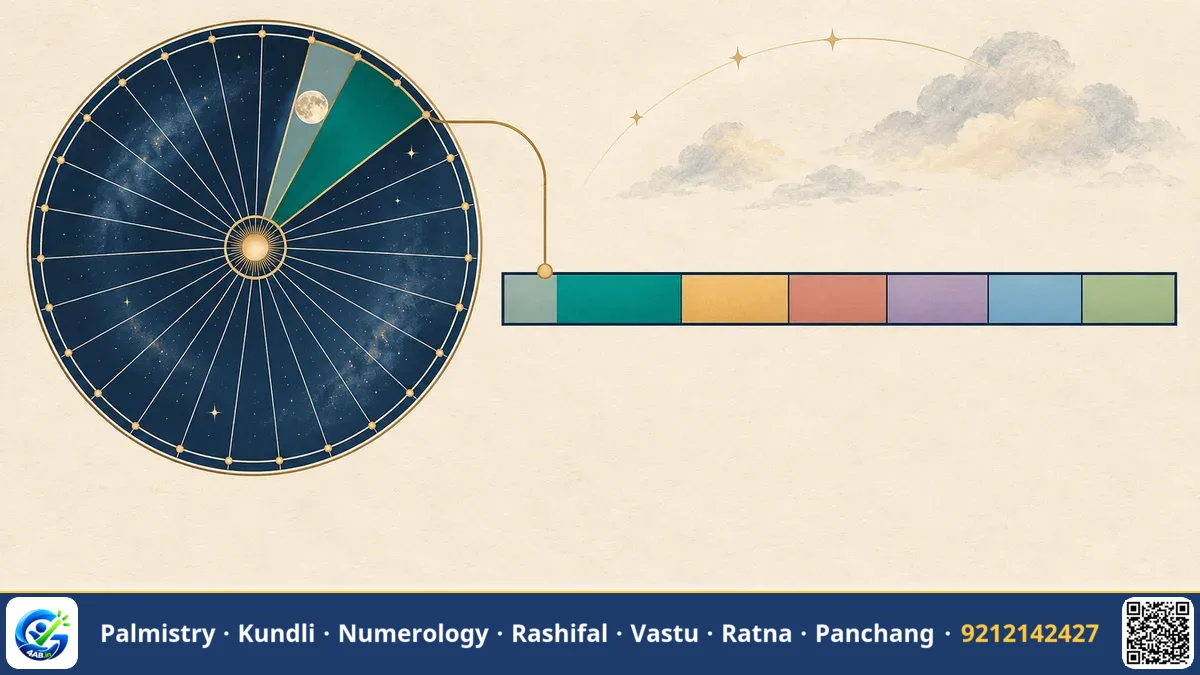
Your opening Mahadasha is governed exclusively by the position of the Moon at birth. In sidereal astrology, the zodiac is divided into 27 nakshatras, beginning with Ashwini and ending with Revati. Each nakshatra spans an equal divisional longitude of 13 degrees and 20 minutes (written as 13°20′). Every nakshatra is subdivided into four equal quarters, known as padas.
Each of the nine planets presides over a set of three nakshatras situated on the zodiac at a trine from each other. The nakshatra occupied by the Moon at birth is your Janma Nakshatra. The planetary ruler of that nakshatra commands your commencing Mahadasha at birth.
| Planetary ruler (Graha) | Mahadasha period (years) | Order in cycle |
|---|---|---|
| Ketu | 7 | Begins at Ashwini |
| Venus | 20 | Follows Ketu |
| Sun | 6 | Follows Venus |
| Moon | 10 | Includes Rohini |
| Mars | 7 | Follows Moon |
| Rahu | 18 | Follows Mars |
| Jupiter | 16 | Follows Rahu |
| Saturn | 19 | Follows Jupiter |
| Mercury | 17 | Ends before Revati concludes |
The sum of these nine periods equals 120 years. Once your initial Mahadasha concludes, the sequence moves forward to the next ruling planet in the table and runs for its full duration.
How dasha balance is calculated with the Rohini formula
A person is rarely born at the exact zero-degree entry point of a nakshatra. At birth, the Moon has usually traversed part of the 13°20′ nakshatra span. Because you cannot experience the planetary period that elapsed before birth, you experience only the remaining uncrossed portion. This remaining duration is called the dasha balance.
To calculate opening dasha balance, determine what proportion of the 13°20′ nakshatra remains uncrossed by the Moon, and multiply that fraction by the planet's total Mahadasha years. Consider the worked Rohini formula from our calculation engine:
Worked Rohini formula example:
Suppose the Moon is positioned at 15° Taurus in the birth chart. In sidereal astrology, 15° Taurus falls inside Rohini nakshatra, which is ruled by the Moon.
- Span traversed: The Moon sits 5° into the 13°20′ nakshatra.
- Portion crossed: 5° divided into 13°20′ equals 37.5% crossed before birth.
- Remaining balance: 62.5% of the nakshatra remains uncrossed at birth.
- Total period of ruler: The Moon's full Mahadasha is 10 years.
- Opening balance at birth: 62.5% of 10 years equals about 6 years 3 months.
The native begins life with an opening Moon Mahadasha balance of about 6 years 3 months. As soon as this balance completes, the full 7-year Mars Mahadasha begins, followed by the 18-year Rahu Mahadasha.
Reading graha, house, and yoga activations on the dasha timeline
When you generate your chart using Create Your Free Janam Kundli, the engine applies the Lahiri ayanamsa. View the chart in North Indian or South Indian styles under the Charts tab, including Rashi (D1), Navamsa (D9), Dashamsa (D10), Moon Chart, and Sun Chart.
Under the Dasha tab, inspect how planetary periods unfold. A dasha period activates the houses and grahas connected to the ruling planet. Follow this three-step analysis:
- Evaluate the ruling graha under the Planets tab: The quality of each dasha depends on the condition and position of that planet. A dasha is traditionally held to be a Poorna Dasha if the planet is powerful or in exaltation, bringing health and wealth. A powerless planet produces a Rikta dasha, meaning devoid of power. A planet in an unfriendly sign or navamsa is traditionally held to produce undesirable results.
- Examine house ownership under the Houses tab: The houses ruled and occupied by the dasha lord show which life departments are stimulated. Themes of Career, Marriage, Finance, or Education under the Life Areas tab are evaluated based on these house connections.
- Review yogas under the Yogas & Doshas tab: Planetary periods indicate when the results of special combinations, known as yogas or Raja Yogas, come to fruition. A dasha lord forming positive combinations is traditionally held to deliver auspicious outcomes during its operational period.
Monitor the Transits tab to see how live movements interact with the operating dasha ruler, and review the Remedies tab for traditional remedies.
Key takeaways
- Vimshottari Dasha is a 120-year cycle divided among nine planetary rulers, calibrated to astronomical solar years of 365.25 days.
- Your opening Mahadasha ruler is determined strictly by the Moon's nakshatra position at birth.
- The dasha balance reflects the uncrossed portion of the 13°20′ nakshatra, calculated by multiplying the remaining percentage by the planet's total period.
- In the worked Rohini formula, a Moon at 15° Taurus leaves 62.5% of the nakshatra uncrossed, giving an opening Moon dasha balance of about 6 years 3 months.
- Use the Dasha tab alongside the Planets, Houses, and Yogas & Doshas tabs to study how operating grahas distribute their influences.
Frequently asked questions
What is the meaning of the word dasha in Hindu astrology?
The Sanskrit word dasha means condition, state, circumstances, or period of life. In Hindu astrology, it refers to planetary periods that indicate when planets distribute their effects based on their signs, houses, and combinations.
Why does the opening dasha not run for its full duration?
Because the Moon has already traversed part of the 13°20′ nakshatra before birth, the native only experiences the uncrossed arc. This remaining fraction is the dasha balance. Subsequent dashas run for their complete allotted years.
How many dasha systems exist in classical Indian astrology?
Classical tradition records at least 43 different dasha systems, but Vimshottari Dasha remains the primary system in vogue across India today.
Which details are required to calculate the dasha timeline accurately?
You need your date of birth, exact time of birth, and place of birth. Entering these details into Create Your Free Janam Kundli allows the calculation engine to determine your exact nakshatra and dasha balance using the Lahiri ayanamsa.
What to do next. Try it yourself on the page below.
Free Janam Kundli (जन्म कुंडली) — Birth Chart, Dasha, Transits & Analysis →