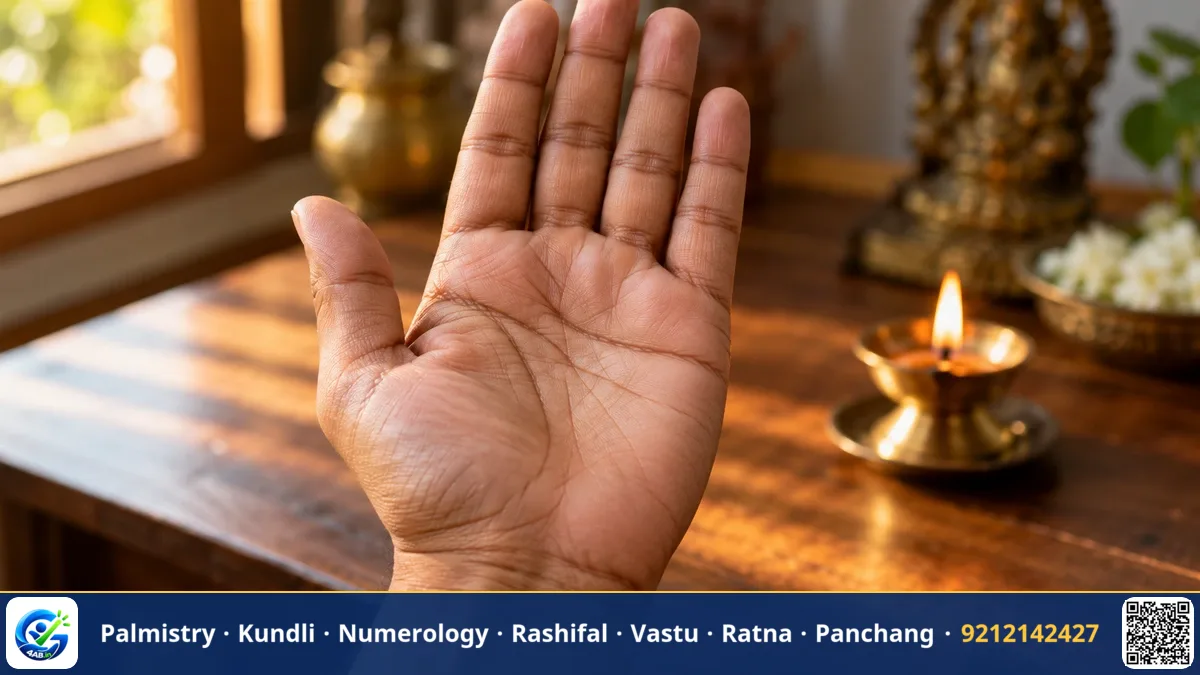
Life line in palmistry: what length and depth suggest
This post shows you where the life line is and how to judge its length and depth.
You will also learn what tradition says about each, and how to photograph your palm clearly.
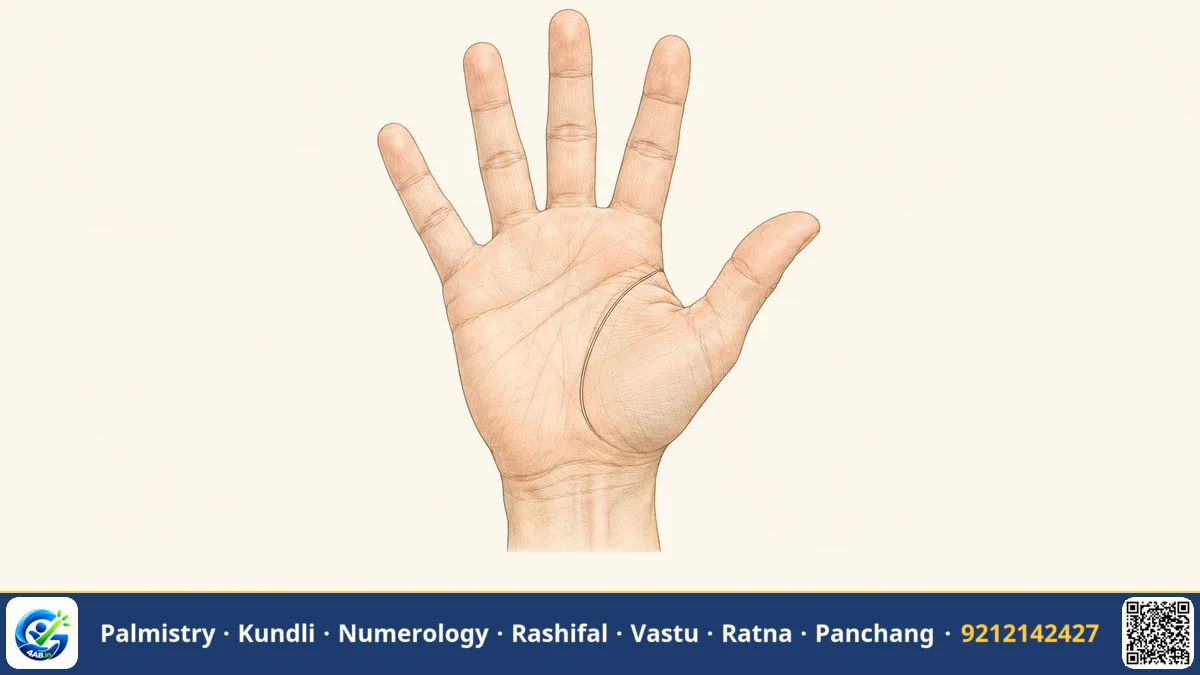
Where the life line is and where it ends
Palmistry is called Hast Rekha in Hindi. It reads four main lines: life, head, heart and fate. The life line is one of the four.
Start between your thumb and your index finger (the finger next to the thumb). The line begins on the edge of the palm there. It then curves down and around the thumb's base, and usually ends near the wrist.
The fleshy area inside that curve is called the mount of Venus. A mount is a raised pad on the palm, and each mount has a traditional meaning. The life line is the border of this mount. The wider the curve, the more space the mount has.
Many beginners confuse the life line with the folds made by moving the thumb. Relax your hand first. Then look for the line that stays visible when the hand is open and still.
Which hand should you look at
Traditionally, the dominant hand is read for the life you are actively making. That is the hand you write with. The non-dominant hand is read for inherited tendencies.
Do not assume the right hand is dominant. Ask the person, or check your own habit. A left-handed person has a different dominant hand.
It helps to look at both hands and note the differences. Write them down. Do not decide anything from one quick glance.
What length suggests
Length is the first thing beginners check. Measure it by eye. Note where the line starts and where it fades or stops.
Here is the first rule to remember. Traditional palmistry does not use the length of this line to say how many years someone will live. The owner's palmistry page also states that it makes no claims about lifespan or health. Length is read for character and energy, as a tendency and not a forecast.
- Long line: traditionally held to suggest steady energy and a settled way of living.
- Short line: traditionally held to suggest a person who depends more on their own effort than on routine. It does not mean a short life.
- Line that fades and returns: traditionally held to suggest that energy goes up and down at different times.
Palmists also disagree with each other on many details. Different teachings give different readings for the same line. So treat every statement here as one traditional view, not as a fact about you.
What depth suggests
Depth means how clearly the line is cut into the skin. Look at it in good light. A deep line casts a tiny shadow. A faint line looks light and thin.
Width matters too. A line can be deep and narrow, or shallow and broad. Note both.
- Deep, clear line: traditionally read as strong vitality and a firm sense of purpose.
- Faint, thin line: traditionally read as a gentler, more sensitive temperament. It is not a weakness.
- Very wide, shallow line: traditionally read as scattered energy.
Depth also changes with age, work and weather. People who work with their hands, wash often, or have dry skin may find their lines look different from month to month. So a faint line today does not settle anything.
Length and depth together: a quick table
Use this table as a memory aid. It collects the traditional readings in one place. These are tendencies and not predictions.
| What you see | Traditional reading | What to check next |
|---|---|---|
| Long and deep | Steady energy, firm purpose | Does the line stay smooth to the wrist? |
| Long and faint | Calm, sensitive nature | Is the light good enough to judge? |
| Short and deep | Strong effort in a focused way | Does it truly stop, or just fade? |
| Short and faint | Light, flexible approach to life | Look at the other hand for comparison |
| Broken or chained | Changes or interruptions in energy | Look for small lines that join the gap |
Notice the last column. A good reader keeps checking before reaching a view. One feature alone says very little.
A worked example for practice
Example: A student looks at her writing hand in daylight. She sees a line that starts between thumb and index finger and curves widely around the thumb base. It is clear for most of its path, then becomes faint near the wrist.
- She notes the position: the line starts at the correct place and curves around the mount of Venus.
- She notes the length: it is long and reaches the wrist area.
- She notes the depth: clear at first, then lighter at the end.
- She writes the traditional view: steady energy early on, with a gentler quality later. She calls it a tendency, not a forecast.
- She then checks her other hand to see if the same pattern appears.
She does not write anything about health, years or events. That is the right approach for a beginner.
How to photograph your palm for a clear reading
A good photo lets you study the lines slowly and share them with a reader. Most bad photos fail for simple reasons. Follow these steps.
- Use daylight. Sit near a window. Avoid direct sun that creates harsh shadows.
- Skip the flash. Flash flattens the skin and hides the fine lines.
- Relax the hand. Open the palm and spread the fingers slightly. Do not stretch or press the palm hard, because that changes the lines.
- Hold the phone directly above the palm. A tilted camera bends the shape of the lines.
- Keep the whole palm in view. Include the wrist and the base of the fingers.
- Take both hands. Label which is the dominant hand.
- Clean the camera lens. A smudge makes everything look soft.
If you would like your palm read by an experienced teacher, Aniket Bhardwaj offers palm reading as a paid service. Check the current fee on the palmistry page before you book. It is traditional interpretation for reflection, not prediction.
Common beginner mistakes
- Reading one line alone. The life line is one of four main lines. Always view it with the others.
- Treating a shape as a prediction. Tradition describes tendencies. Nothing here tells you what will happen.
- Guessing when unsure. It is better to leave a feature unanswered than to guess. "Not sure" is a fair answer.
- Using palmistry for serious decisions. It is a belief-based practice, not a scientifically validated method. Do not use it as a medical, legal or financial guide.
If you do want to practise, the owner's palmistry page has a self-observation section. It asks plain questions about what you can see on your own palm, and then builds a reading from your answers. Sit in good light and answer only what you can see.
Key takeaways
- The life line curves around the base of the thumb, a raised area called the mount of Venus.
- Traditionally, length and depth are read for energy and temperament. They do not show how long a person will live.
- Read the dominant hand for the life you are making, and the other hand for inherited tendencies.
- Use daylight, no flash, a relaxed hand and a camera held straight above the palm.
- Palmistry is traditional and belief-based. Treat every reading as a tendency, not a forecast.
Frequently asked questions
Does a short life line mean a short life?
No. The owner's palmistry page makes no claims about lifespan or health. Traditionally, length is read as a sign of character and energy, and not as a count of years.
Which hand should I check first?
Start with your dominant hand, which is the one you write with. Tradition reads it for the life you are actively making. Then look at the other hand, which is read for inherited tendencies.
My life line looks faint. Is that bad?
Not necessarily. A faint line is traditionally read as a gentler temperament. Light, dryness and the pressure of your hand can also change how clear it looks. Take a new photo in daylight before drawing any view.
Can I rely on palm reading for big decisions?
No. Palm readings are not scientifically validated predictions. They must not be treated as medical, legal, financial or other professional advice. Use them for reflection and learning.
What if my reading differs from another reader's?
This is common. Teachings of palmistry give many different interpretations of the same line. Compare the views with care, and do not treat any one of them as certain.
What to do next. Try it yourself on the page below.
Palmistry / Hast Rekha — Lines, Mounts, Fingers & Signs →