The most stable conformation of the following compound is: · ABC26OR0754
Subject: Organic Chemistry · Chapter: Stereochemistry · Topic: Stereochemistry – General · Exam: GATE 2000-2022 · Marks: 2 · Difficulty: Easy
The most stable conformation of the following compound is: 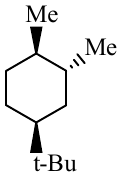
(a)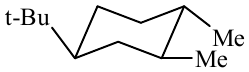
(b)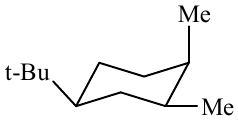
(c)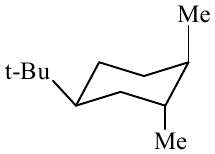
(d)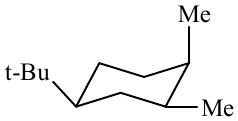
Answer
Answer: C ✓ checked by 4AB · confidence high
The source book printed B; on checking, C is correct — see the explanation.
cis-1,4 Me/t-Bu with t-Bu equatorial forces C-1 Me axial; the C-2 Me is trans-1,2 to it, so it must also be axial (trans-1,2 = ax/ax or eq/eq). Only (c) has both Me axial. The book key (Q15 = c) agrees; (b) is the cis-1,2 diastereomer.
Explanation
In the compound, the C-1 Me (wedge) and the C-4 t-Bu (wedge) are cis-1,4, and the C-2 Me (hash) is trans to the C-1 Me. t-Bu must be equatorial, so the cis-1,4 C-1 Me is axial. A trans-1,2 pair is either diaxial or diequatorial, so the C-2 Me is also axial (check: C-2 Me and t-Bu are trans-1,3, ax/eq ✓). The only chair with t-Bu equatorial and both methyls axial is (c). (b) and (d) have one Me axial and one equatorial (the cis-1,2 isomer), and (a) has a trans-1,4 relationship. Answer (c).
Study loop for Stereochemistry