Tarot basics: Major and Minor Arcana explained
This post explains how a tarot deck is built and what its two big parts mean.
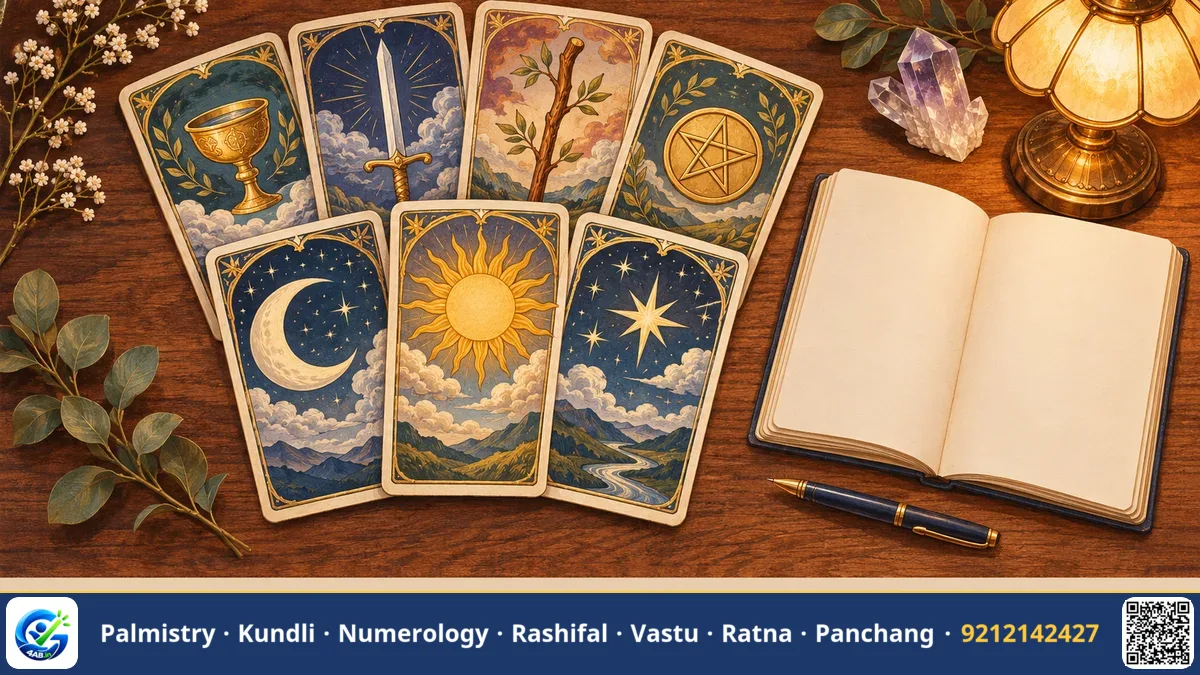
You will learn what the Major and Minor Arcana are, and how to read them as prompts for thinking.
What arcana means and how the deck is divided
"Arcana" is a word for secrets or hidden things. In tarot, it names the two groups of cards. Think of one book with two sections. One section deals with large turning points. The other deals with daily life.
The full deck has 78 cards. Here is the split:
| Part | Number of cards | What it covers |
|---|---|---|
| Major Arcana | 22 | Big themes, turning points, lessons that stay with you |
| Minor Arcana | 56 | Daily events, habits, feelings and actions, in four suits |
Check that the numbers add up: 22 plus 56 is 78. If a deck in your hands has a different count, it may be a special or partial deck. Learn the standard one first.
Why does this split help? When a card appears, your first job is to place it. Is it a big theme or a daily matter? That one step already narrows what the card may be asking you to think about. Beginners often skip it and try to memorise 78 separate meanings. That is slow and tiring. Place the card first, and the meaning becomes easier to find.
The Major Arcana: the big themes
The Major Arcana are 22 cards. Each one stands for a large idea, such as a new beginning, a hard test, a change, or the end of a phase. Traditionally, these cards are read as the main chapters of a person's inner story.
When a Major Arcana card appears in a draw, slow down. Ask yourself which big theme in your life it connects to. Do not rush to call it happy or sad. A card that looks heavy may simply point to something you have been avoiding. A card that looks bright may ask you to be careful with excess.
A good habit is to keep one Major card in front of you for a full week. Look at its picture each day. Write two lines each evening about where you saw that theme in your day. This teaches you more than memorising a list.
Why does this work? A picture invites you to notice details. A list of words only invites you to repeat them. When you notice details yourself, the card becomes a question you own, not an answer handed to you.
The Minor Arcana: four suits of daily life
The Minor Arcana have 56 cards in four suits: Wands, Cups, Swords and Pentacles. A suit is a group of cards that share one symbol and one area of experience. This is the traditional way to read them:
| Suit | Area it points to | Question it raises |
|---|---|---|
| Wands | Energy, effort, drive | Where am I putting my energy? |
| Cups | Feelings and relationships | What am I feeling, and why? |
| Swords | Thoughts, words, decisions | What am I telling myself? |
| Pentacles | Work, health habits, material matters | What practical step is in front of me? |
Learn the suit first. If you see a Cups card, you already know the topic is about feelings or people. Then the number on the card, or the court card, tells you more.
Court cards are the picture cards of each suit. They are read as people or attitudes, meaning a way of behaving in a situation. Read a court card as a part of yourself, or a style of acting, that is leading right now. Do not read it as a prediction about a real person you know.
How the two parts work together in a draw
In a real reading, you will usually see both kinds of cards. Treat them as a pair of lenses. The Major card gives the large frame. The Minor cards show how that frame appears in daily life.
Suppose you draw one Major card and two Minor cards. Ask three simple questions:
- What is the big theme here? (the Major card)
- Which area of life is it touching? (the suit of each Minor card)
- What small, practical action can I take this week?
If many Minor cards of one suit appear, that area may be taking more of your attention right now. If most cards are Major, the matter may feel larger than ordinary daily concerns. Both are only prompts for thought. Neither is a verdict.
A worked example with a three-card spread
A spread is a fixed pattern for laying out cards, where each position has a set meaning. A simple one is the three-card past–present–future spread. The first card is read as what led to the situation. The second is where things stand. The third is the direction they are moving.
Example: A student feels stuck about choosing a study plan. She draws three cards.
- Position one (what led here): a Swords card. She reads it as many worried thoughts and mixed advice from others.
- Position two (where things stand): a Major Arcana card about a choice. She reads it as a real turning point, not a small matter.
- Position three (direction): a Pentacles card. She reads it as a hint to take one practical step, such as making a weekly timetable.
She does not take this as a promise of any result. She uses it to see that her worry came from too much thinking, and that a small, practical step is a sensible next move.
Notice that the cards did not tell her what will happen. They gave her better questions. Read the three together, not one by one, because the story is in how they connect.
Reversed cards and how to start
Sometimes a card falls upside down. This is called a reversed card. Some readers use reversals and some do not. On our tarot page, there is an option called "Include reversed cards", so you can choose. As a beginner, leave them out at first. Learn the upright meanings well, then add reversals later.
A simple way to begin:
- Start with a single card each day. Look at it for a minute.
- Note whether it is Major or Minor. If Minor, name the suit.
- Write one plain sentence about what the card makes you think of.
- Move to a three-card spread after a few weeks.
The shuffle matters too. On our page, the draw is made from a genuinely shuffled 78-card deck. Each draw is random, so do not read meaning into the idea that a card "came for you". Read it as a question to sit with.
What tarot cannot do
Be clear about the limits. There is no scientific evidence that cards predict events. Use tarot for personal reflection only. Never use a reading to make a medical, legal or financial decision. For such matters, speak to a qualified person.
Also be careful of anyone who charges money to remove a curse or avert misfortune. This is a known scam pattern. It is not part of any genuine tradition.
Key takeaways
- The tarot deck has 78 cards: 22 Major Arcana and 56 Minor Arcana.
- Major cards are read as big themes. Minor cards are read as daily life through four suits.
- The four suits are Wands, Cups, Swords and Pentacles. Learn the suit first.
- Read every card as a prompt for thinking, not as a prediction.
- Start with one card a day and keep short notes.
Frequently asked questions
How many cards are in a tarot deck?
A standard deck has 78 cards. Of these, 22 are Major Arcana and 56 are Minor Arcana.
What are the four suits of the Minor Arcana?
They are Wands, Cups, Swords and Pentacles. Each suit is traditionally linked to an area of life: effort, feelings, thoughts and practical matters.
Can tarot predict my future?
No. There is no scientific evidence that cards predict events. Tarot is a reflective practice. Use the cards to ask better questions about your situation.
Should a beginner use reversed cards?
You can leave them out at first. Learn the upright meanings, then add reversed cards when you feel ready.
Which spread should I try first?
Start with a single card. After that, try the three-card past–present–future spread, where the cards show what led to the situation, where it stands and its direction.
What to do next. Try it yourself on the page below.
Tarot — Card Meanings, Spreads & a Genuinely Random Draw →