Ekadashi tithi: meaning and how the Panchang calculates it

This post explains what Ekadashi tithi means and how the Panchang finds it from the Moon's position.
You will also learn how it is traditionally observed, so you can read a Panchang entry with confidence.
What Ekadashi means
The Sanskrit word Ekadashi means "the eleventh". It points to the eleventh tithi in the Vedic calendar. A tithi is a lunar day. It is not the same as a day counted from midnight to midnight.
Every lunar month has two halves, called pakshas:
- Shukla paksha is the waxing, or bright, half. The Moon grows towards the full moon.
- The waning, or dark, half is the other paksha. The Moon shrinks towards the new moon.
Each half has its own eleventh tithi. So there are two Ekadashis in every lunar month. There are usually 24 Ekadashis in a year. Occasionally, two extra ones occur in a Hindu leap year.
Ekadashi is popularly observed within Vaishnavism, where worship is offered to Vishnu. It is traditionally held to be a day for self-discipline and for turning the mind towards spiritual progress.
How the Panchang calculates a tithi
The word Panchang means "five limbs". The five limbs are tithi, vara (weekday), nakshatra (lunar star group), yoga and karana. The tithi is the first limb. It comes purely from the positions of the Moon and the Sun.
The method is simple to state:
- Find the Moon's position and the Sun's position in the sky.
- Subtract the Sun's position from the Moon's. This gives the Moon's distance ahead of the Sun, in degrees.
- Divide that distance into steps of 12°. Each step is one tithi.
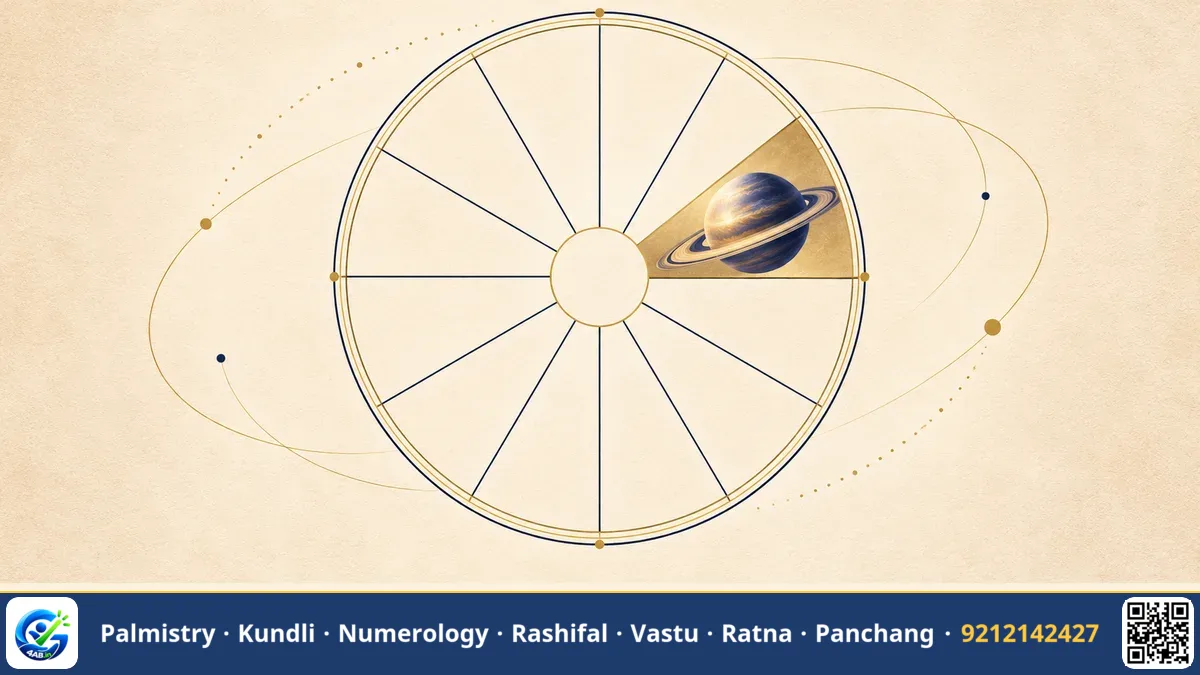
The Hindu calendar divides the Moon's progress from one new or full moon to the next into fifteen equal arcs of 12°. Each arc is one tithi. Each half of the month therefore has fifteen tithis, and Ekadashi is the eleventh of them.
Here is the key point for beginners. A tithi is not a fixed number of hours. Its length is the time the Moon takes to cross its 12° arc. The Moon does not move at the same speed all month. So some tithis are shorter and some are longer. A tithi can begin or end at any hour of the day or night. This is why a Panchang gives a start time and an end time for each tithi.
What the sky looks like at Ekadashi
The eleventh tithi matches a definite angle and a definite Moon phase. You can check it with your own eyes.
- In the bright half, the Moon is about three-quarters full when Ekadashi starts.
- In the dark half, the Moon is about three-quarters dark when Ekadashi starts.
This is a useful check for a beginner. If you see a nearly full, slightly lopsided Moon in the waxing half, an Ekadashi is close. If you see a Moon that is mostly dark in the waning half, the same is true.
A worked example
Question: The Moon has completed ten full steps of 12° ahead of the Sun in the bright half. Which tithi is running?
- Ten steps are complete, so ten tithis are over.
- The Moon is now inside the next step. That step is the eleventh.
- The Moon is still waxing, so this is the bright half.
Answer: It is Shukla Ekadashi. It ends when the Moon finishes this eleventh step of 12°. Then Dwadashi, the twelfth tithi, begins.
The rule to remember is this: tithi number = completed steps + 1. If no step is complete, the first tithi is running. If ten are complete, the eleventh is running. The same counting is done in the dark half.
How the Panchang picks the day for observance
Because a tithi can start at any hour, one civil day may hold parts of two tithis. A common beginner question follows: which calendar day is Ekadashi?
Traditionally, the tithi that is running at sunrise is taken as the tithi of that day. Many Panchangs follow this rule for fixing the day. Some traditions add extra rules when Ekadashi overlaps the tithi before or after it. These rules differ between traditions and regions. If your family follows a particular custom, ask an elder or your family priest before you decide the date.
Great Astrology has a Today's Panchang section, with a Full Panchang view. Use it to read the day's entry. Sunrise differs from city to city, so always read the entry for your own place.
How Ekadashi is traditionally observed
The main practice is fasting. In Hinduism, the primary purpose of fasting on Ekadashi is traditionally held to be control over the mind and the senses, and directing them towards spiritual progress. In its strict form, the fast spans three days:
- Dasami (the day before): a single meal is taken in the afternoon, so that no residual food remains in the stomach the next day.
- Ekadashi: a strict fast, with no food or water.
- Dwadashi (the day after): the fast is broken only after sunrise.
This strict form is very stringent. It may not be possible for everyone, because of health or life circumstances. So most devotees follow a more liberal form. The common types are given below.
| Type | What is taken |
|---|---|
| Nirjala | Complete fasting, without even water |
| Jalahar | Only water |
| Ksheerbhoji | Milk and milk products |
| Phalahari | Only fruits |
| Naktabhoji | A single meal, generally in the later part of the day, with no grains and no legumes |
For the naktabhoji meal, the usual dishes are made of sabudana, singhada, sweet potato, potatoes and groundnuts. Rice, wheat, millets, dals and beans are not taken.
The choice is personal. Each devotee can pick the approach that suits their health, lifestyle and spiritual goals. If you have a medical condition, speak to your doctor before you fast. Do not treat any fast as a duty that must override your health.
The legend behind the day
The legend says that Vishnu was sleeping, or in a meditative state, when a demon named Murdanav came to attack. A woman sprang forth from Vishnu. She agreed to marry the demon only if he defeated her in battle. In the fight, Murdanav was killed.
Vishnu woke and named her "Ekadashi". He declared that anyone who fasts on this day, with all eleven senses focused, would attain moksha. The eleven are five senses of knowledge, five of action and the mind. This is how the tradition explains the name and the importance of the day.
Read it as a traditional story. It explains the meaning that devotees attach to the day. It is not part of the astronomical calculation.
Key takeaways
- Ekadashi is the eleventh tithi. It occurs once in the bright half and once in the dark half of every lunar month.
- A tithi is a 12° step in the Moon's distance ahead of the Sun. Count the completed steps and add one to get the tithi number.
- Tithi length is not fixed, so always check the start and end times for your own city.
- Traditionally, the tithi running at sunrise names the day, though customs differ in overlap cases.
- Ekadashi fasts range from complete abstention to fruits or one simple meal. Choose a form that suits your health.
Frequently asked questions
How many Ekadashis are there in a year?
There are usually 24, two in each lunar month. In a Hindu leap year, two extra Ekadashis occasionally occur.
Is Ekadashi on the same date every year?
No. The tithi depends on the Moon's position, not on the civil date. So the date changes from year to year. Check the Panchang for the current year.
What is the difference between the bright-half and dark-half Ekadashi?
The bright-half Ekadashi falls while the Moon is waxing. The dark-half Ekadashi falls while it is waning. The method of counting is the same. Only the Moon's phase differs.
Must I fast without water?
No. Complete fasting without water is only one form. Many devotees keep a milder fast with water, milk, fruits or one simple meal. Choose what suits your health.
Why does my Panchang show Ekadashi starting the previous evening?
A tithi begins when the Moon has covered the required steps ahead of the Sun. That can happen at any hour. The tithi at sunrise usually names the day for observance.
What to do next. Try it yourself on the page below.
Free Kundli — Birth Chart, Dasha, Transits & Analysis →